Japan-South Korea feud deepens with disputed accounts of trade meeting
TOKYO: A row between Japan and South Korea escalated on Saturday, with contested accounts of a frosty meeting the day before that had failed to make progress on a dispute that could threaten global supplies of microchips and smartphone displays.
Tokyo lodged a protest against Seoul, saying it
had broken an agreement on what the two sides would disclose from the Friday
discussions on Japan’s curbs of exports to Korea of some materials used to make
high-tech equipment, said Japanese trade ministry official Jun Iwamatsu.
Japan’s Ministry of Economy, Trade and Industry
(METI) also disputed a Korean official’s statement that Seoul had asked Japan
on Friday to withdraw the restrictions.
But a Korean trade ministry official shot back
that Seoul had “clearly demanded Japan withdraw its trade restrictions at
yesterday’s meeting, and there should be no disagreement over that matter with
Japan.”
He told Reuters the two sides had discussed
what they would disclose but that there was no agreement.
“I am frustrated,” said the Korean official,
who declined to be named due to the sensitivity of the matter.
Japan recently tightened restrictions on the
export of three materials used in high-tech equipment, citing what it has
called “inadequate management” of sensitive items exported to South Korea, as
well as a lack of consultations about export controls.
But the dispute also appears to be rooted in a
decades-old wartime disagreement. It comes amid deep frustration in Japan over
what Tokyo sees as Seoul’s failure to act in response to a South Korean court
ruling ordering a Japanese company to compensate former forced labourers from
the Second World War.
In the Friday talks, South Korean officials
expressed regret over Japan’s export restrictions and asked Tokyo to remove
them, participant Han Cheol-hee, a trade ministry director, told reporters as
he was leaving Japan on Saturday.
In response, Iwamatsu, director of METI’s trade
control policy division, told a hastily arranged news conference: “We’ve
checked the record of the meeting ... We found no clear comment asking for the
withdrawal.”
Iwamatsu said the two sides had agreed on what
they would disclose from the talks but that the Korean official went beyond the
agreement. “We believe this is something that affects our relationship of
trust,” he said.
One reason for the sensitivity over
characterising the talks could be a Japanese fear that if Korea can assert that
it used consultations and unsuccessfully sought to have Tokyo withdraw the
curbs, Seoul could justify escalating the matter to the World Trade
Organisation.
“The nature of the meeting is not a
consultation, but an occasion where Japan gives explanation after getting a
request from the South Korean government,” Iwamatsu said.
“Therefore we would like to correct expression from a South Korean official that the meeting can appropriately be described as consultation for problem solving.”
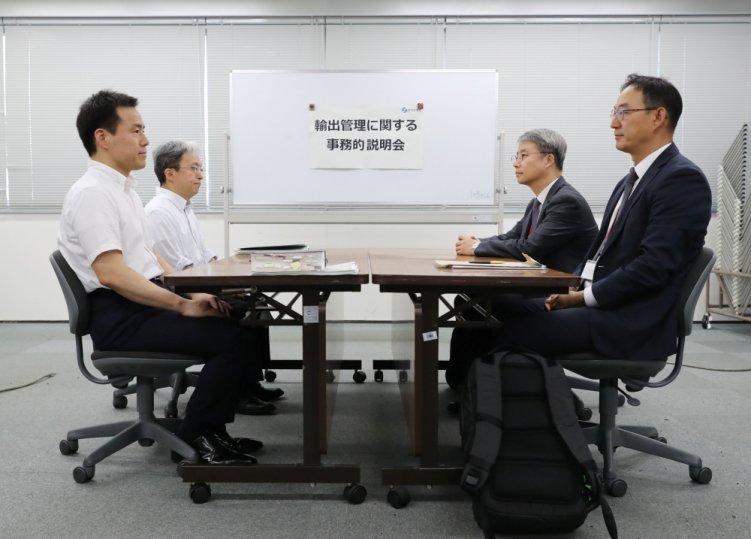
Friday’s talks began with two negotiators from
each side facing off in stony silence in a small meeting room, without greeting
each other and with the Japanese officials not standing or bowing when their
Korean counterparts entered.
A Japanese official later explained that the
bureaucrats had earlier met and exchanged greetings. South Korean media,
however, reported there was a “cold reception” for their officials, and that
the meeting took place in a room that looked like a “garage”.
2 Comments
No comments yet. Be the first to join the discussion!