February 9, 2026
Palm oil sits at the heart of Pakistan’s food economy
In this interview, Izzana Salleh, Secretary General of the Council of Palm Oil Producing Countries (CPOPC), talks about the importance of the palm oil sector, the challenges it faces, the opportunities it creates, and Pakistan’s role in its future.

February 9, 2026
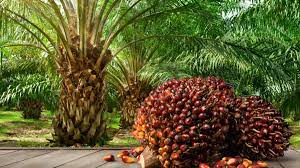
Palm oil is so embedded in daily life in Pakistan that it is almost invisible. It is the ghee in household kitchens, the base fat in bakery items, the frying medium for snacks, and a quiet but constant presence in packaged foods across income groups. Yet outside policymaking and industry circles, few realise that palm oil is not just another imported commodity. It is one of Pakistan’s largest and most persistent imports, a cornerstone of food affordability, and a major source of caloric intake for a population that relies overwhelmingly on imported edible oils.
In fiscal year 2025 alone, Pakistan imported about 3.2 million tonnes of palm oil, worth roughly $3.4 billion, making it one of the country’s most critical import lines by value and volume. Palm oil accounts for the bulk of edible oil consumption in a country that imports more than 80% of its edible oils, leaving domestic food prices highly sensitive to global supply conditions. Any disruption in palm oil flows would ripple quickly through household budgets, food manufacturers, and retail markets. This dependence is not accidental, nor is it recent. It reflects decades of structural reliance on palm oil as the most affordable and versatile vegetable oil available.
One of the most significant factors underpinning this dependence has been Pakistan’s long-standing relationship with Southeast Asia’s two palm oil powerhouses, Malaysia and Indonesia. Together, they supply the vast majority of Pakistan’s palm oil imports and anchor the country firmly within the Asian palm oil value chain.
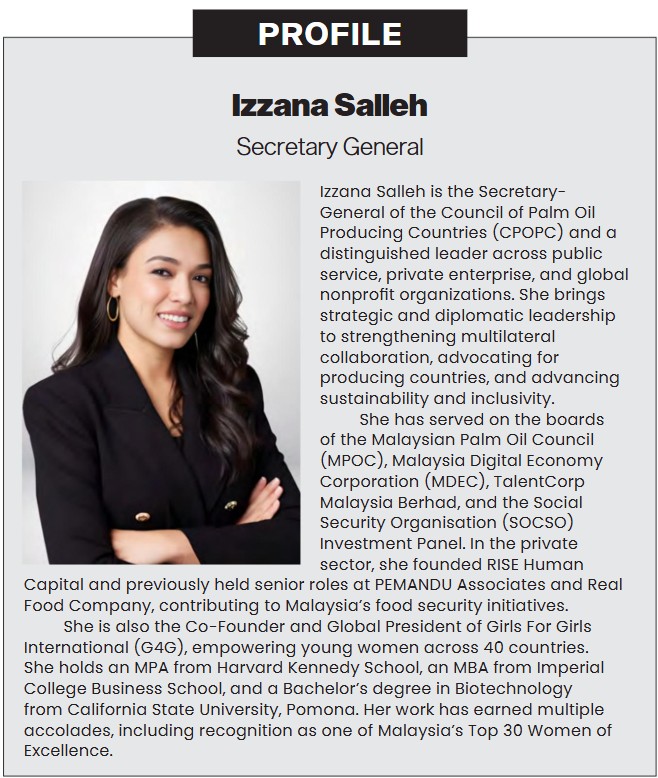
Still, the interview we speak with Izzana Saleh, the Secretary-General of the Council of Palm Oil Producing Countries (CPOPC), who provides insights on the current conditions of the palm oil sector and the steps needed to enhance its role on the global stage.
- What distinguishes CPOPC’s role in the palm oil sector, and what progress has it enabled so far?
CPOPC SG: CPOPC is neither a regulator nor a commercial actor. Our role is to act as a bridge and connector. We bring producing and consuming countries to the same table and encourage constructive, evidence-based dialogue. Over time, this has helped shift the global conversation on palm oil from a polarized debate to a more balanced and solution-oriented discussion that recognizes benefits for farmers, industries, and consumers alike.
We focus on how palm oil contributes simultaneously to food security, affordability, and sustainability, and how these objectives can progress together rather than being treated as competing priorities.
- What major changes have shaped the palm oil sector in recent years?
CPOPC SG: The most significant change is that palm oil no longer exists in isolation. Today, food systems, energy transition, trade, and geopolitics are deeply interconnected. Sustainability has moved firmly into the mainstream: certified sustainable palm oil now represents more than 20% of global supply, and this share continues to grow.
At the same time, demand has shifted decisively toward Asia. Markets such as India, China, and Pakistan are now shaping global palm oil dynamics, giving Asian consumers and policymakers a stronger voice in determining how the sector evolves.
- How important is Pakistan in the global palm oil value chain?
CPOPC SG: Pakistan is extremely important both in scale and strategic significance. It is among the world’s top palm oil importers, accounting for around 9% of global import demand, alongside India (18%) and China (11%). This firmly positions Pakistan as one of the three largest consuming markets globally and confirms Asia as the center of gravity for future demand.
Pakistan’s palm oil consumption reached approximately 3.3 million tonnes in 2024, or about 4.3% of global consumption, making it the world’s fifth-largest consumer after Indonesia, India, China, and the EU-27.
CPOPC does not view Pakistan merely as a market. It is a long-term strategic partner whose stability matters to the entire global palm oil value chain from producers and smallholders to traders, processors, and consumers.
- From CPOPC’s perspective, what are the most urgent needs of the palm oil sector today?
CPOPC SG: The most urgent need is predictability in policy, trade, and sustainability expectations. Palm oil sits at the intersection of food security, energy transition, and rural livelihoods, yet it is also one of the most heavily regulated agricultural commodities globally.
Sustainability is no longer niche. Certified sustainable palm oil accounts for about 20.1% of global production, making it a real-volume reality rather than a voluntary add-on.
Inclusivity is equally critical. Smallholders contribute around 70% of global food production, yet only about 19% of global ESG financing reached agriculture and smallholder systems in 2024. Sustainability must therefore move from compliance to contribution, rewarding real progress on the ground, including credible national schemes such as ISPO and MSPO.
Stronger producer–consumer dialogue is also essential, especially in markets like Pakistan, where palm oil accounts for 70–75% of edible-oil consumption and directly affects household staples such as ghee and cooking oil.
- How has the long-standing partnership between Pakistan, Indonesia, and Malaysia evolved?
CPOPC SG: This partnership has deep roots. Pakistan first imported palm oil from Malaysia in 1970, and Indonesia became a major supplier in 2000. For more than five decades, the relationship has been built on trust and reliability.
Looking ahead, cooperation can expand beyond trade into refining, logistics, and regional distribution, allowing Pakistan to play a stronger role in the wider region.
- How important is producer–consumer dialogue in countering misinformation and ensuring science-based policies?
CPOPC SG: As a major importer, Pakistan faces recurring concerns around health, price volatility, and import dependence. CPOPC’s engagement combined government dialogue, expert communication, and mass-media outreach.
Working with ministries, health professionals, industry stakeholders, and the Pakistan Edible Oil Council, we positioned palm oil within Pakistan’s food security and affordability priorities using science-based messaging.
This approach delivered results. Positive sentiment toward palm oil rose from 8.2% to 11.5%, while negative sentiment remained contained despite price sensitivities demonstrating that dialogue directly enables science-based policymaking.
- What are the main objectives of the Global Framework of Principles for Sustainable Palm Oil (GFP-SPO)?
CPOPC SG: The GFP-SPO is built on one simple idea: sustainability must be fair, inclusive, and practical. Adopted in 2021 and launched in 2022, it is anchored in the UN Sustainable Development Goals.
It aligns sustainability narratives, maps existing mandatory schemes such as Indonesian Sustainable Palm Oil (ISPO) and Malaysian Sustainable Palm Oil (MSPO), and provides a common SDG-based language for engagement with consumer markets. It is not a replacement scheme, but it is framed to be globally applicable while still recognizing different national realities and levels of development, and it explicitly includes smallholder inclusiveness as a core principle.
- What approach does CPOPC use to improve the global narrative of palm oil?
CPOPC SG: We reframe the conversation from confrontation to common interest. Palm oil lies at the intersection of food security, affordability, energy transition, and rural livelihoods which concerns shared by producers and consumers alike.
CPOPC acts as a bridge, counters misinformation with data, and builds trust so sustainability, trade, and food security can advance together.
- How can Pakistan align sustainability standards without increasing costs for consumers?
CPOPC SG: By focusing on long-term partnerships and supply predictability rather than short-term policy shifts. Recognizing credible national standards such as ISPO and MSPO, encouraging gradual improvement, and maintaining open dialogue are cost-effective approaches. Sustainability should reinforce and not undermine palm oil’s affordability.
- What message would you like to share with Pakistan’s policymakers, industry leaders, and consumers?
CPOPC SG: Palm oil will remain central to Pakistan’s food security and economic stability. The future should not be framed as palm oil versus sustainability, but palm oil as part of the solution. With cooperation and trust, palm oil can continue to support affordable food and responsible production.
- How does CPOPC help improve public understanding of palm oil?
CPOPC SG: We focus on facts. Palm oil is one of the most land-efficient vegetable oils and plays a vital role in feeding millions. Health and sustainability concerns must be addressed openly and scientifically.
Through initiatives such as the YoungElaeis Ambassadors (#YEAs) programme, we empower youth, including many from Pakistan, to communicate science-based information. CPOPC has received over 500 applications and nearly 25% of registrants are from Pakistan, reflecting strong engagement among young people.
- What role can CPOPC play in stabilizing Pakistan’s edible oil sector?
CPOPC SG: With demand projected to exceed 5 million tonnes before 2030, long-term coordination is essential. CPOPC can facilitate dialogue, share policy insights, anticipate regulatory changes, and encourage investment partnerships in refining, logistics, and bio-based energy helping reduce uncertainty and support stability.
- What is your long-term vision for the palm oil sector?
CPOPC SG: My vision is to move the sector from volatility to trust. Palm oil should be part of the solution for food security, inclusive growth, and regional stability. Sustainability must reward improvement, not create division.
0 Comments
No comments yet. Be the first to join the discussion!