Power circular debt falls 23% YoY to Rs1.85 trillion, but FY26 buildup reaches Rs240 billion
K-Electric non-payments add Rs183 billion and DISCO underperformance Rs226 billion, while Rs236 billion in stock payments helps offset the increase

Pakistan’s outstanding power-sector circular debt stood at Rs1.853 trillion at the end of April 2026, down by Rs558 billion, or 23.1% year-on-year, from Rs2.411 trillion a year earlier, according to data from the Ministry of Energy compiled by Arif Habib Limited Research.
However, circular debt increased by Rs15 billion, or 0.8%, from Rs1.838 trillion recorded in February 2026.
During the fiscal year to April, the circular debt stock increased by Rs240 billion, compared with an increase of only Rs18 billion during the corresponding period of the previous fiscal year.
The latest fiscal-year buildup was also Rs15 billion higher than the Rs225 billion recorded up to February.
Payables to power producers fell to Rs933 billion in April from Rs1.116 trillion in February, reflecting a decline of Rs183 billion, or 16.4%.
Compared with April 2025, these payables dropped by Rs716 billion, or 43.4%, from Rs1.649 trillion.
Payables owed by public-sector generation companies to fuel suppliers stood at Rs86 billion, down 3.4% from Rs89 billion in February.
However, GENCO payables remained 8.9% higher than the Rs79 billion recorded in April last year.
The circular debt financing component increased by 31.8% to Rs834 billion in April from Rs633 billion in February.
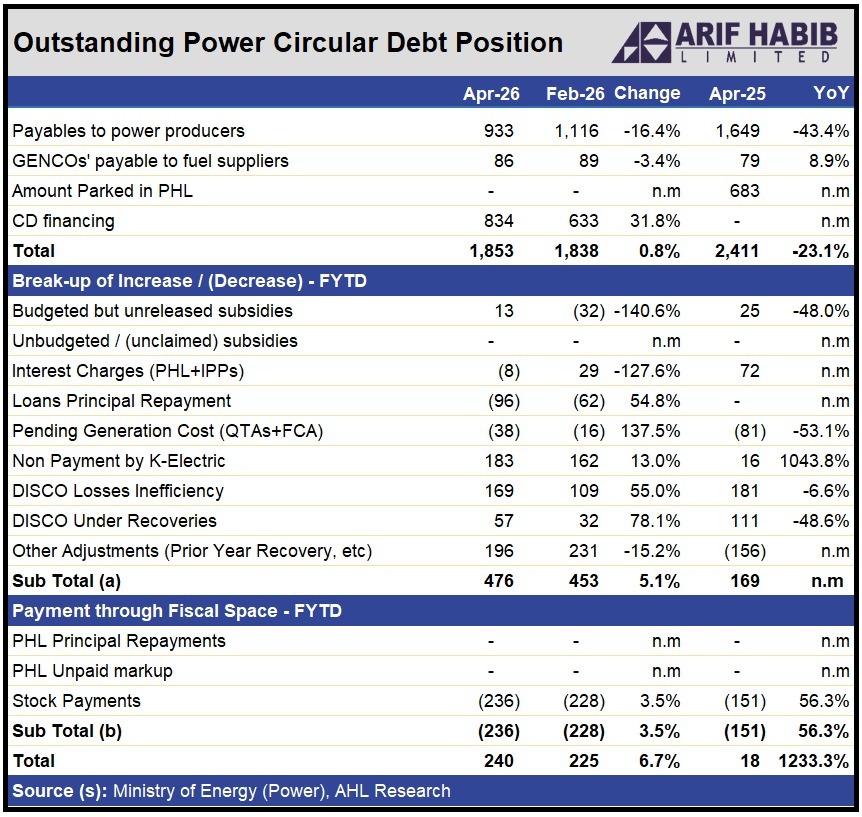
Arif Habib Limited said the government introduced circular debt financing as a separate line item in its December 2025 report, replacing debt previously classified as amounts parked in Power Holding Limited.
In April 2025, Rs683 billion had been recorded under the amount parked in the PHL category. No amount was shown under this head in the latest report following its reclassification into bank financing.
The research house said Rs96 billion in principal had been repaid from the circular debt financing facility by April 2026.
Debt previously parked in PHL was to be refinanced at a lower interest rate equivalent to the Karachi Interbank Offered Rate minus 0.9%.
DISCO performance adds Rs226 billion
Distribution companies’ operational inefficiencies and under-recoveries collectively added around Rs226 billion to circular debt during the fiscal year to April.
Losses and inefficiencies at DISCOs contributed Rs169 billion, compared with Rs181 billion during the corresponding period last year.
Under-recoveries added another Rs57 billion, down from Rs111 billion in the same period of FY25.
Although under-recoveries increased from Rs32 billion in the February fiscal-year-to-date position, they remained 48.6% lower on an annual basis.
Similarly, the impact of DISCO losses and inefficiencies rose from Rs109 billion in February but was 6.6% lower than a year earlier.
The combined Rs226 billion impact from DISCO underperformance was lower than the Rs292 billion recorded in the corresponding period last year.
K-Electric non-payments rise
Non-payment by K-Electric emerged as one of the largest contributors to the circular debt buildup, reaching Rs183 billion by April.
This was 13% higher than the Rs162 billion recorded up to February and compared with only Rs16 billion during the corresponding period last year.
The annual increase amounted to 1,043.8%.
Other adjustments, including prior-year recoveries, added Rs196 billion to circular debt, compared with Rs231 billion in February.
During the same period last year, this category had reduced circular debt by Rs156 billion.
Budgeted but unreleased subsidies added Rs13 billion to the stock, down from Rs25 billion a year earlier.
Repayments and adjustments reduce pressure
Loan principal repayments reduced circular debt by Rs96 billion during the period, compared with a reduction of Rs62 billion up to February.
Pending generation costs related to quarterly tariff adjustments and fuel cost adjustments reduced the debt by Rs38 billion, compared with Rs16 billion in February and Rs81 billion a year earlier.
Interest charges related to Power Holding Limited and independent power producers resulted in a net reduction of Rs8 billion, compared with an addition of Rs29 billion in the February position.
These components resulted in a gross fiscal-year circular debt buildup of Rs476 billion before payments through fiscal space.
Stock payments reach Rs236 billion
Stock payments reduced circular debt by Rs236 billion during the fiscal year to April, compared with Rs228 billion recorded up to February.
The payments were also 56.3% higher than the Rs151 billion recorded during the same period last year.
Arif Habib Limited said the increase in stock payments to independent power producers indicated improved liquidity in the electricity supply chain.
After adjusting the Rs476 billion gross addition against Rs236 billion in stock payments, the net fiscal-year increase in circular debt stood at Rs240 billion.
Despite the 23.1% annual decline in the overall circular debt stock, the increase recorded during FY26 remained substantially higher than the buildup during the corresponding period last year.
Comments
No comments yet. Be the first to join the discussion!