Pakistan’s mobile internet gender gap falls to 8%, but phone ownership divide remains high
GSMA report shows women’s mobile ownership gap narrowed from 37% to 27%; 28% of female mobile internet users still rely on others’ internet-enabled phones


Pakistan recorded a sharp narrowing in the gender gap for mobile internet adoption in 2025, with the gap falling to 8% from 25% a year earlier, according to the GSMA Mobile Gender Gap Report 2026, released at an event hosted by the Telecom Operators’ Association (TOA), together with GSMA.
The report said the change in Pakistan was among the most notable country-level improvements in the surveyed low- and middle-income countries, driven by women adopting mobile internet at a faster rate than men.
Mobile internet gap narrows
In Pakistan, 53% of women and 58% of men used mobile internet in 2025, while the GSMA report placed the country’s mobile internet gender gap at 8%.
The report defines the gender gap as how much less likely women are than men to own a mobile phone, own a smartphone or use mobile internet.
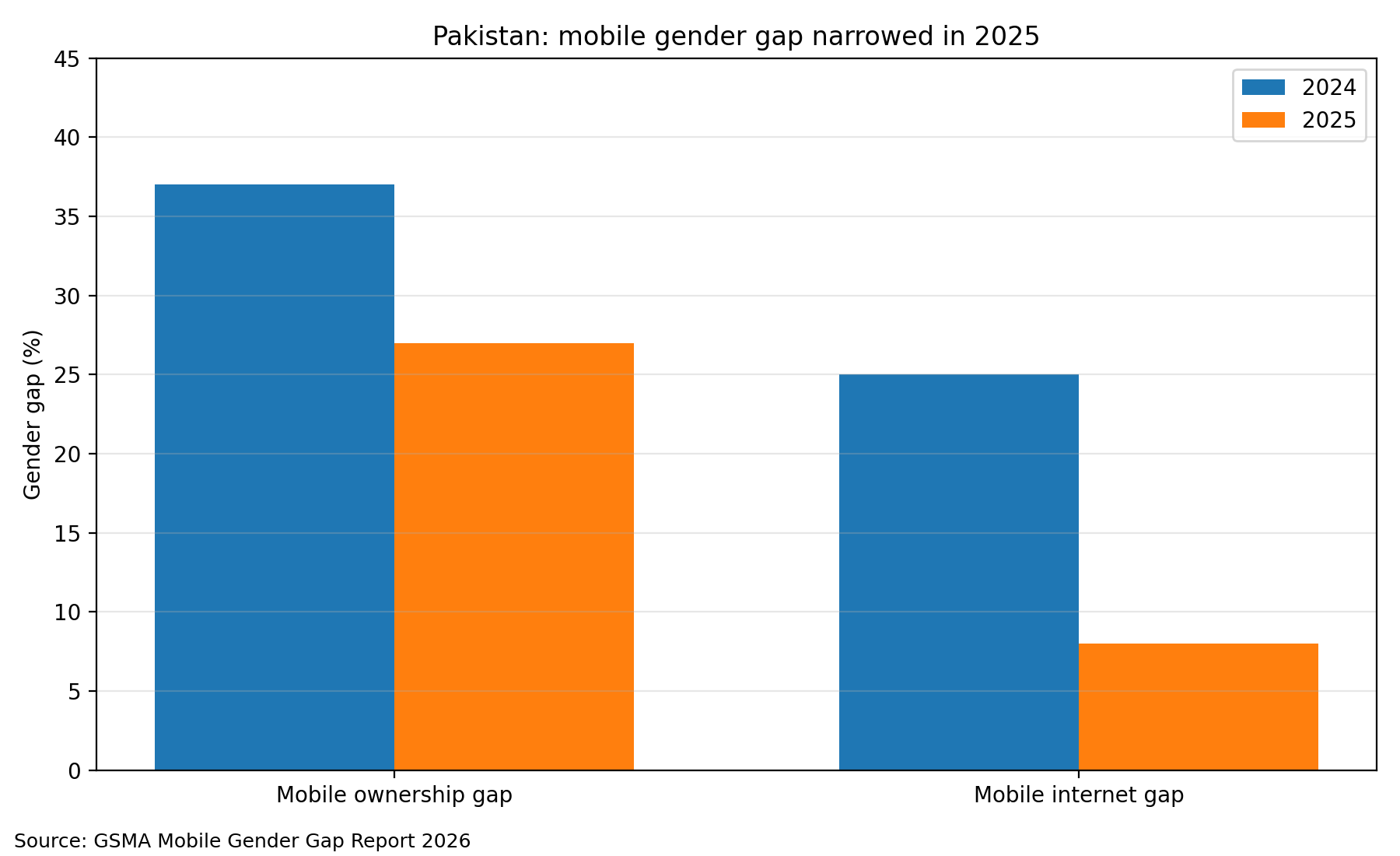
Pakistan’s improvement came as the broader gender gap in mobile internet adoption across low- and middle-income countries declined slightly in 2025, mainly due to progress in South Asia and Sub-Saharan Africa.
Phone ownership remains a major divide
Despite the improvement in internet use, Pakistan continued to have one of the widest mobile ownership gaps among the 14 surveyed countries.
Women in Pakistan were 27% less likely than men to own a mobile phone in 2025, the highest gap among the surveyed countries. However, the figure marked an improvement from 2024, when the gap stood at 37%.
The report showed that 68% of women in Pakistan owned a mobile phone in 2025, compared with 93% of men.
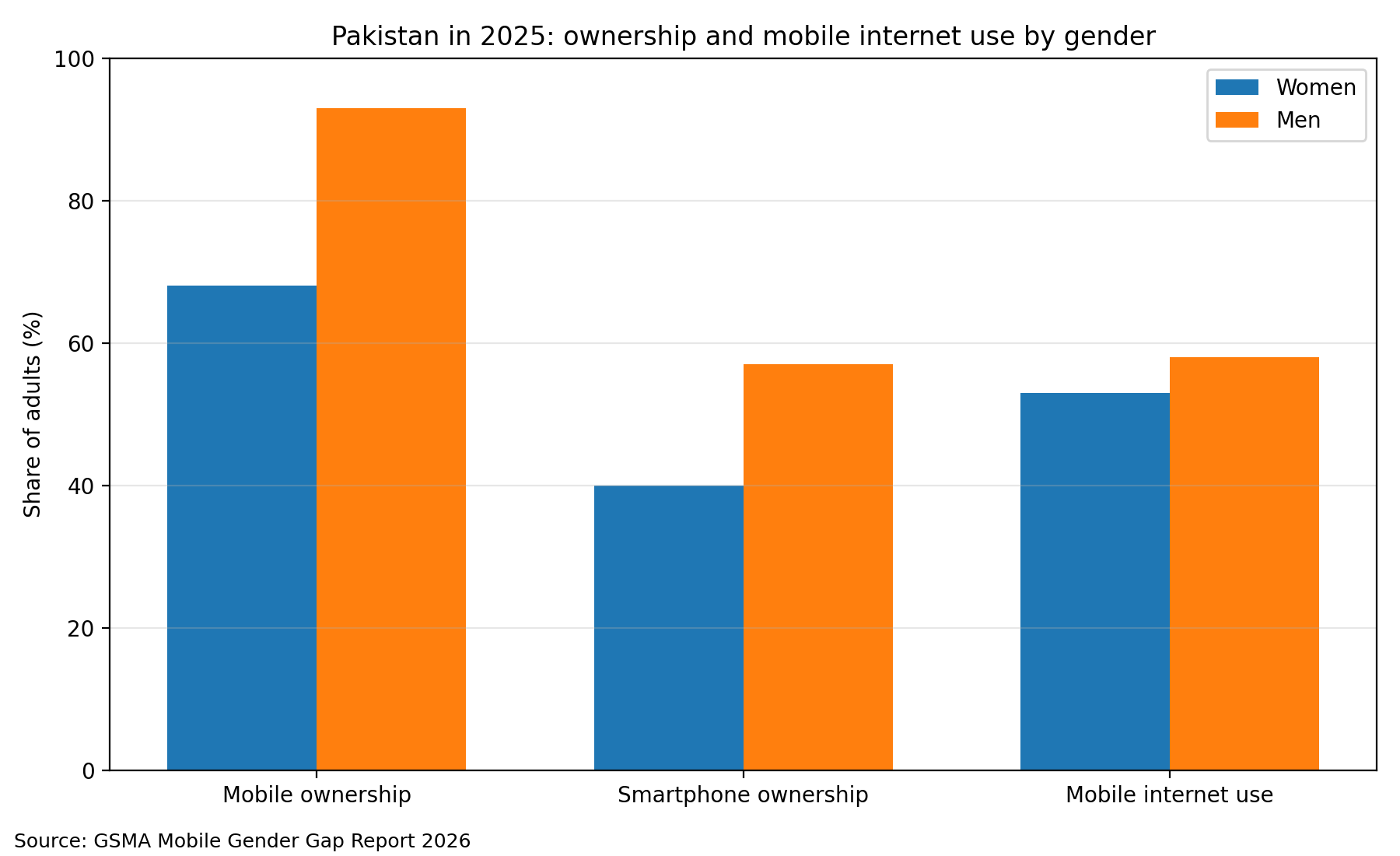
The smartphone ownership gap also remained high. Only 40% of women in Pakistan owned a smartphone, compared with 57% of men, resulting in a 30% gender gap.
The report said Pakistan’s smartphone ownership gap narrowed by 18 percentage points, but women’s ownership levels remained well below men’s.
Shared phones drive internet access
Pakistan’s case differed from most other markets because its mobile ownership gap was much higher than its mobile internet adoption gap.
The report linked this to the high share of women who use mobile internet without personally owning an internet-enabled phone.
According to the report, 28% of female mobile internet users in Pakistan do not personally own an internet-enabled phone, compared with only 4% of male users.
It also found that 29% of female mobile internet users in Pakistan said they could not use the internet more because the phone they used was shared, compared with 17% of men.
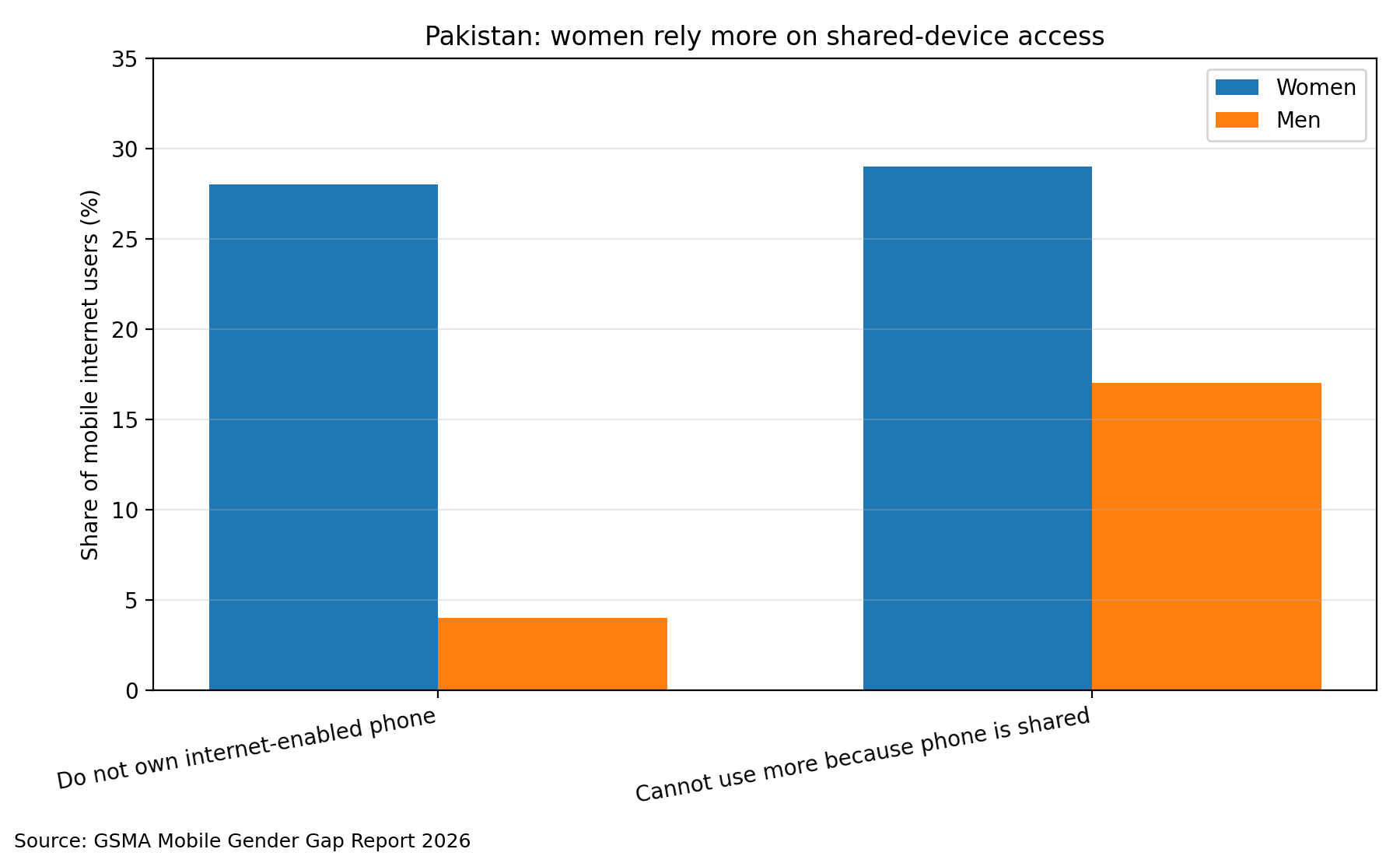
The report said shared-device access can provide some connectivity, but it limits privacy, convenience, digital literacy and direct access to services.
The difference in daily use was also significant among women in Pakistan who used mobile internet and owned an internet-enabled device, 94% accessed mobile internet every day. Among women who used mobile internet but did not own an internet-enabled device, daily usage stood at 48%.
Pakistan’s mobile internet awareness was almost equal among men and women. The report found that 15% of both men and women in Pakistan were unaware of mobile internet.
However, 32% of women were aware of mobile internet but did not use it, compared with 27% of men.
This shows that awareness alone has not translated into equal adoption, particularly for women.
Literacy, cost and family approval remain barriers
Literacy and digital skills were among the main barriers to mobile internet adoption in Pakistan.
Among women in Pakistan who were aware of mobile internet but did not use it, 32% cited reading and writing difficulties as the single most important reason stopping them from adopting mobile internet. The same proportion of men gave this reason.
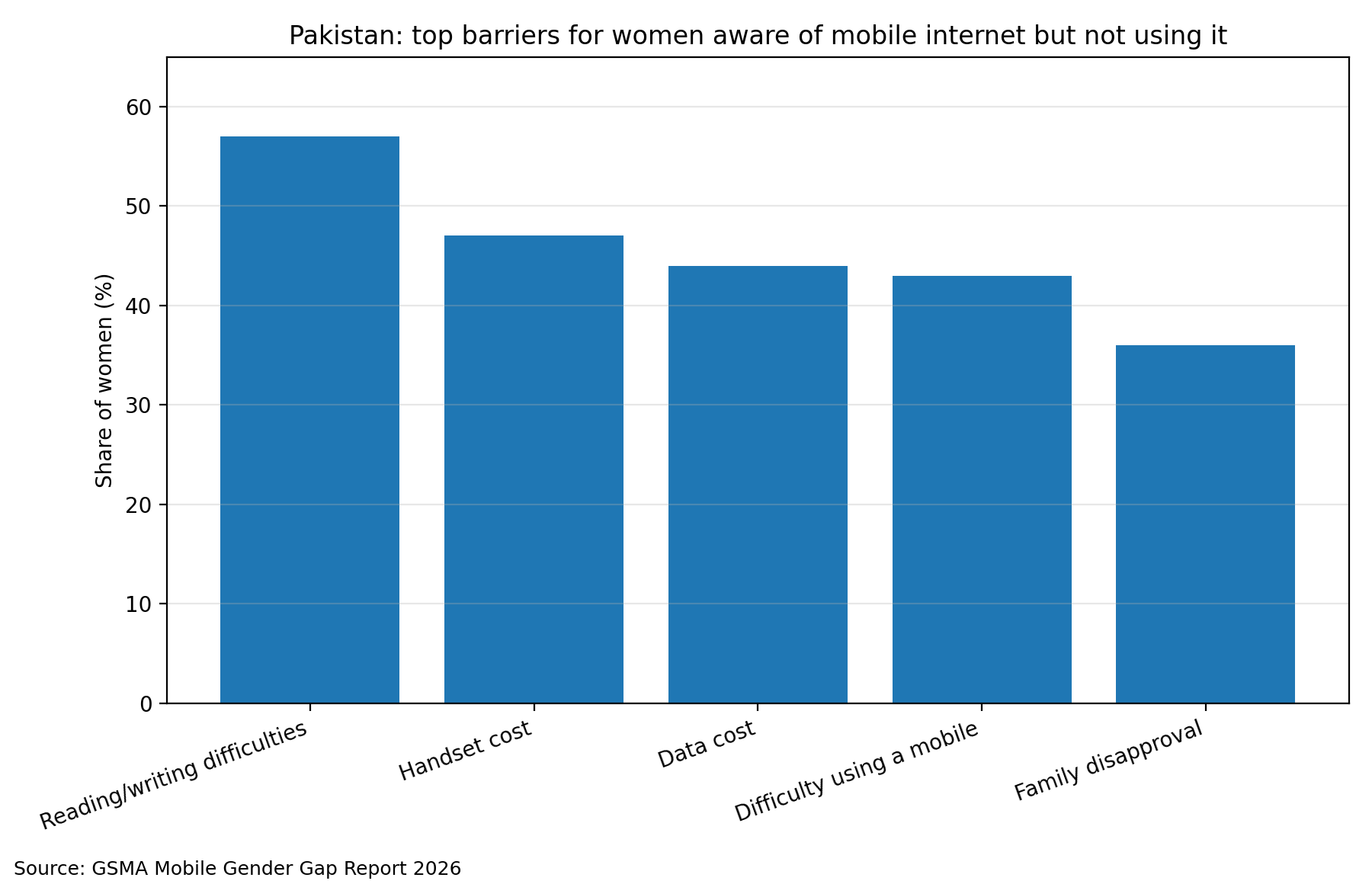
When respondents were asked to identify all barriers to adoption, 57% of women cited reading and writing difficulties, 47% cited handset cost, 44% cited data cost and 43% cited difficulty using a mobile in general.
Family disapproval was a much larger barrier for women. The report showed that 17% of women in Pakistan who were aware of mobile internet but did not use it cited lack of family approval as the most important barrier, compared with 2% of men.
Overall, 36% of women in Pakistan identified family disapproval as a barrier to adopting mobile internet, compared with 20% of men.
For existing users, the barriers shifted towards service quality, online safety and cost.
Among women using mobile internet in Pakistan, 38% cited scams or fraud as a barrier to using mobile internet more, while another 38% cited slow connection speeds.
Other barriers to further use among women included data cost at 34%, harmful content at 34%, handset cost at 33%, information security at 33%, reading and writing difficulties at 31%, and shared phone access at 29%.
Among men in Pakistan, slow connection speeds were the most widely cited barrier to further use at 45%, followed by inconsistent or no coverage at 36%, data cost at 35%, and scams or fraud at 32%.
Women use mobile internet less for economic activity
The report’s use-case data showed that Pakistani women who use mobile internet are most active in communication and entertainment-related activities.
Among female mobile internet users in Pakistan, 68% used mobile internet weekly for video calls, 64% for instant messaging, 64% for online videos, 61% for online calling, 55% for social media and 48% for online entertainment.
Men reported higher weekly use across most categories. Among male mobile internet users in Pakistan, 79% used mobile internet weekly for online calling, 78% for social media, 76% for instant messaging, 75% for video calls, 74% for online videos and 64% for online entertainment.
The gender gap was wider in economic and service-related uses. Only 3% of female mobile internet users in Pakistan reported using it weekly to search for online job or business information, compared with 18% of men.
For income generation, the figure was 11% for women and 18% for men. For online banking or mobile money, it was 11% for women and 30% for men.
Women also reported lower weekly use of mobile internet for government services, at 12% compared with 21% for men, and for employment or online work, at 11% compared with 22% for men.
Impact on livelihoods and income
The report also examined the perceived impact of mobile internet on livelihoods and income.
Among self-employed women mobile internet users in Pakistan, 41% said mobile internet had improved their livelihoods and income, while 54% reported no impact, 3% said it had worsened outcomes and 2% did not know.
Among unemployed women mobile internet users, 11% said mobile internet had improved their livelihoods and income, 70% reported no impact, 12% said it had worsened outcomes and 7% did not know.
For men in Pakistan, 18% of employed mobile internet users said it had improved livelihoods and income, while 58% reported no impact, 16% said it had worsened outcomes and 9% did not know.
Among self-employed male users, 28% reported improvement, 60% said there was no impact, 7% reported worsening outcomes and 5% did not know. Among unemployed male users, 14% reported improvement, 69% said there was no impact, 12% reported worsening outcomes and 4% did not know.
Global and regional picture
Across low- and middle-income countries, 65% of women use mobile internet compared with 74% of men, leaving women 12% less likely than men to use mobile internet.
This translates into around 200 million fewer women than men using mobile internet.
The report estimated that 810 million women in low- and middle-income countries still do not use mobile internet, with more than two-thirds living in South Asia and Sub-Saharan Africa.
Across low- and middle-income countries, women are 13% less likely than men to own a smartphone and 7% less likely to own a mobile phone of any type.
Around 385 million women in these countries still do not own a mobile phone.
The GSMA report is based on face-to-face surveys conducted between September and November 2025 in 14 low- and middle-income countries. The 14 countries surveyed were Bangladesh, Egypt, Ethiopia, Ghana, Guatemala, India, Indonesia, Kenya, Mexico, Nigeria, Pakistan, Senegal, Sri Lanka and Uganda.
The survey covered more than 16,000 respondents, with around 1,000 male and female adults aged 18 and above surveyed in most countries. In India, the sample was around 2,000.
Pakistan was among six countries surveyed by the GSMA every year from 2017 to 2025, along with Bangladesh, India, Kenya, Nigeria and Guatemala.
Speaking at the event, Aamir Ibrahim, Chairman of TOA, said, “Pakistan’s progress in narrowing the gender gap in mobile ownership and internet use is a significant achievement and demonstrates what is possible when government, industry, and other stakeholders work toward a shared goal of digital inclusion. Sustaining this momentum will require continued focus on affordability, digital skills, and creating more opportunities for women to independently participate in the digital economy.”
Comments
No comments yet. Be the first to join the discussion!