Panic selling or planned panic? PSX plunges 9.57% in unprecedented 16,000-points single-day slide
Brokers allege "trash and cash" by large investors as PSX drop substantially exceeds other global markets


A bloodbath gripped the Pakistan Stock Exchange (PSX) on Monday as the benchmark KSE-100 Index plunged over 9%, triggering a market halt under PSX regulations. The sharp decline was attributed to the escalating regional instability after the joint US-Israel attack on Iran and Tehran’s retaliatory actions, particularly targeting US military installations in Gulf countries.
At about 9:20 am, the benchmark index dropped to 152,991.15, losing 15,071.01 points, or 8.97%. Trading was suspended at 9:22 am under PSX regulations after the KSE-30 Index declined 5% from the previous close.
The market resumed at 10:30 am, with the KSE-100 trimming part of its losses and rising to 159,328.59. However, selling pressure persisted, and the index closed at 151,972.99, down 16,089.17 points, or 9.57% from the previous session.
“All TRE Certificate Holders are hereby informed that due to a 5% decrease in the KSE-30 index from the previous trading day’s close of the same, a Market Halt has been triggered as per PSX Regulations, and all equity-based markets have been suspended accordingly,” read the PSX notice.
Under PSX regulations, if the KSE-30 Index moves 5% above or below the previous day’s close and stays there for five consecutive minutes, the Exchange suspends trading in all equities and equity-based derivative markets for a cooling-off period. During the halt, the system cancels outstanding orders, the market resumes with a pre-open session, and NCCPL can require brokers to deposit mark-to-market losses/margins before they are allowed to trade after reopening
Panic selling or planned panic?
While a drop in all global markets was expected, following what ensued in Iran over the weekend, suggestions of foul play have been levelled against the big investors of PSX.
Most of the markets around the world dropped, but only by a small margin. Most notably, Saudi Arabia's Tadawul Index dropped just around 2.1%, while other gulf countries' indices (with the exception of UAE and Kuwait) dropped under 2%, with countries like Bahrain showing an even lesser drop of below 1%.
Meanwhile, the PSX's response was deemed disproportionate given that a single session drop of over 9% was not even seen when major Pakistani cities were under attack on May 8th, 2025. The extent of the drop at the time was 6%.
Some stockbrokers, speaking on condition of anonymity, alleged that institutional investors may have intensified panic in the market by exploiting the prevailing domestic and regional uncertainty.
An intensified panic like this, by a big investors, leads to an across the board selling from smaller investors, allowing the former to sweep up the shares at a much lower price as the panic cools down and shares come back to their original price levels.
Sources also pointed out that there was no panic sell-off witnessed globally as declines in major global markets were largely limited to 1-2%, whereas the more than 8% drop at PSX has raised concerns among market participants.
They also rejected comparisons between PSX and Gulf markets, arguing that exchanges in the UAE, Kuwait, Oman and Qatar are facing direct security threats amid ongoing retaliatory attacks by Iran following the US-Israel action.
However, it is also important to note that Pakistan is, in fact in a unique situation as of now. With protests erupting across the country following the death of Iranian supreme leader, also a religio-sectarian figure for many Pakistanis, the country is in a volatile law and order situation.
Simultaneously, the war on the north-western border, though cooled down is far from over. Adding to that, the volatility of Pakistan's financial state, and the vulnerability of Pakistan's credit ratings, a more extreme reaction than other global commodity and equity markets is justified. The magnitude of it, however, may have been blown out of proportion, which is something to be observed in the trading sessions to follow.
International impact
International markets also reacted to the Middle East conflict. Chinese blue-chips were off just 0.1%, though the country does get much of its seaborne oil imports from the Middle East. MSCI's broadest index of Asia-Pacific shares outside Japan fell 1.2%.
The UAE and Kuwait temporarily closed their stock markets, citing "exceptional circumstances".
For Europe, EUROSTOXX 50 futures shed 1.3% and DAX futures slid 1.4%. FTSE futures fell 0.6%. On Wall Street, S&P 500 futures and Nasdaq futures both lost 0.8%.
Brent crude rose 4.5% to $76.07 per barrel, after briefly crossing $82, while US crude gained 3.9% to $69.59. Gold increased 1% to $5,327 per ounce.
Military exchanges between the United States, Israel and Iran continued, raising concerns about potential disruption to the Strait of Hormuz, through which about one-fifth of global seaborne oil and 20% of liquefied natural gas flows.
During the previous week, the KSE-100 had already declined by 5,107.53 points, or 2.9%, to close at 168,062.17, amid continued regional tensions and domestic security concerns.
Highest ever decline by far
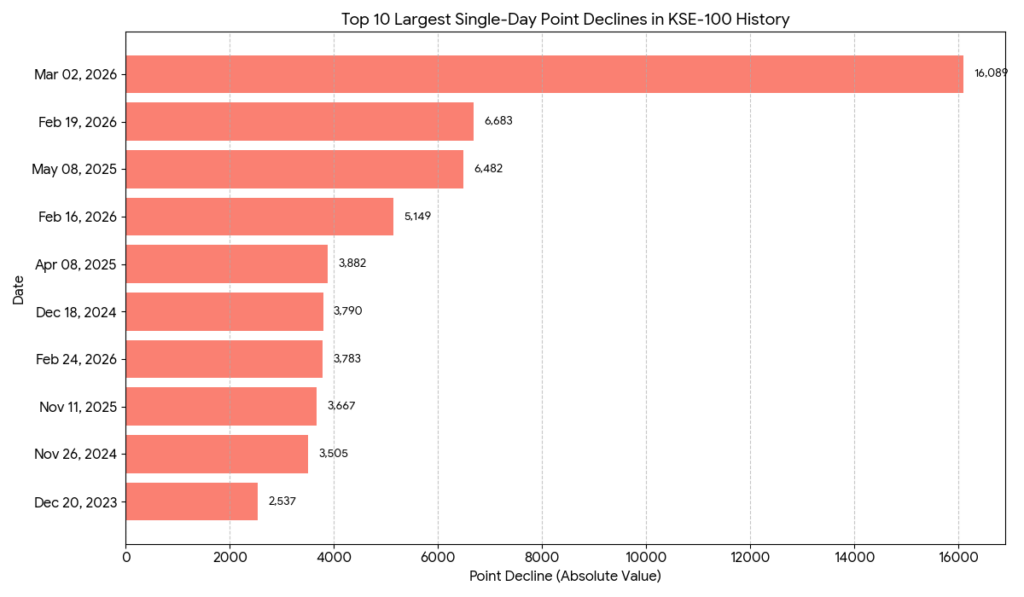
Monday's decline also marks KSE-100’s highest-ever single-day fall in absolute terms.
| Date | Point Decline | Cause/Context |
| March 02, 2026 | 16,089 | Escalating regional instability and strikes in the Middle East. |
| February 19, 2026 | 6,683 | Heavy foreign selling and low Ramadan volumes. |
| May 08, 2025 | 6,482 | Record single-day loss at the time amid Pak-India tensions. |
| February 16, 2026 | 5,149 | Major market meltdown during a period of regional unrest. |
| April 08, 2025 | 3,882 | Global equity sell-off following US tariff announcements. |
| December 18, 2024 | 3,790 | Profit-taking and concerns over IMF review and oil prices. |
| February 24, 2026 | 3,783 | High volatility and futures rollover pressure. |
| November 11, 2025 | 3,667 | Sharp sell-off attributed to macroeconomic concerns. |
| November 26, 2024 | 3,505 | Political unrest and protests in the federal capital. |
| December 20, 2023 | 2,537 | Significant profit-taking after the index hit record highs. |
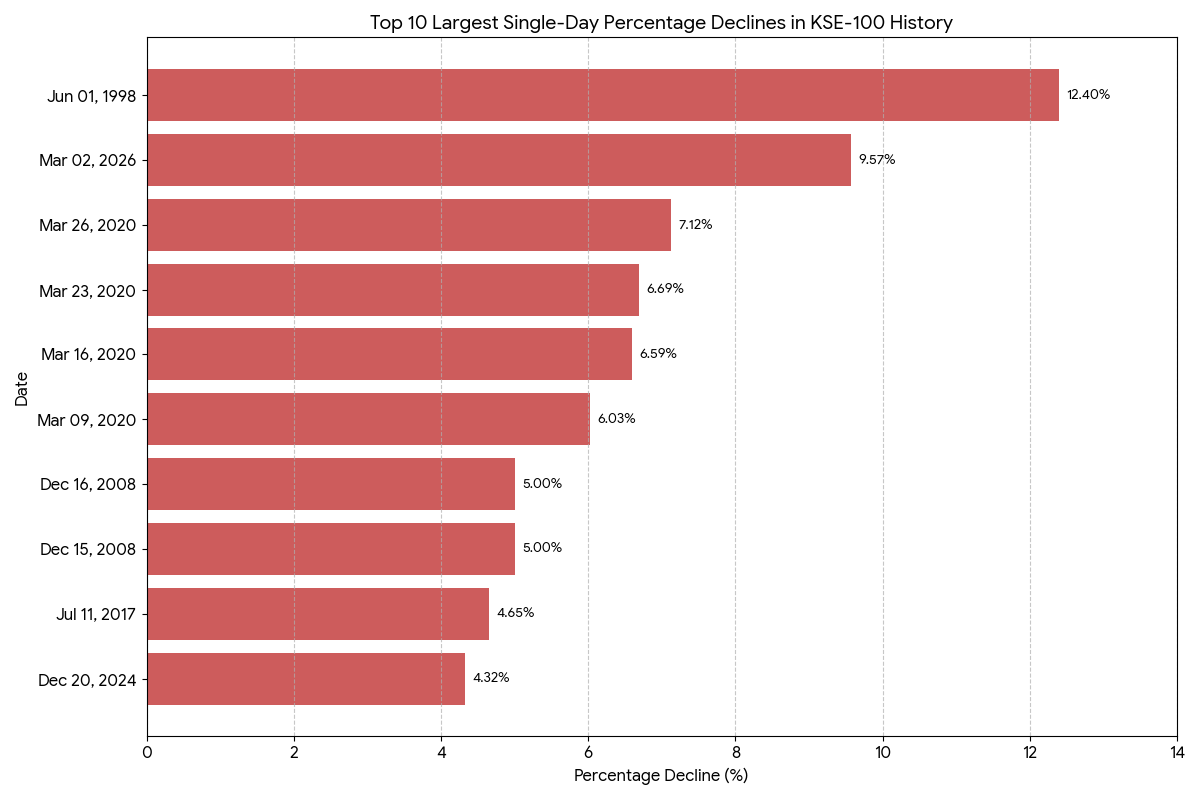
Historically, the largest percentage decline was on June 1, 1998 (12.4%), but due to the lower base of the index at that time, it does not rank in the top 10 for absolute point drops.
| Date | Percentage Decline | Primary Reason / Context |
| June 01, 1998 | 12.40% | Post-Nuclear Tests and Global Sanctions. |
| March 02, 2026 | 9.57% | Middle East Geopolitical Conflict. |
| March 26, 2020 | 7.12% | COVID-19 Lockdown and Global Panic. |
| March 23, 2020 | 6.69% | COVID-19 Economic Fears. |
| March 16, 2020 | 6.59% | Global Market Meltdown (COVID-19 onset). |
| March 09, 2020 | 6.03% | Global Oil Price Crash and Pandemic Uncertainty. |
| December 15, 2008 | 5.00% | Removal of Market "Floor" during 2008 Financial Crisis. |
| December 16, 2008 | 5.00% | Continued sell-off after floor removal (Day 2). |
| July 11, 2017 | 4.65% | Political storm following the Panama Papers JIT report. |
| December 20, 2024 | 4.32% | Political Unrest and Year-end Economic Panic. |
1 Comment
No comments yet. Be the first to join the discussion!