This year’s mango crop is dying from disease. How deadly is it, and is there a way out?
The deadly batoor disease has run rampant through Sindh’s mango orchards and threatens not just this year’s crop but also next year’s.
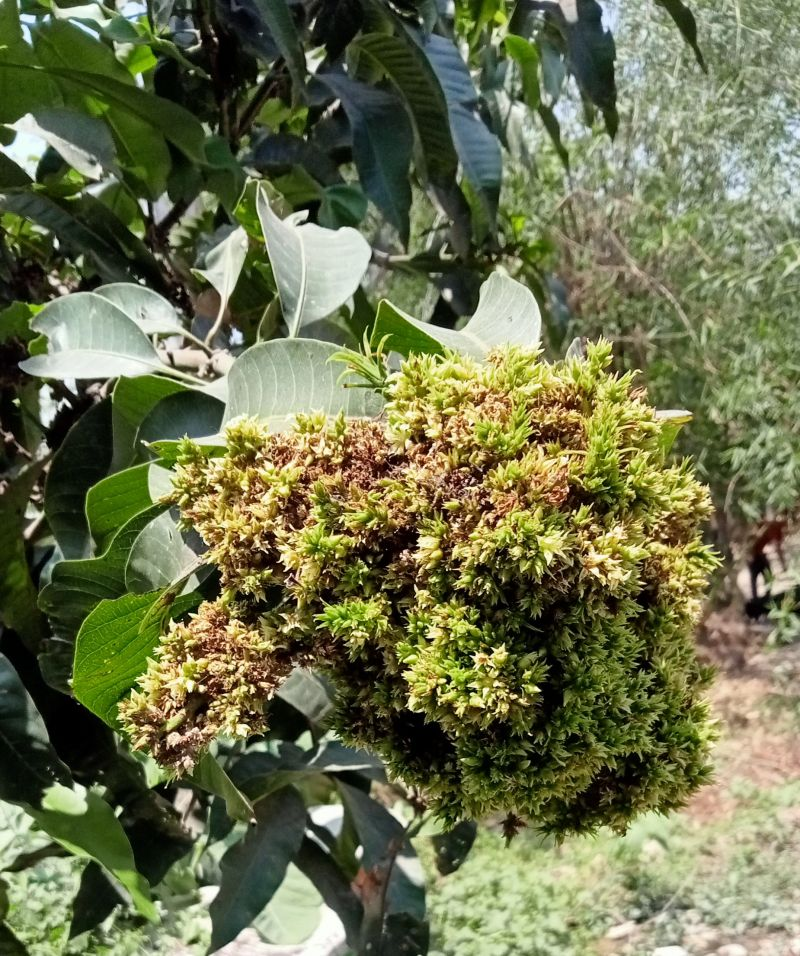
Mango, for all its sweetness, is in peril. Reports have emerged that the orchards in lower Sindh are facing mango malformation, a condition of disease known locally as batoor. A fungal infection, it has the potential to wreck not only the current year’s crop, but also the following year’s as well. And deservedly does it incur the farmer’s spite and wrath.
For Pakistan, which is the sixth largest producer of mangoes in the world, this is no small matter. Yet Pakistan’s mango production in recent years has been wobbly, often decreasing, though sometimes increasing as well. Although this has little to do with any large-scale change in local practices, it has everything to do with changes in climate.
Often in recent years, the time when the mango trees are in the flowering and fruit-setting phases, heatwaves have struck, damaging crops across the plains of Punjab and Sindh, and cutting down production. Conversely, the reason when the crop has performed well is when there have been unseasonably conducive weather conditions, encouraging young shoots and budding fruits to flourish into growth.
However, although climate remains a persistent worry and little can be done on a small scale to mitigate its harm in the short term, disease remains something that is preventable, yet always threatening and often biting. Similarly, certain practices which have harmed the crop continue to be undertaken, resulting in lower yields in certain areas.
This situation is complicated by the fact that mangoes do bring in some export revenue, and many producers rely on higher prices fetched by exports to regional markets.
The Disease(s)
Disease in crops is not simply a matter of harm to the plants, but also to livelihoods. And the mango malformation disease, or batoor, is no different in this regard.
Ostensibly this is a fungal disease that causes flowers, leaves, and shoots to disform, and interferes with their development. Appearing often as clusters of shoots that are composed of narrow and brittle leaves bunching together inwards, this disease effectively colonises the mango tree. [INSERT PICTURE}
Abdul Ghaffar Grewal, former Director of Mango Research Institute Multan, explains what really makes this disease so nefarious. “The fastest growing variety of mango is Sindhri, which can grow around 7 to 8 grams per day; even that sucks water and growth out of adjacent budding mangoes. The bhatoor, on the other hand, can grow more than 150 grams per day. And to power this growth it cannot rely on the roots alone, and starts pulling nutrition from neighboring branches, flowers, and flowering fruits, all of which are affected.”
Grewal highlights three major harms the growth of bhatoor causes. First, it impedes the growth of mangoes in neighbouring branches. Second, owing to its dark bushy structure, it provides a good hideout for pests and insects, who can escape light and pesticide sprays. And third, batoor pulls nutrition from neighbouring branches, essentially draining the plant of its vitality. This handicaps the tree and makes it unable to bear fruit in the next cycle.
The cure for the disease lies in timely intervention. Any budding batoor clusters must be shaved off the branches as soon as visible, protecting precious nutrients for the mango flowers and budding fruits. There are long-term measures as well. Timely spray of pesticides ideally before winters, the use of potash, and avoiding over-irrigation of the orchard are some that Grewal highlights. He also insists that careful selection of new plants to ensure there were no or very little malformations is important, and so is the cautious removal of cut batoor from the orchard.
Mango malformation, however, is not the only potential disease that mango orchards face in Pakistan. Anthracnose is one such fungal disease, which although usually attacks fruit when it is ripening in store, has recently been known to attack fruit as it is growing on the tree. It appears as black spots on the surface of the mango, rendering the fruit not fit to eat.
There is also a condition that’s called the mango dieback, though according to Abdul Ghaffar Grewal it is not a disease, but a symptom. Visible to humans usually as the drying up of branches and shoots from the top of the tree gradually to the bottom, it eventually results in the death of the tree, unless precautions and treatments are administered, of course. This disease is a response to root decline, so normal methods of treating diseases (e.g., by fungicides, pesticides, or even fertilizer) do not work. The root cause is a fungal infection, whose growth is supported by harmful farming practices such as over-irrigation of orchards.
There is also the mango hopper, which is perhaps the most dangerous pest facing the mango plant. A small insect, it feeds on the sap of the budding shoots, and strikes at the plant when it is in the developmental phase, crippling it. These pests have the potential to ravage whole orchards, and are identified – other than their pesty bodies – through shiny spots on leaves, which are sticky residue left . Given that these also lay eggs, which are impervious to any pesticide, these have the potential to keep destroying plants if adequate and timely measures are not taken. Reports of hopper attacks are usual, and have risen in recent years to the great
Other Issues
In recent years, however, climate change has emerged as a threat that has determined the fate of mango perhaps more than any other cause. The fluctuation in mango production numbers in recent years has been attributed to what way the climate wind blows.
Early summers, especially heatwaves in the latter half of March, when the mango trees are flowering and fruit is setting on them, have destroyed crops with reports that the production has fallen anywhere from 20 to 50 percent in those years. And in years where an unseasonably cool late March occurred, farmers have felt optimistic for better output. In fact, 2023 was one such year, where the average temperature during this time remained in a temperate range between 27 and 32 degrees Celsius. This was in contrast to the heatwave years, where temperatures reached 37 to 42 degrees in the vital growth period of the tree causing massive fruit-shedding.
Although farmers have on the whole expressed that in general we are producing less mangoes than we ought to in recent years – sometimes by even 50 percent – the production numbers released by the National Food Security and Research show a rising trend.

There is, however, a caveat that these numbers are estimates based on acreage and the expected yield per acre, and nor do these account for the mangoes that were dropped before they were ripe. And, as for the estimates by the farmers that production has been down in most recent years by 40 to 50 percent, those are also estimates based on personal observations, and might not reflect the whole situation.
What is common between the two figures is that there has indeed been some variation in yields. While we don’t have official numbers for 2024-25 crop, according to Abdul Ghaffar Garewal, the past year was no different from the trend, where the production was down by as much as half, owing to heatwaves in springtime. Even though he is hopeful for a better production cycle this year, his hopes are circumscribed by assumptions of favourable weather conditions as well as protection against hopper attacks and other diseases.
These variations are consequential also because they directly impact the livelihoods of hundreds of thousands of people involved in mango production. And then, there is the question of exports as well, upon which mango producers depend to fetch better prices. The export targets fluctuate every year. In 2023, for example, the aim was to export 125,000 tonnes of mangoes. This target was revised next year to 100,000 tonnes, and then reinstated to 125,000 in 2025.
Yet, exports are a complicated matter, considering the political turmoil the broader region is being pushed into. Even last year, when producers were aiming to export Sindhri and White Chaunsa to Iran, which is one of the top buyers of top-grade of these two varieties, their hopes were quashed by the war imposed by Israel and the US on Iran. The exporters were unable to export what they had wished, and consequently these varieties continued to flood the market. Similarly, Afghanistan has also emerged as a key market for second-grade mangoes from Pakistan, according to Abdul Ghaffar Garewal. Given the hostilities at the Afghan border this year, and the current war on Iran and the broader region, such aspirations remain contested.
And to top it all, there is the question of farming practices, and the export-readiness of Pakistani mangoes. As mentioned above, some farmers continue to overirrigate orchards, damaging the roots and consequently harming the trees ability to bear that year and the next years’ crop. Similarly, poor handling in the post-falling phase often leads to the loss of considerable quantities of the fruit. According to some estimates, such as one by Pakistan Horticulture Development & Export Board Manager Khawar Nadeem reported last year by The Express Tribune, as much as 30 percent of mangoes are lost before they reach the consumer due to outdated practices. Nadeem was also reported as saying that conventional Pakistani farms had 40-60 plants per acre, unlike farms in Australia and Egypt which can reach up to 600 plants per acre since they use modern techniques like high-density planting, using superior rootstocks, and greenhouse setups.
Moreover, the question of export-readiness of Pakistani mangoes is also a lasting one. There are certain phytosanitary protocols that need to be met for export to the EU and countries such as Japan, China, Australia, the United States, etc. These include treatment by heat vapours, certifications that the mangoes were grown in a pest-free area, and proper documentation. Most of all however, these measures include treatment by hot water, a process that kills fruit-fly larvae right after harvesting. This is important because fruit flies lay eggs beneath the skin of the fruit, rotting the inside and making the fruit inedible.
Pakistan has been working on meeting these standards, with the number of hot water treatment facilities reportedly rising from 1 in 2014 to 26 in 2024, which is encouraging, but not enough. Dr. Mubarik Ahmed, a consultant with the Trade and Development Authority of Pakistan, was reported as saying in 2024 that “around 40 percent of the country’s mango exports went through hot water treatment”. This means that there certainly is more potential to unlock more advanced markets, and bring in more revenue than currently is possible.

Comments
No comments yet. Be the first to join the discussion!