May 4, 2026
Governance by shock
May 4, 2026
What unfolded on the night of May 1, 2026, at One Constitution Avenue in Islamabad is not an isolated enforcement action; it is a defining moment that exposes how a flawed system can first enable, then ignore, and ultimately turn against its own citizens. Nearly 200 families, representing close to Rs. 20 billion in private capital, a meaningful portion belonging to overseas Pakistanis, now find themselves caught in a crisis not of their making. For over two decades, a developer defaulted on obligations, deviated from approved land use, and sold units without a clear title. Yet the project moved forward through formal approvals and construction permissions under the regulator’s watch. This is not a procedural lapse; it is a structural breakdown.
At the heart of this crisis lies a deeper institutional dysfunction that can be understood as a three-window failure of governance: approvals without accountability, weak oversight during execution, and delayed or disproportionate enforcement after the fact. In such a system, responsibility becomes fragmented, and when failure eventually surfaces, it is often the end-user, not the originator, who bears the cost. This is not governance in the true sense; it is institutional discontinuity.
Then came the response, sudden, forceful, and deeply unsettling. In the middle of the night, a large police contingent entered a residential complex and went door to door, asking families to vacate within hours. Women, children, elderly residents, overseas Pakistanis, and even foreign tenants, including diplomats, were left scrambling to make immediate arrangements. Reports of intimidation and the absence of clearly presented written judicial orders have raised serious concerns. Regardless of the legal merits of the case, enforcement without due process erodes legitimacy. A state is not judged only by the authority it exercises, but by the restraint and fairness with which it exercises it.
This incident sends a profoundly contradictory signal at a time when Pakistan seeks to attract capital, particularly from its diaspora. We encourage overseas Pakistanis to invest, return, and anchor their future in this country. Yet here, many who did exactly that, investing through documented channels backed by official approvals and NOCs, now find themselves exposed. Some had purchased these apartments as retirement homes after decades of work abroad; others had relocated to contribute professionally within Pakistan. What they are left with is not just uncertainty over property, but a deeper question of trust in the system itself.
At the same time, Pakistan stands at a critical economic inflection point. The evolving regional shifts in the Middle East have created a genuine, time-sensitive opportunity for capital reallocation by overseas Pakistanis seeking stability and long-term investment destinations. However, capital does not respond to sentiment alone; it responds to systems. If Pakistan is to benefit from this moment, it must not only attract diaspora investment but also arrest persistent domestic capital flight and enable reinvestment within the country. This requires a clear national philosophy; we must first put our own house in order. Without regulatory certainty, enforcement predictability, and protection of bona fide investment, capital will continue to exit rather than enter.
The regulatory dimension of this case is central to the crisis. Developments of this scale do not occur in isolation. Approvals are granted, compliance is reviewed, and construction is monitored, or at least that is the institutional expectation. It is also important to note that the original lease permitted a hotel development with associated commercial and serviced apartment components, indicating that the project’s evolution was not entirely outside an initially approved framework. For years, this mixed-use interpretation remained largely uncontested by both authorities and buyers, further reinforcing a sense of regulatory acceptance. If violations occurred, they did so under the oversight of the relevant authority. Yet, years later, corrective action has fallen disproportionately on end-users. This inversion of accountability reflects a deeper governance failure. Accountability must follow a continuous chain from approval to enforcement; institutions cannot separate authority from responsibility after the fact.
This is not an isolated pattern. Across Pakistan, similar episodes have unfolded, from high-rise demolitions to anti-encroachment drives in urban centers. Informal settlements have also faced abrupt operations, often without structured rehabilitation frameworks or phased transition plans. Entire communities have been displaced with limited notice. The principle remains consistent; illegality must be addressed, but through due process, proportionality, and humane implementation. When enforcement becomes episodic and reactive, it ceases to be reform; it becomes disruption.
This is the essence of what can be described as “Governance by Shock,” a pattern where decisions are delayed, institutional clarity is absent, and corrective action is eventually taken in sudden, disruptive, and often disproportionate bursts. It is the direct outcome of systemic adhocism, where firefighting replaces foresight and policy continuity is replaced by reaction. Pakistan’s net FDI inflows now stand at approximately 0.5% of GDP, a stark reflection of investor caution and systemic uncertainty. Such incidents do not remain isolated; they travel across markets and shape national perception.
International experience provides a clear contrast. In jurisdictions where real estate and urban investment systems function effectively, governance is anchored in predictability. Specialized property tribunals, time-bound dispute resolution mechanisms, escrow-based transaction systems, and digitized land records ensure that both developers and buyers operate within a transparent and enforceable framework. Investors are willing to take commercial risk, but they are far less willing to take regulatory or sovereign uncertainty. That distinction defines outcomes.
There is also a deeper institutional concern. Increasingly, there is a perception that state power operates without sufficient checks, consistency, or accountability. When citizens begin to feel exposed not only to market risks but also to regulatory unpredictability, the social contract weakens. The rule of law is not defined by enforcement intensity; it is defined by fairness, consistency, and equal application. Without these, systems risk drifting toward what increasingly feels like the law of the jungle.
From a policy standpoint, three structural reforms emerge clearly. One, regulatory accountability must be institutionalized so that approving authorities remain responsible for downstream outcomes. Two, bona fide buyers must be protected through structured legal safeguards, escrowing mechanisms, and clear ownership validation frameworks. And three, dispute resolution must be made time-bound through specialized tribunals that prevent prolonged uncertainty and capital stagnation. These are not incremental fixes; they are foundational corrections.
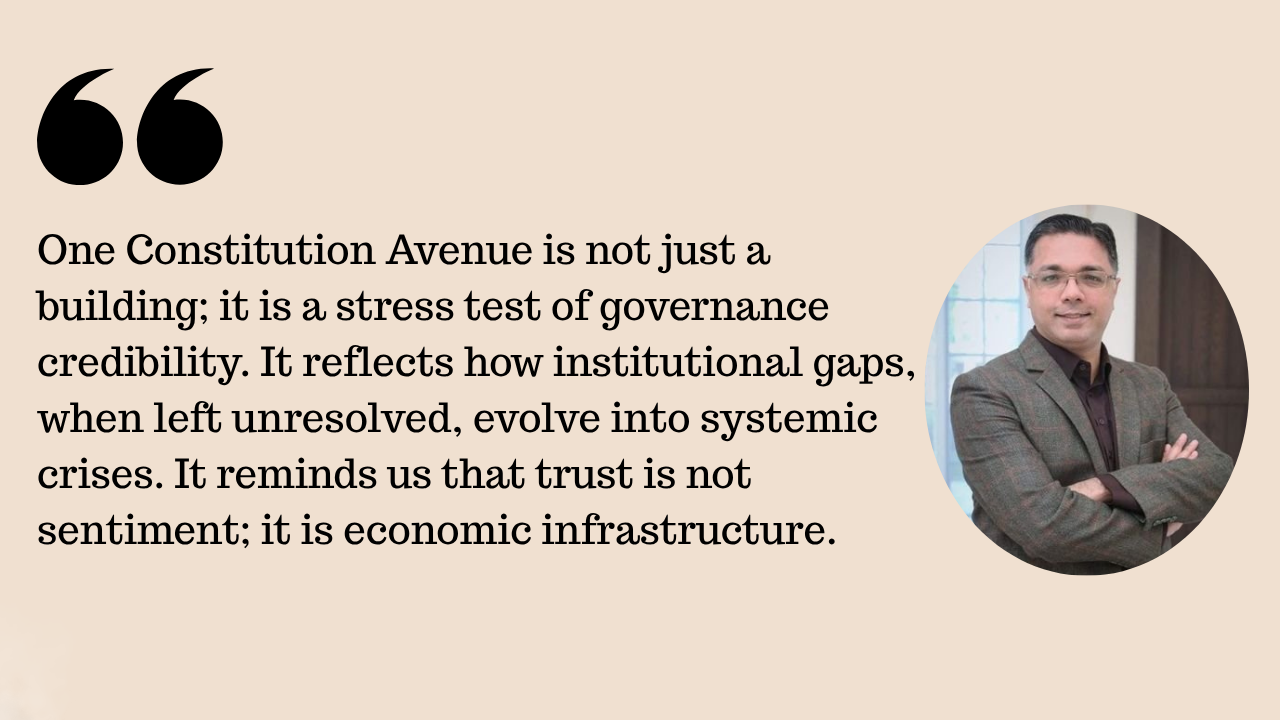
One Constitution Avenue is not just a building; it is a stress test of governance credibility. It reflects how institutional gaps, when left unresolved, evolve into systemic crises. It reminds us that trust is not sentiment; it is economic infrastructure. And it underscores a fundamental truth: governance is not measured in moments of control, but in systems of predictability.
If Pakistan is serious about economic stability, diaspora engagement, and investor confidence, then this moment must trigger structural correction, not episodic reaction, because nations do not lose investors in a single night; they lose them through repeated signals that trust is conditional and systems are unpredictable.
A deeply unfortunate state of affairs and a clear reminder that without reform, “Governance by Shock” risks becoming not an exception, but the operating norm.
Muhammad Azfar Ahsan is a public policy advocate, business strategist, and former Pakistan’s Minister for Investment and Chairman of the Board of Investment. He is a strategic advisor to leading corporate entities, focusing on business policy, investment facilitation, and leadership branding. He writes frequently on the economy, governance, and society.
View all articles →1 Comment
No comments yet. Be the first to join the discussion!