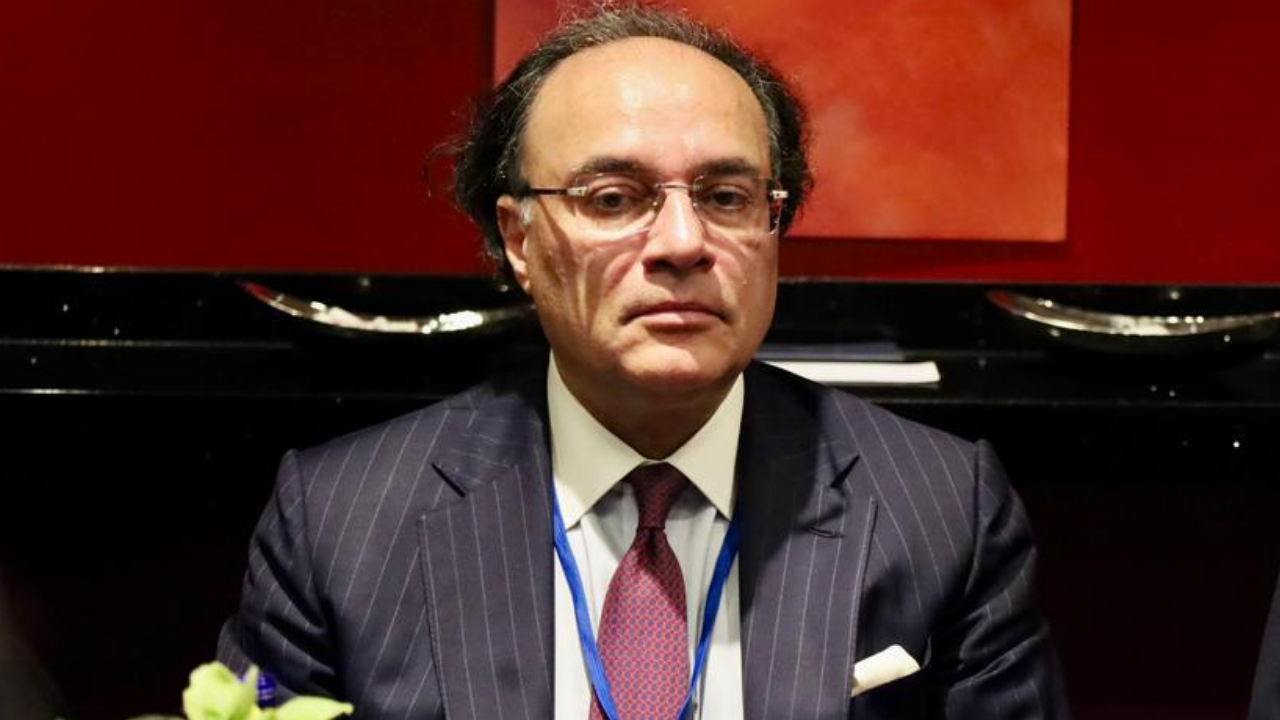
Finance minister defends FY27 budget, says export-led growth remains government’s central focus
At post-budget press conference, Muhammad Aurangzeb highlights tax relief and tariff reforms, says Pakistan remains in close consultation with IMF under ongoing programme commitments


ISLAMABAD: Finance Minister Muhammad Aurangzeb on Saturday defended the federal budget for FY2026-27, saying it had been designed to support export-led growth, improve industrial competitiveness and create an enabling environment for sustainable economic expansion.
Addressing a post-budget press conference alongside Minister of State for Finance Bilal Azhar Kayani, Minister for Information and Broadcasting Attaullah Tarar and Federal Board of Revenue (FBR) Chairman Rashid Mahmood Langrial, Aurangzeb said the budget sought to utilise available fiscal space to promote growth while maintaining economic stability.
“This budget aims to bring together all the enabling factors required for export-led growth,” he said, adding that the industrial sector would remain the primary driver of higher exports and economic activity.
The finance minister said the government, under the direction of Prime Minister Shehbaz Sharif, was preparing a new tariff policy aimed at rationalising duties and reducing the cost of raw materials and intermediate goods to improve export competitiveness.
He said extensive consultations had been held with business organisations, including the Federation of Pakistan Chambers of Commerce and Industry (FPCCI), Pakistan Business Council (PBC), and chambers of commerce from Karachi, Lahore, Sialkot, Islamabad and Quetta before finalising the budget proposals.
Aurangzeb said the government's priorities included promoting “Made in Pakistan” products, supporting Small and Medium Enterprises (SMEs), strengthening manufacturing and increasing exports.
He also highlighted the growing importance of the services sector, particularly information technology, expressing confidence that Pakistan’s IT exports would reach $4.5 billion during the current fiscal year.
“The IT services and freelancing sectors are emerging as major contributors to the economy and will play an important role in the development of a digital economy,” he said.
Discussing tax measures, Aurangzeb said the government had proposed substantial relief for salaried individuals and businesses.
The government has proposed abolishing super tax for income slabs between Rs150 million and Rs500 million, while reducing the rate from 10% to 8% for income exceeding Rs500 million annually.
He noted that income tax rates had also been reduced for several salary brackets. Under the budget proposals, the tax rate for individuals earning between Rs2.2 million and Rs3.2 million annually has been reduced from 23% to 20%, while the rate for those earning between Rs3.2 million and Rs4.1 million has been cut from 30% to 25%. For individuals earning between Rs5.6 million and Rs7 million annually, the rate has been lowered from 35% to 32%.
Aurangzeb said the government remained committed to broadening the tax base through improved enforcement, compliance and digitisation rather than increasing the burden on existing taxpayers.
He added that the FBR was moving towards greater automation and the use of artificial intelligence to reduce human intervention and improve tax administration.
Responding to questions on the economy, the finance minister said Pakistan remained in close consultation with the International Monetary Fund (IMF) due to its ongoing programme commitments.
“As long as we are in the IMF programme, discussions and consultations will continue as part of the programme requirements,” he said.
On regional developments, Aurangzeb said the government hoped tensions in the Middle East would ease soon but acknowledged that disruptions to energy infrastructure could have spillover effects on Pakistan's economy in the next fiscal year.
“We have managed the situation effectively so far, but there could be implications for the coming year,” he said.
The finance minister also dismissed reports that the government had considered imposing taxes on solar panels.
“It was never part of the discussion,” he said.
Addressing agriculture, Aurangzeb said agricultural credit and financing had increased by around 15% year-on-year and exceeded Rs2 trillion.
He highlighted the introduction of the Zar Khaiz Scheme, saying the initiative was designed to improve access to financing for small farmers and reduce their dependence on commission agents.
“Agriculture remains one of the key pillars of our growth strategy going forward,” he said.
On labour issues, Aurangzeb said the government would engage with the private sector regarding implementation of the proposed increase in the minimum monthly wage from Rs37,000 to Rs40,700.
Bilal Azhar Kayani described the budget as people-friendly, citing relief measures for the salaried class, exporters, industrialists and the construction sector.
Explaining the new retailer taxation framework, Kayani said the proposed 1% tax on turnover would apply to retailers with annual sales below Rs200 million, while the Rs25,000 amount mentioned in the budget represented only the minimum cash payment required.
“The actual tax remains 1% of turnover. The Rs25,000 is simply the minimum amount payable after adjustments,” he said.
Attaullah Tarar described the budget as relief-oriented and said it provided a framework for sustaining economic growth.
Aurangzeb had presented the Rs18.77 trillion federal budget in the National Assembly on Friday, proposing tax relief for salaried individuals and incentives for exporters, construction and real estate sectors.
The government has set an FBR revenue target of Rs15.264 trillion for FY2026-27, representing growth of 17.6% over the revised revenue estimate of Rs12.983 trillion for the outgoing fiscal year.
The budget projects economic growth of 4%, average inflation of 8.2%, a fiscal deficit of 3.6% of GDP, equivalent to Rs5.226 trillion, and a primary surplus of 2% of GDP.
The government has also allocated Rs8.045 trillion for debt servicing in FY2026-27.
Comments
No comments yet. Be the first to join the discussion!