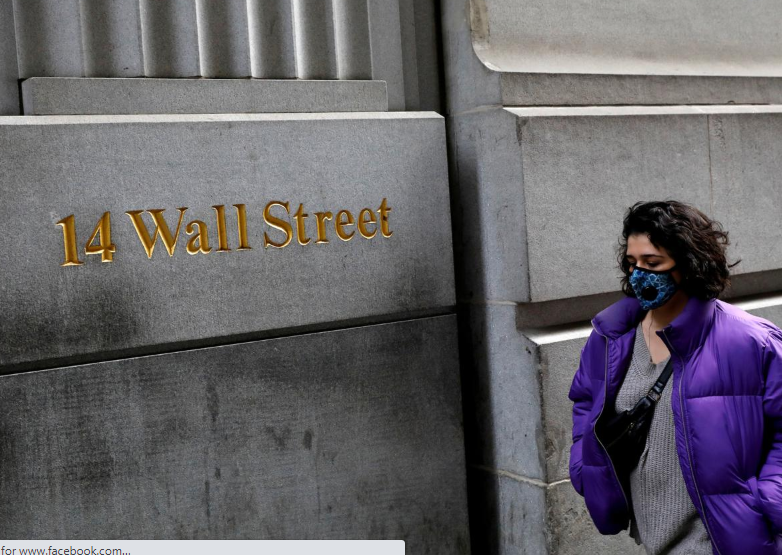
Wall Street falls more than 1% as Fed signals possible rate hikes this year
Dow loses 507 points, while S&P 500 and Nasdaq decline 1.21% and 1.34% after policymakers drop earlier guidance on rate cuts

Wall Street’s main indexes closed lower on Wednesday after the Federal Reserve kept interest rates unchanged but signalled that its next move could be an increase as policymakers focused on controlling inflation.
The Dow Jones Industrial Average fell 507.12 points, or 0.98%, to 51,492.55 after recording closing highs in the previous two sessions.
The S&P 500 declined 91.25 points, or 1.21%, to 7,420.10, while the Nasdaq Composite dropped 354.69 points, or 1.34%, to 26,021.66.
The Federal Reserve maintained its benchmark interest rate within the 3.50% to 3.75% range, as markets had expected.
However, updated quarterly projections showed that nine officials expected at least one rate increase by the end of 2026 amid concerns over inflation. The policy statement also removed previous language indicating that rate cuts were likely this year.
Kevin Warsh, presiding over his first policy meeting as Federal Reserve chair, said the central bank remained committed to price stability.
Warsh did not submit an individual projection for the future path of interest rates as part of the quarterly forecasts, departing from the practice followed by previous Federal Reserve chairs.
Following the announcement, short-term US interest-rate futures showed that markets considered an increase as early as September more likely than rates remaining at their current level, according to CME Group’s FedWatch tool.
The probability of rates remaining unchanged through the end of the year fell to around 13% from 40% on Tuesday.
Michael James, managing director and equity sales trader at Rosenblatt Securities, said the Federal Reserve’s statement and Warsh’s remarks reflected a shift towards tighter policy, with inflation and price stability becoming the central focus.
Warsh also announced a review of major aspects of Federal Reserve policy-making and said financial markets should price securities according to their assessment of economic data rather than attempting to anticipate policymakers’ thinking.
All 11 major S&P 500 industry sectors closed lower after the meeting.
Communication services was the weakest sector, falling around 3%, while industrials recorded the smallest decline at 0.1%.
Regional banks performed worse than larger lenders. The KBW Regional Banking Index fell 1.8%, compared with a 0.2% decline in the S&P 500 Banks Index.
The State Street SPDR S&P 500 Homebuilders exchange-traded fund declined 2.3%, as expectations of higher interest rates weighed on housing-related stocks.
The Cboe Volatility Index rose by two points to 18.44, marking its largest one-day increase in four sessions.
Market movements had remained limited before the Federal Reserve announcement. US stocks had risen from Thursday through Monday after oil prices declined following President Donald Trump’s announcement of a preliminary US-Iran peace agreement.
Oil prices edged higher again on Wednesday after Trump said the agreement was not final and warned that the conflict could resume if he was dissatisfied with Iran’s compliance.
Inflation concerns had increased during the Iran war as higher oil prices raised expectations of broader price pressures.
Economic data released earlier on Wednesday showed that US retail sales increased more than expected in May, supported by household purchases of cars and other vehicles despite higher petrol prices.
Among individual stocks, SpaceX shares fell 4.9%, recording their first decline since the space and artificial intelligence company made its market debut on Friday.
CME Group declined 3.5% after the exchange operator announced that Chief Executive Officer Terry Duffy would step down on March 1 and move into the role of executive chairman.
Allbirds shares rose 39% after the footwear company-turned-artificial intelligence business changed its name to Smartbird and appointed former Amazon executive Nadia Carlsten as chief executive officer.
Declining stocks outnumbered advancing shares by 2.62 to one on the New York Stock Exchange, where 282 securities reached new highs and 131 recorded new lows.
On the Nasdaq, 1,778 stocks advanced and 3,131 declined, leaving falling shares ahead by a ratio of 1.76 to one.
The S&P 500 recorded 27 new 52-week highs and 18 new lows, while the Nasdaq Composite posted 86 new highs and 117 new lows.
Trading volume on US exchanges reached 23.66 billion shares, compared with an average of 21.07 billion shares during the previous 20 sessions.
Comments
No comments yet. Be the first to join the discussion!