Dollar steadies after first round of US-Iran talks, pound slips on UK political uncertainty
Brent falls to $79.36 as Qatar and Pakistan cite 60-day roadmap for final deal; yen weakens to 161.55 per dollar amid intervention concerns


SINGAPORE: The dollar held steady on Monday after the first round of US-Iran talks ended, though investors remained cautious as President Donald Trump threatened to restart military action in the Middle East and Tehran announced the closure of the Strait of Hormuz.
A joint statement issued by Qatar and Pakistan said the United States and Iran had agreed to a roadmap towards a final deal within 60 days.
The statement said the two sides also agreed on a mechanism to end fighting in Lebanon and opened a communication line to help ensure safe passage for commercial ships through the Strait of Hormuz.
Oil prices fell after the announcement, with Brent crude futures down more than 1% at $79.36 a barrel.
Chris Weston, head of research at Pepperstone, said tight physical oil markets could continue to provide support, while foreign exchange and commodity flows, particularly gold, would remain influenced by developments in energy markets.
Sterling fell 0.21% to $1.32103 as traders assessed political uncertainty in Britain, where Prime Minister Keir Starmer was reported to be considering his political future after Andy Burnham’s election victory to parliament.
OCBC currency strategists said the initial weakness in the pound was unlikely to extend significantly and maintained a neutral view on the currency. They said current signals suggested Burnham would remain within the existing fiscal framework, although policy delivery would matter more than guidance.
The euro trimmed losses to trade at $1.14647. The Australian dollar was flat at $0.7011 after earlier weakness, while the New Zealand dollar stood at $0.573.
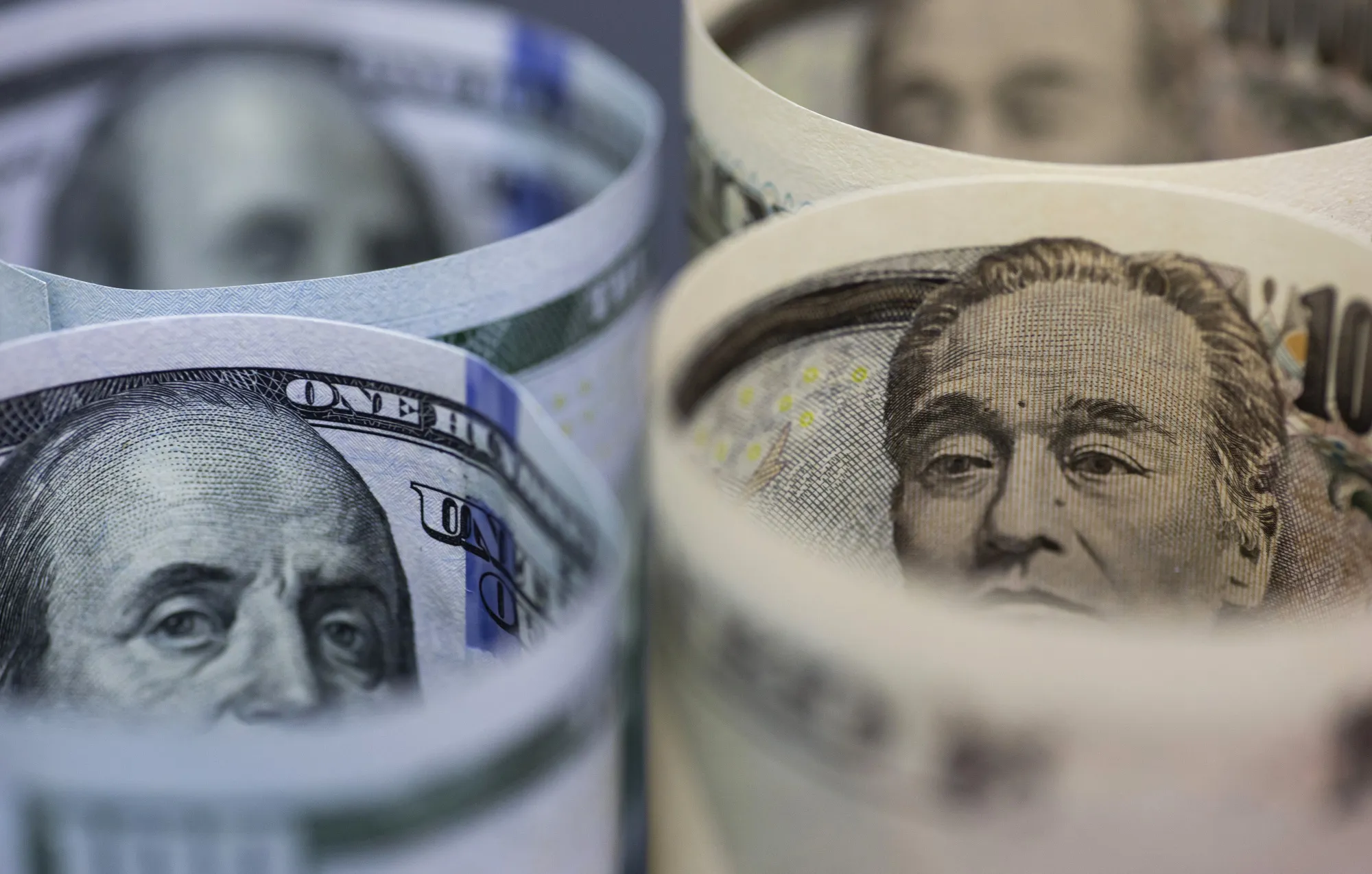
The Japanese yen weakened to 161.55 per dollar, staying close to a two-year low reached last week. A break beyond 161.96 would take the yen to its weakest level since 1986.
Japanese Finance Minister Satsuki Katayama said authorities were ready to respond appropriately to currency moves at any time.
Matt Simpson, senior market analyst at StoneX, said Japan’s Ministry of Finance may be watching the dollar-yen move closely, but intervention could be difficult against the backdrop of a hawkish Federal Reserve and strong US fundamentals.
The yen has given up gains made after interventions from April 30, as the Federal Reserve’s hawkish shift has led traders to increase expectations of US rate hikes this year.
Shen Li, head of foreign exchange sales for APAC at State Street, said dollar-yen movement was being driven mainly by interest rate differentials, with markets focused on how the Federal Reserve adjusts policy.
US Treasuries remained under pressure, with yields on two-year notes rising to 4.2276%, their highest level since early 2025.
Traders are now pricing in 43 basis points of rate hikes this year, with a 25-basis-point increase fully priced in by September.
Comments
No comments yet. Be the first to join the discussion!