CDWP clears Rs34.7bn in new development schemes, advances AI and digital infrastructure agenda
Planning body forwards major AI, satellite, rail and power projects to ECNEC, with technology and connectivity initiatives taking centre stage in the latest development pipeline.
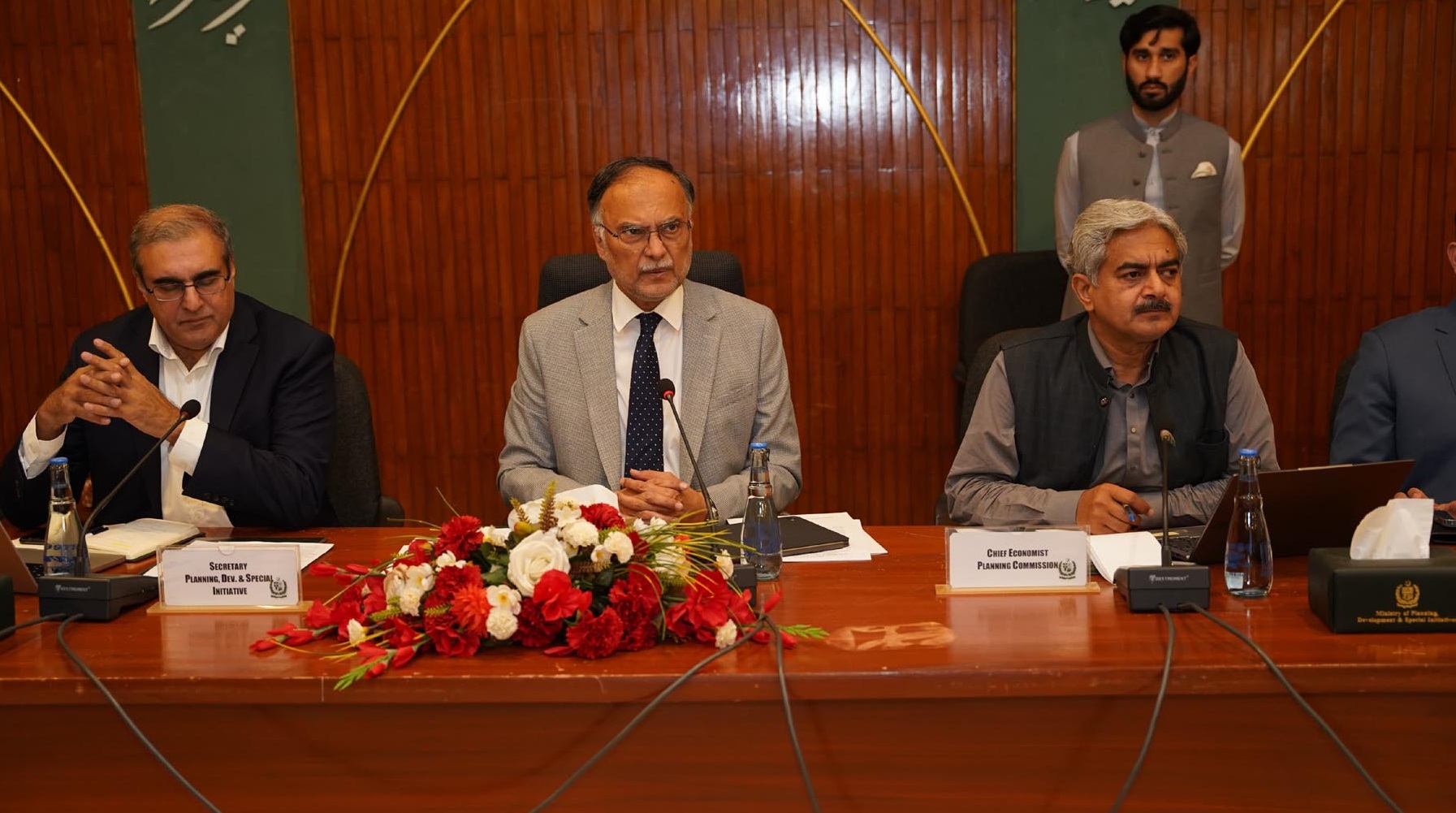
The Central Development Working Party (CDWP) on Thursday approved 15 development projects worth Rs34.74 billion and recommended several major infrastructure, technology and energy initiatives to the Executive Committee of the National Economic Council (ECNEC) for final approval.
The projects were reviewed during a meeting chaired by Federal Minister for Planning, Development and Special Initiatives Ahsan Iqbal, covering sectors ranging from artificial intelligence and satellite technology to railways, power infrastructure, security and road connectivity.
A significant portion of the meeting focused on digital transformation initiatives, reflecting the government's push to strengthen Pakistan's technology ecosystem under the URAAN Pakistan framework.
Among the projects referred to ECNEC was the Rs13 billion National Artificial Intelligence Ecosystem Development Program (NAIEDP), which aims to establish the foundations for a national AI strategy through a comprehensive feasibility study examining infrastructure needs, financial viability, governance structures, stakeholder engagement and implementation requirements.
The CDWP also endorsed the Rs7.93 billion Establishment of Emerging Technologies Data Centre project. The proposed facility will provide government-owned artificial intelligence and high-performance computing infrastructure to support cloud computing, big data analytics, research activities and digital services while reducing reliance on foreign cloud platforms.
Another major technology initiative recommended for further consideration was the Rs37.19 billion Pakistan Communication Satellite-2 (PakSat-2) project. The programme includes deployment of a new communications satellite in geostationary orbit and upgrades to existing ground control facilities in Lahore and Karachi to strengthen satellite operations and communications capabilities.
Speaking during the meeting, Ahsan Iqbal said the approved projects were aligned with the government's broader vision of promoting digital transformation, modern infrastructure and sustainable economic growth.
He stressed that investment in advanced technologies and modern infrastructure would be critical to building a more competitive, knowledge-driven economy.
Beyond the technology sector, the forum recommended several large transport projects for ECNEC approval, including the Rs278.62 billion upgrade of the ML-3 railway corridor between Rohri, Sibi, Quetta and Koh-e-Taftan. The project includes track renewal, rehabilitation of bridges and embankments, replacement of railway turnouts and construction of 11 new stations between Spezand and Taftan.
The railway scheme is proposed to be financed through the Public Sector Development Programme (PSDP), supported by interim bridge financing from Reko Diq Mining Company and the federal government.
The forum also approved the Rs20.35 billion Lalamusa Bypass project, the Rs43.65 billion Mashkel-Chedgi Road scheme and the revised Rs10.87 billion Rathoa Haryam Bridge project in Azad Jammu and Kashmir.
In the power sector, the CDWP recommended the Rs10 billion Strengthening and Improvement of Electricity Supply Network in AJ&K project, which aims to improve reliability through feeder upgrades, load bifurcation, transformer augmentation and other network enhancements designed to reduce outages and improve voltage stability.
A separate Rs9.41 billion project involving land acquisition and consultancy services for the establishment of a Special Protection Unit facility for Islamabad Police in Sector H-11 was also recommended for ECNEC consideration.
During discussions on the Rathoa Haryam Bridge project, Iqbal noted that the scheme had remained stalled since 2018 despite having originally been launched in 2006. He said the federal government revived the project after assuming office in April 2022 and resolved outstanding issues that had delayed implementation.
According to the minister, the project was subsequently reinitiated through PSDP funding and has now reached physical completion, marking the culmination of a long-delayed infrastructure initiative.
Comments
No comments yet. Be the first to join the discussion!