March 9, 2026
SBP holds policy rate at 10.5% amid rising global oil prices, war uncertainty
Central bank warns Middle East conflict could raise fuel, freight and insurance costs while pushing inflation above 7% in coming months.

March 9, 2026
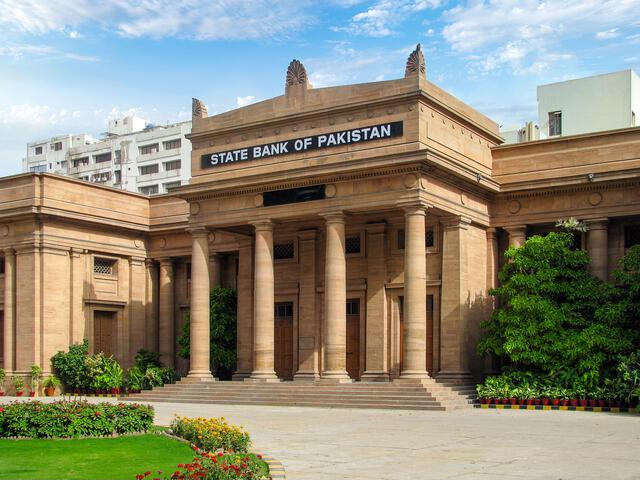
The State Bank of Pakistan kept its benchmark policy rate unchanged at 10.5% on Monday, as policymakers weighed the economic risks stemming from the escalating conflict in the Middle East and its potential impact on global energy prices and inflation.
The decision came in the central bank’s second Monetary Policy Committee (MPC) meeting of 2026 and was widely anticipated by financial markets.
Analysts had predicted the central bank would maintain the status quo amid rising global oil prices and growing uncertainty in international markets.
A poll conducted by Reuters showed all 10 analysts surveyed expected the rate to remain unchanged.
Brokerage firms also projected no change. Arif Habib Limited said the central bank would likely maintain the rate to signal caution amid a rapidly shifting global environment, while Topline Securities cited a survey indicating that 96% of market participants expected the MPC to keep the policy rate steady.
Market sentiment shifted in recent weeks as tensions in the Gulf region intensified, pushing Brent crude oil prices up by roughly 25% over the past two to three weeks.
In its monetary policy statement, the central bank said the outbreak of war in the Middle East has sharply raised global fuel prices as well as freight and insurance costs while also affecting cross-border trade and travel.
The MPC said the duration and intensity of the conflict would determine the extent of the impact on Pakistan’s domestic economy.
“While incoming data remained broadly consistent with the projections shared after the January meeting, the macroeconomic outlook has become more uncertain following the outbreak of war in the Middle East,” the central bank said.
Despite the external risks, the MPC noted that Pakistan’s macroeconomic position is stronger than during the early phase of the Russia–Ukraine War in 2022, particularly in terms of inflation trends and foreign exchange buffers.
The committee said its preliminary assessment indicates that the outlook for key macroeconomic indicators for FY26 remains within earlier projected ranges, although risks have increased.
Inflation has begun to rise again in recent months. Headline inflation increased to 5.8% in January and climbed further to 7% in February 2026.
Core inflation also rose to around 7.6%.
The central bank attributed the increase largely to the fading of favourable base effects from food and energy prices and adjustments in fixed electricity charges for households.
However, the MPC said improved food supply conditions and stronger agricultural output prospects could help offset some inflationary pressure from higher energy prices.
Even so, the committee warned that inflation remains vulnerable to volatile food prices, potential changes in administered energy tariffs and the uncertain global environment.
The MPC expects inflation to stay above 7% during the remaining months of FY26 and continue into FY27.
Economic indicators show that domestic activity is gradually strengthening.
High-frequency indicators including automobile sales, cement dispatches, electricity generation and petroleum product sales excluding furnace oil recorded stronger growth during July–January FY26.
Large-scale manufacturing grew by 0.4% year-on-year in December 2025, bringing cumulative expansion to 4.8% in the first half of FY26.
The central bank said recent policy measures including reductions in the cash reserve requirement, lower bank markup rates on export financing and adjustments in industrial energy tariffs have supported manufacturing activity.
Agricultural prospects also remain favourable, with wheat sowing targets largely achieved and input availability stable.
Based on these developments, the MPC maintained its earlier projection of real GDP growth between 3.75% and 4.75% for FY26, though it said the outlook remains vulnerable to global developments.
On the external front, Pakistan’s current account posted a surplus of $121 million in January 2026, keeping the cumulative deficit at $1.1 billion during July–January FY26.
Imports declined during the month while exports and workers’ remittances remained broadly stable.
Remittance inflows continued to finance a significant portion of the trade deficit.
Foreign exchange reserves held by the central bank rose to $16.3 billion by February 27, supported by continued interbank market purchases despite weak official inflows.
The MPC said the current account deficit is expected to remain within the earlier projected range of 0–1% of GDP during FY26.
However, it stressed that timely realisation of planned official inflows will be necessary to reach the targeted reserve level of $18 billion by June 2026.
Fiscal data pointed to continued consolidation, with the overall budget balance registering a surplus and the primary surplus remaining close to last year’s level, mainly due to lower interest payments.
At the same time, tax collection by the Federal Board of Revenue remained below expectations.
FBR revenues increased by 10.6% during July–February FY26, significantly below the pace required to achieve the annual tax target.
The central bank emphasised the need to broaden the tax base and continue fiscal reforms to maintain macroeconomic stability.
Monetary data also indicated shifts in liquidity conditions.
Broad money (M2) growth slowed to 16% as of February 20, mainly due to reduced government borrowing from the banking system.
Private sector credit expanded by Rs790 billion by February 20, driven by increased lending to textiles, wholesale and retail trade, and chemicals, while consumer financing also continued to grow.
Currency in circulation increased while deposits declined, pushing up the currency-to-deposit ratio and raising reserve money growth.
Our monitoring team diligently searches the vast expanse of the web to carefully handpick and distill top-tier business and economic news stories and articles, presenting them to you in a concise and informative manner.
View all articles →0 Comments
No comments yet. Be the first to join the discussion!