March 28, 2026
Express Group launches Pakistan’s 4th english news channel in a year amid reports of strategic state backing
The debut of Express 24/7 comes as English-language television continues to struggle commercially in Pakistan, reviving questions about why multiple new channels are emerging despite a history of financial failures in the segment.

March 28, 2026
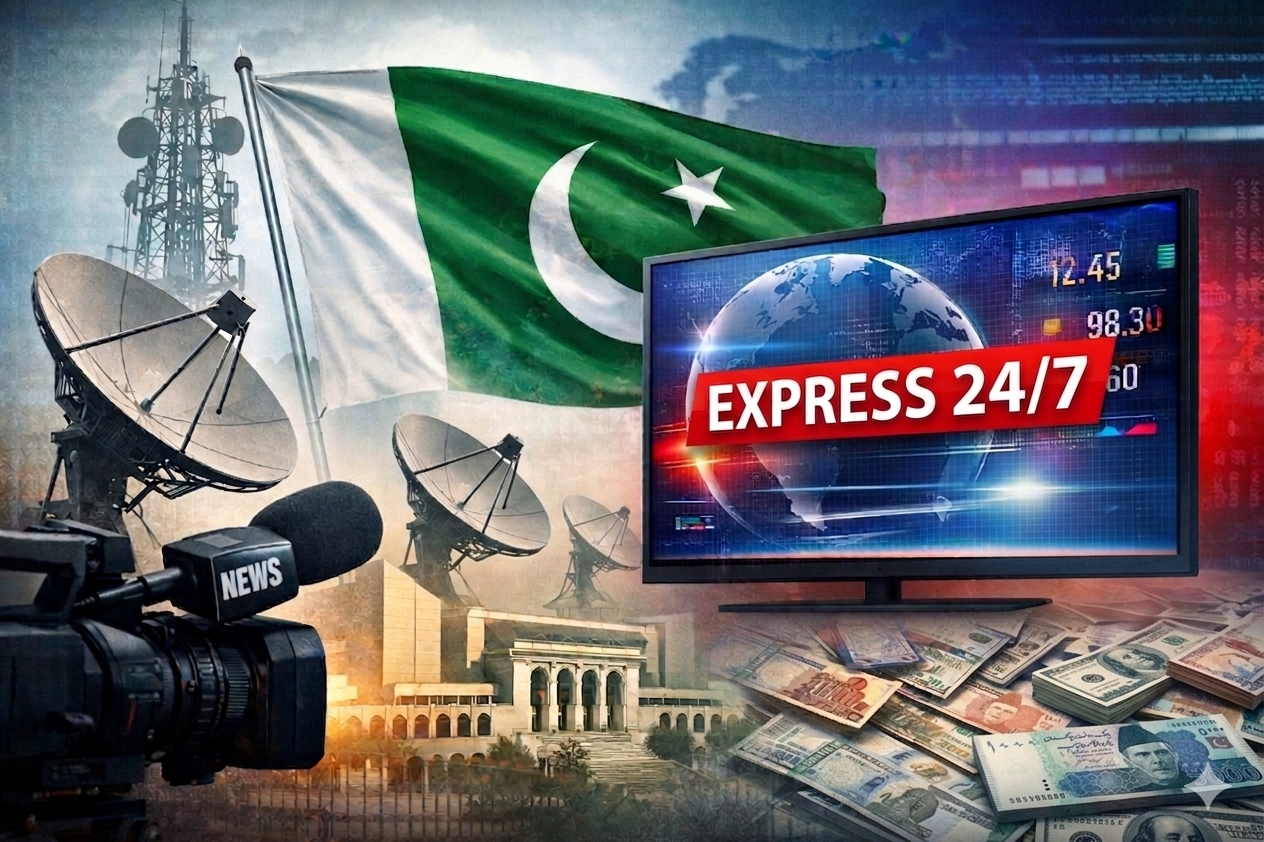
Express Media Group has formally entered the English-language television space with the launch of Express 24/7, expanding its broadcast portfolio and adding to a growing list of English-language news channels that have emerged in Pakistan over the past year. The move marks a significant shift for one of the country’s largest media houses and underscores a broader trend that is reshaping the upper end of the television news market.
Announcing the development, Azfar Nizami described the new channel as a strategic expansion designed to engage a wider and more diverse audience, both locally and internationally, while strengthening the group’s presence across multiple platforms. The launch was framed as part of a long-term effort to expand reach and influence at a time when media organizations are under pressure to adapt to changing consumption patterns and intensifying competition across the industry.
However, the arrival of another English-language channel has also reignited debate within the media sector about the commercial logic behind such ventures. Television as a medium is facing structural headwinds globally, with audiences steadily shifting toward digital and on-demand platforms. In Pakistan, the pressure is particularly pronounced, as advertising growth has slowed and broadcasters compete for a limited pool of revenue. Within this environment, English-language television represents one of the most commercially constrained segments of the market, serving a relatively small audience compared with Urdu-language programming that continues to dominate viewership and advertising share.
The economic challenges facing English-language television in Pakistan are not theoretical. They are rooted in the sector’s own history. In the early 2000s, several English-language news channels were launched during a period of rapid media liberalization and geopolitical tension, when private broadcasting expanded and expectations for growth were high. Despite strong initial backing and ambitious editorial positioning, many of those channels struggled to generate sufficient advertising revenue to sustain operations. Within a few years, several shut down or scaled back significantly, leaving behind a cautionary precedent that continues to shape investor calculations today.
That experience established a widely accepted industry view: English-language television in Pakistan rarely survives on commercial fundamentals alone. The audience base remains limited, production and transmission costs remain high, and advertisers tend to prioritize reach rather than influence. As a result, profitability has historically been difficult to achieve without external financial support or strategic backing.
Against that backdrop, the recent surge in English-language channel launches has prompted a fundamental question across the media landscape: if the business model has long been fragile, what explains the sudden expansion now?
Part of the answer may lie in the evolving role of media as a strategic communications tool. Reporting by The New York Times indicated that Pakistan’s security agencies had actively encouraged journalists and media executives to establish new English-language outlets following last year’s regional tensions. According to officials cited in the report, the agencies “motivated and requested” media ventures to launch state-friendly English-language channels in order to strengthen Pakistan’s ability to shape narratives in the international arena.
The same reporting suggested that officials involved in the initiative believed such channels would struggle to remain commercially viable without institutional backing. In practical terms, this support can take several forms. It may include government advertising allocations, tax exemptions, regulatory facilitation, or other financial arrangements that help offset operating costs during the early stages of a channel’s development. While these mechanisms vary, their impact on financial sustainability can be decisive.
Industry executives note that launching a 24-hour television news channel requires substantial capital investment from the outset. Expenses include newsroom staffing, satellite and distribution infrastructure, studio production, digital integration, and marketing. Even under favorable conditions, revenue growth tends to lag behind operational costs in the initial years, making financial backing essential for survival. When multiple channels enter the market within a short period, the scale of investment required becomes even more significant.
The timing of the recent expansion has therefore drawn particular scrutiny. The emergence of several English-language broadcasters within roughly a year suggests a coordinated shift in the sector rather than isolated business decisions driven purely by market demand. Media analysts say that while individual companies may pursue expansion for strategic or reputational reasons, the broader pattern indicates that institutional considerations are playing an increasingly important role in shaping the direction of the industry.
The strategic value of English-language broadcasting has also grown in importance as governments seek to communicate directly with international audiences. English-language channels provide a platform to respond to foreign media narratives, explain policy positions, and project national perspectives during periods of diplomatic tension. This function has become especially relevant in an era when information flows rapidly across borders and public perception can influence economic and political outcomes.
Countries seeking to strengthen their global voice have invested heavily in international broadcasting networks designed to prioritize influence rather than immediate profitability. Prominent examples include Al Jazeera and TRT World, both of which operate with sustained state funding and long-term strategic mandates. Their growth demonstrates that international media platforms can succeed as instruments of national communication, but typically only when financial support remains stable over extended periods.
For Pakistan, the launch of Express 24/7 represents both an expansion of private media capacity and a signal of broader structural change within the industry. The rapid growth of English-language broadcasting suggests that television news is increasingly being viewed not only as a commercial enterprise but also as a strategic asset capable of shaping narratives beyond national borders.
Whether the current wave of channels can achieve long-term sustainability remains uncertain. Past experience indicates that without consistent financial backing, many English-language ventures struggle to survive once initial enthusiasm fades and operational costs begin to outweigh revenue. That historical pattern continues to inform industry expectations as new entrants establish themselves in an already competitive and financially demanding market.
In that sense, the launch of Express 24/7 is more than a routine corporate development. It highlights a recurring tension at the heart of Pakistan’s media sector: the gap between the strategic value of English-language broadcasting and the commercial realities of sustaining it in a market where audience size, advertising demand, and revenue growth remain constrained.
0 Comments
No comments yet. Be the first to join the discussion!