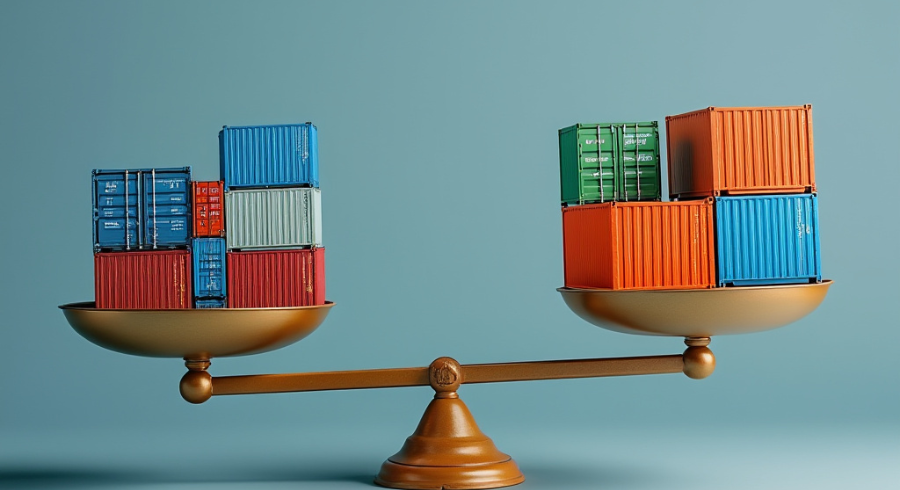
Pakistan has started trading through Iranian land routes. What is being transported and where to?
A series of moves including the easing of banking restrictions have made Iran an alternative route for Pakistani goods moving to Central Asia. With meat, fruit, rice, and other items being moved, how far can it go?
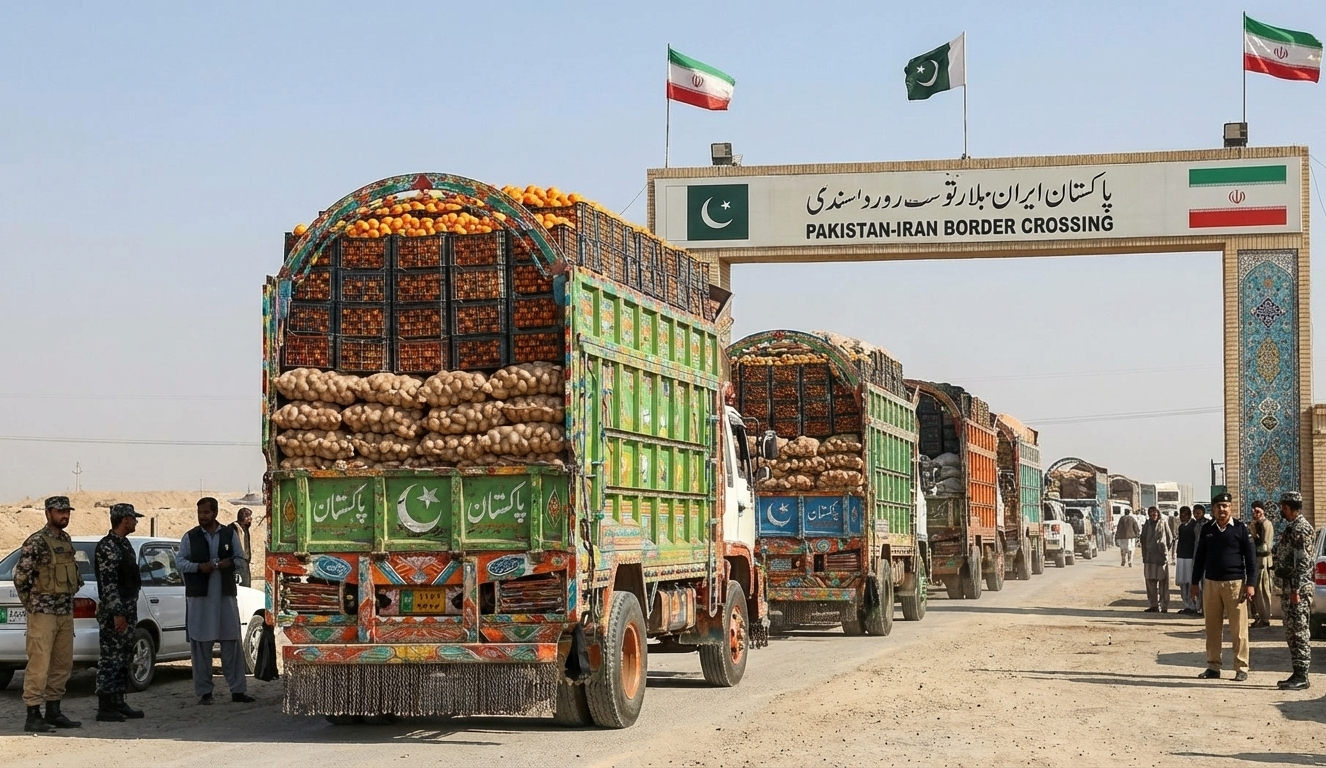
Pakistan has started using a land trade route through Iran to access Central Asian markets. The first shipment – of frozen beef – had been dispatched from Gwadar port in Pakistan to Rimdan in Iran a few days ago, from where it would travel to the city of Tashkent in Uzbekistan.
The necessity of looking for alternative trade routes, especially to the landlocked countries of Central Asia, had assumed an urgent aspect especially since Pakistan’s borders with Afghanistan closed last year. Afghanistan had been the traditional route for Pakistani exporters to send their wares across to countries in the north. But with that route shut due to repeated skirmishes and flaring tensions at the border, exporters within the country were left hanging with no prospect of getting their products off their hands. The case of potatoes illustrates this predicament quite well.
This situation was inflected through the changing nature of Pakistan’s trade with Iran. Ostensibly, Iran has been under sanctions with heavy restrictions on its ability to trade with most of the world. Yet, with Pakistan, since they share a border, there has long been a robust informal economy on the border. Given the security situation in the Persian Gulf driven by American and Israeli aggression, Pakistan’s trade with Iran has taken on an added importance.
The country has been easing banking rules to facilitate exporters to not only trade with Iran but also to use Iran’s trade routes to Central Asian countries to re-engage markets that had all but shut off since the closure of the Afghan border. For instance, the requirement to route exports through banks and use banking financial instruments to keep track of export revenues, has been temporarily waived At the same time, the Irani riyal has been gaining against the rupee since January, even while its price in the international markets remains at a historic low, pointing to an informal economy where the demand for the Irani currency is rising.
In such a context, the need to use alternative trade routes assumes a particular significance. And Iran appears to be a neighbour willing to assist with this. And cultivation of such trade routes – if the issue of sanctions on Iran is resolved – might also be a great investment. Yet the persisting informal nature of the trade and the (temporary) relaxation of financing regulations for exports might mean that some part of the export proceeds might remain outside the government’s purview, underscoring the need for some sort of oversight arrangement that try to balance the constraints of both countries.
The context
Pakistan’s border with Afghanistan was effectively closed last year in October, when security clashes between the forces of these two countries reached new heights of intensity. Since then, the border has, more or less, remained closed. This has robbed Pakistani exporters not only of the Afghan market, but also of the route that Afghanistan provided for our exports to Central Asia. This has become a little bit of a problem for local exporters. For instance, the bumper potato crop this past season which yielded 12 million tonnes had a surplus of 4 million tonnes. This surplus was supposed to be exported; but now that massive sack of potatoes had nowhere to go since Afghanistan and the Central Asian markets had been their traditional destination.
This obviously underscored the need to diversify our export supply chain. Given the state of political turbulence in the world, having a backup plan seems a no-brainer, and now the Pakistan government is learning it the hard way.
The Gabd-Rimadan border crossing – where the shipment is due to pass through – had been inaugurated a few years back in 2022. The location was prime: 120 km from the Iranian port of Chabahar and 70 km from the Pakistani port of Gwadar. Yet the trade between the two countries, at least through official channels, remained negligible. According to the State Bank’s data, our official exports to Iran amounted to 3.49 million USD in FY25, and the categories included only nominal ones such as government goods and services, and travel. So, nothing really remarkable. And it would make sense too, since the United States had imposed sanctions on trade with Iran; even the Pak-Iran gas pipeline project had to be shelved because of sanctions pressure.
An informal economy – characterised by barter, weak banking links, and propensity for informal settlement – has always been a feature of the 900-km border, where people across the border often share families with the inhabitants of the other side. The border is situated in a rocky and mountainous region, making patrolling every part of it quite difficult. Consequently, everything from Irani chocolates, snacks, crockery, to petrol is smuggled across the border with minimal oversight. Petrol, perhaps, is the most important of these exchanged items, and has spawned a different economy surrounding fuel in Balochistan, which is relatively immune from the shocks the rest of the country goes through.
There is, of course, great potential in such trade were it to go through legal channels, but the matter of American sanctions complicates this prospect. The trade continues, and with the new turmoil in the Middle East, specifically the aggression under Iran, has given a new push to this cross-border smuggling.
In fact, the impact has been so pronounced that the Irani riyal has increased in value almost four times since before the US-Israeli attacks on the last day of February. Dealers in Karachi reported that say 10 million rials that sold for about PKR 2,500 before the war are now being quoted near PKR 10,000, while money changers in Lahore describe a similar move from about PKR 2,000 to PKR 8,000. This must be measured against the price of the Irani currency in international markets, where it remains sulking in the slumps. And the reason for this difference is the fact that here – on the streets – the demand for the riyal is going up. Part of the reason is the need for riyal for smuggled trade. Part is due to speculation that once the war ends, the currency is likely to shoot up. And part of it is the growing government involvement into making use of this route, especially since the closure of the Afghan border.
Formalising the trade?
The Pakistan government has increasingly been willing to test out the Iranian ways, even at the cost of transparency. Recently, for instance, the government temporarily suspended some of the procedural requirements for exports as stipulated in the Para 3 of the Export Policy Order, 2022. These requirements effectively stated that the exporters must route exports through formal bank-compliant payment channels, and make use of bank-issued letters of credit or advance payments. This was a ploy to ensure that exports revenues remain traceable and to curb under-invoicing. But under this new measure by the government instituted in late March, these requirements were waived for the export of certain goods to Iran and Central Asian countries through to 21 June 2026. The goods included certain food items as well as pharmaceutical products and tents.
This was not totally out of the blue, however. In December 2025, for instance, the government had granted a one-time exemption from this financial instruments requirement for the export of kinnows and potatoes to Central Asian countries through Iran. The Commerce Ministry’s 2024-25 yearbook also stated that it had removed the mandatory financial-instrument requirement for mango exports to Iran, describing the move as one that eased costs and procedural burden for seasonal trade.
So, the government had been testing waters for a few months now, especially after the closure of the border with Afghanistan. The official numbers don’t really reflect the movement of goods and money under these ad hoc arrangements, but that can at least partly be explained by the prevalence of barter in the informal trade between the two economies. In fact, barter has been recognised as an official state policy. As late as October 2025, Iran and Pakistan agreed to amend the Business to Business (B2B) Barter Trade Mechanism, 2023 SRO in order to ease restrictions upon cross-border trade.
The dispatch of the first frozen meat shipment from Pakistan to Uzbekistan through Iran must be understood in this context. The relaxation of the financial instrument requirements – for the past few months now – shows that the government is willing to compromise on transparency just to get the ball rolling. Although there is a non-existent banking link between the two countries, and the trade is restricted by sanctions anyway, the need for such measures have taken on a new urgency recently. Surpluses of multiple crops lie waiting, with farmers bemoaning their beleaguered circumstances ushered in by the closure of the Afghanistan border. And the conditions at the Afghan border do not inspire great hopes for its sustained reopening anytime soon.
Moreover, the importance of Central Asian countries – specifically Uzbekistan, where this shipment of frozen beef is headed – cannot be understated in this regard. In FY25, Pakistan exported 28.78 million dollars’ worth of frozen bovine meat overall. Uzbekistan was the biggest market, accounting for around 39 percent of the total share, with UAE making the second place with 26 percent of this share. In fact, Uzbekistan’s share in the frozen beef exports had increased from FY24, where it had made up 33 percent of the total frozen beef exports of 36.47 million dollars. UAE’s share, on the other hand, decreased during this period from around 40 percent to 26 percent. Given the recent decrease in the UAE’s share of this market, Uzbekistan becomes even more important.
Therefore, setting up alternative trade routes, such as through Iran, becomes even more important. And, as mentioned above, it is not simply about beef either. A host of our food exports are destined for Central Asia. Having your neighbour as your transit partner seems a good strategy to cultivate, especially at a time when your troubles with another neighbour are harming your business interests.
We also see how the removal of sanctions on Iran are being floated around as one of the key terms of a potential peace agreement between the United States and Iran. This, if it happens, would open up a whole new market for Pakistan and at that time investment in trade routes with Iran would begin to pay dividends.But that’s not the only reason why such measures should be encouraged. We already have discussed the urgency of the need to develop alternative export chains, for instance, and the need to at least get our exports going to relieve pressure on domestic producers.
However, Pakistan does stand to lose a big part of its potential export revenues given the informal nature of general trade and the temporary relaxation of financial instruments requirements for initiating exports. Some type of formalisation – of course within whatever limits there exist on both sides – needs to be institutionalised so that people across both the sides of the border are able to benefit from more of their mutual trademaking.

2 Comments
No comments yet. Be the first to join the discussion!