April 30, 2026
European Investment Bank eyes Reko Diq investment as it resumes Pakistan financing after a decade
EU lender seeks share in critical minerals; govt calls $6 trillion reserves estimate exaggerated, Barrick slows project over security risks

April 30, 2026
- Bank resumes Pakistan financing after over a decade, signs €100 million deal for Sindh Flood Emergency Housing Reconstruction Project
The European Investment Bank (EIB) has expressed interest in investing in Pakistan’s Reko Diq mining project, with a focus on supporting infrastructure while securing access to critical mineral supplies, The Express Tribune reported.
Speaking at the EU-Pakistan Business Forum, an EIB official said the bank was open to financing enabling infrastructure for the project but stressed the importance of maintaining supply links with European markets. He said access to critical minerals is essential for Europe’s green and digital transition.
Pakistan’s Director General (DG) Minerals at the Ministry of Energy, Nawaz Ahmed Virk, said claims that the country holds $6 trillion worth of mineral reserves are not based on detailed exploration and are overstated. He added that while Pakistan has significant mineral resources, accurate estimates require further study.
The Reko Diq project, one of the world’s largest undeveloped copper and gold deposits, is currently under review by Barrick Gold. The company has slowed development activity until mid-2027, citing rising security concerns and the need to reassess financing, timelines and project scope.
Barrick said the review could lead to revisions in the project’s capital costs, previously estimated at $5.6 billion to $6 billion for Phase 1 and $3.3 billion to $3.6 billion for Phase 2. Initial production had been targeted for the end of 2028.
The project is owned 50% by Barrick, 25% by three federal state-owned enterprises, and 25% by the Government of Balochistan.
Officials also said tax-related issues have been raised by contractors involved in the project. While income from Reko Diq has been exempted from taxation to attract investment, discussions are ongoing with the Finance Division regarding the treatment of general sales tax and withholding tax during the development phase.
The EIB noted that investment decisions in mining projects depend on regulatory stability, policy clarity and risk management. It said addressing issues related to enforcement, currency risks and regulatory predictability is critical for project viability.
€100 million financing agreement
Separately, the EIB has resumed financing operations in Pakistan after a gap of over a decade, recently finalising €160 million in agreements for housing reconstruction and water sector projects.
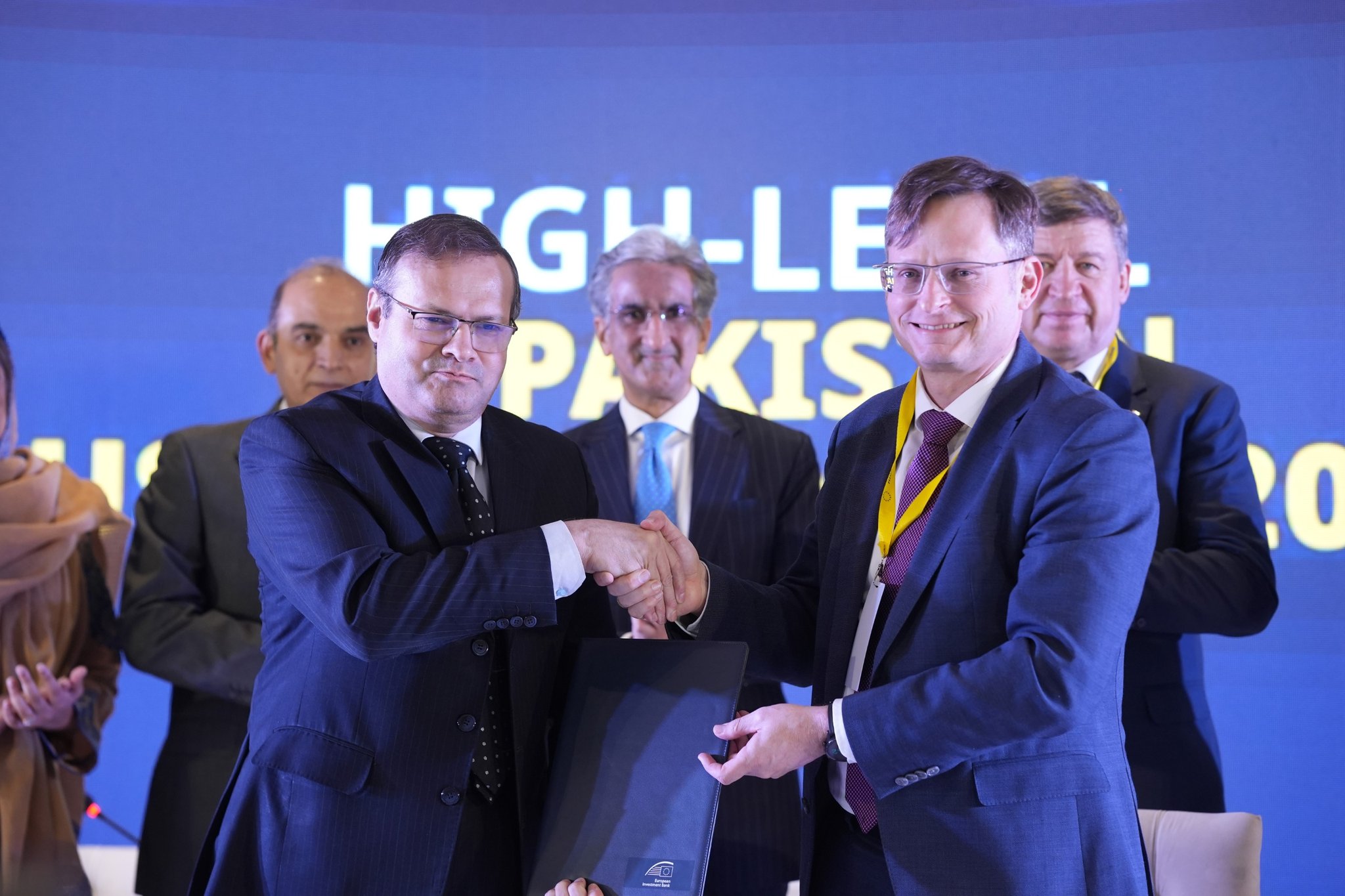
On Wednesday, Pakistan and the EIB signed a €100 million financing agreement for the Sindh Flood Emergency Housing Reconstruction Project. The agreement was signed by Federal Secretary for the Ministry of Economic Affairs Muhammad Humair Karim Kidwai on the sidelines of the EU-Pakistan Business Forum.
The project aims to rebuild homes damaged during the 2022 floods in Sindh, with around 1.7 million houses planned for reconstruction in rural areas.
With a total estimated cost of nearly €1.9 billion, the programme is being supported by multiple development partners, including the World Bank, Asian Development Bank and Islamic Development Bank, and is expected to benefit around 40 per cent of rural households in the province.
Our monitoring team diligently searches the vast expanse of the web to carefully handpick and distill top-tier business and economic news stories and articles, presenting them to you in a concise and informative manner.
View all articles →0 Comments
No comments yet. Be the first to join the discussion!