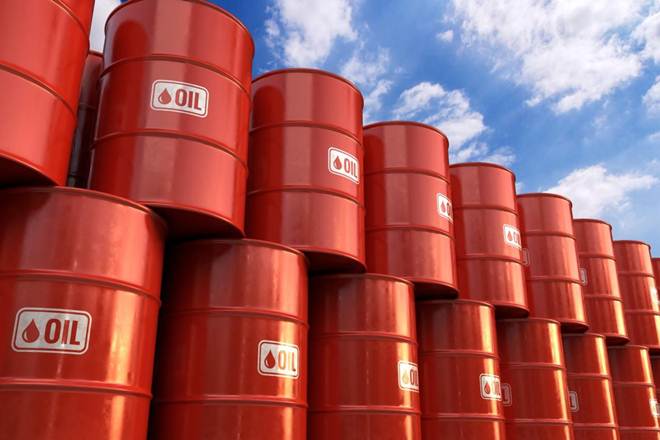
Oil prices sink nearly $4 as Iran–US deal signals potential return of Gulf supply
Oil prices tumbled nearly $4 to three-month lows after an Iran–US framework raised hopes of reopening the Strait of Hormuz and returning Gulf supply, though timelines remain uncertain.


HOUSTON: Oil prices tumbled around $4 a barrel on Monday, hitting a three-month low as markets reacted to news of a memorandum of understanding between the United States and Iran aimed at ending the conflict and reopening the Strait of Hormuz.
Brent crude futures fell $4.11, or 4.71%, to $83.22 a barrel by 1:30 p.m. EDT (1730 GMT), while US West Texas Intermediate dropped $4.34, or 5.11%, to $80.54. Both benchmarks touched their lowest levels since March 10, extending losses after a more than 3% decline in the previous session.
The selloff intensified after US President Donald Trump said Washington and Tehran had signed an agreement framework intended to restore maritime flows through the Strait of Hormuz, a critical chokepoint for global energy trade.
According to a US official, the memorandum was signed by Trump, Vice President JD Vance, and Iranian parliament speaker Mohammad Bagher Qalibaf. A formal signing ceremony is expected later in the week in Geneva.
Iran’s semi-official Mehr news agency reported that the draft arrangement includes provisions to reopen the Strait within 30 days under Iranian supervision.
Market participants said the prospect of returning Gulf supply triggered sharp selling across crude benchmarks. “With a wall of oil supply very possibly on the way, the selloff looks justified,” said Dennis Kissler, senior vice president of trading at Bok Financial.
Iran also reduced its official selling price for light crude to Asian buyers to $7.15 a barrel above the Oman/Dubai benchmark for July, compared with a $13 premium in the previous month, according to the National Iranian Oil Company.
The Strait of Hormuz, which handles about a fifth of global oil and LNG flows, has been closed for more than three months during the conflict, removing millions of barrels per day from global supply chains. Analysts said the timeline for restoring full flows remains uncertain, particularly given logistical and insurance constraints for shipping.
“Getting the vessel supply chain in place and the restarts all running smoothly within the Arab Gulf will be tough,” said Neil Crosby, head of research at Sparta Commodities, adding that insurers and shipowners may remain cautious.
The International Energy Agency estimates that more than 14 million barrels per day of output has been disrupted, equivalent to roughly 14% of global demand, with recovery expected to take weeks to years depending on infrastructure damage and restart conditions.
Analysts said inventory drawdowns and slow supply normalization could still support prices in the medium term, even after the initial selloff. UBS analyst Giovanni Staunovo noted that strategic stockpile replenishment could tighten markets over time.
Saxo Bank’s Ole Hansen said the pre-war Brent range of $60–$70 may no longer hold, suggesting a higher price floor of around $75–$80 going forward, with further upside risk depending on recovery pace in the Gulf.
Geopolitical tensions in the region remain elevated, with Israeli Defense Minister Israel Katz saying military forces would remain in security zones in Lebanon, Syria and Gaza. The future of Iran’s nuclear programme is expected to be addressed in subsequent negotiations, according to sources.
Comments
No comments yet. Be the first to join the discussion!