Pakistan’s farms need horsepower
For an Agrarian economy, it should be a point of grave embarrassment that 43% of our households are food insecure. The only way out is to give our agriculture the tools they need to keep feeding us

In August 2024 I had the opportunity to travel through the midwestern United States, visiting large soybean and corn farms across Iowa, Illinois, Kansas, and Missouri. The first visit was to a farm in Illinois spread over nearly a thousand acres. The soybean crop was near completion and around three weeks from being harvested.
As the farm’s owner showed us around the property there was a lot to be learned. Agriculture might not be the first thing that comes to mind when a person thinks of the United States (it contributes anywhere between 0.8 to 5.5 percent to the GDP depending on who you ask), the country still has some of the largest and best managed farms in the world. Nearly all of the midwestern farms on our trip were organised and plotted in a near identical manner. They all used the same high-yield, high-impact GMO seeds.
But perhaps nothing was more surprising than the amount of manpower needed to manage the thousand acre property. The farm’s owner told us that it was primarily a three person team: his wife, his brother, and himself. “We’re lucky because the kids get their break from college around the same time as harvest season. Having a few extra hands during that time helps out.”
Compare that to Pakistan, where a 25 acre farm (considered a large “Murabba” land holding) requires at least 6 manual labourers per acre to cut and bundle wheat. In the American midwest, the big game changer is machinery. The Illinois farm in question was manned by a single family, yes, but one equipped with massive tractors, harvesters, seed drillers, and planters.
Pakistan is a vastly different agrarian culture than the United States. Our crops are outdated, our farms are far smaller, and our fields are labour intensive. That makes our farming inefficient. And this is when compared to the United States. The US, along with countries like Australia, Canada, and Brazil, have the advantage of populations that are small relative to their land size, allowing for large scale farms that can be worked with large scale machinery. Yet Pakistan lags behind even compared to similar agrarian culture. India, China, and Japan all have smaller average farm sizes than Pakistan but are significantly more mechanised.
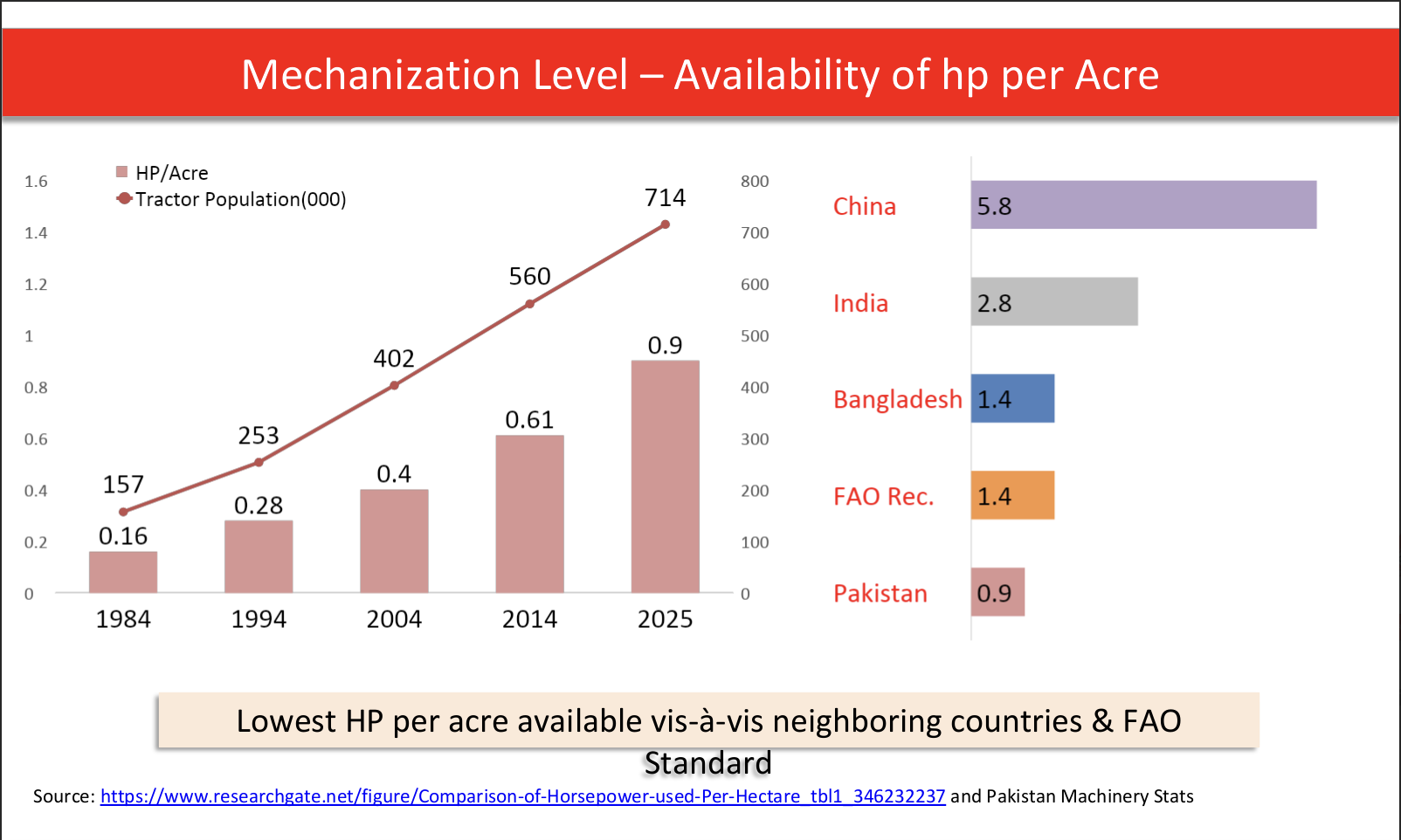
Currently the country’s mechanization ratio is below 1 horsepower per acre. The recommended rate as per the UN’s Food and Agriculture Organisation is at least 1.4 horsepower per acre, and preferably over. Compared to Pakistan, India is at 2.8 horsepower per acre, and China is at 6 horsepower per acre. Go back to the 1960s and you will see all of these countries had similar rates of mechanisation.
But why has Pakistan lagged so far behind? It is a story none of us will be unfamiliar with. Inconsistent policies and a lack of political will have left our farmers relying on oxen and their own sweat and blood where they should be harnessing the power of machines. Yet over the course of this country’s history, there has never been, for example, a formal farm mechanisation policy. India and China have both benefitted from similar official direction. Even Bangladesh introduced a similar policy in 2020. In Pakistan it remains a pipedream.
The consequences from this abysmal lack of horsepower are not abstract. Pakistan, once a proud agrarian country, can no longer provide enough food for its citizens. We have been a net importer of food since 2021. The 2026 Global Report on Food Crises has placed Pakistan among the world’s major centres of acute hunger, with around 11 million people facing high levels of acute food insecurity in 2025, while the 2025 Global Hunger Index ranks the country 106th out of 123 countries and places it in the serious hunger category.
The crisis has already happened. Our agriculture is weak and uncompetitive. At best, nearly half of our population does not know where their next meal is coming from. At worst, the coming generations will be weaker and sicker because of a lack of nutrition. The only thing we can do now is push our agriculture and give the land what it needs to thrive. But can it be done?
The hunger crisis
The immediate reading of Pakistan’s ranking as one of the world’s major centres of acute hunger is grim enough. The deeper reading is worse. Pakistan is not facing a simple shortage of food. It is facing a system in which production, markets, imports, incomes, nutrition and climate risks are moving out of sync.
The latest IPC analysis for Pakistan shows the same pattern in sharper local detail. In 45 vulnerable rural districts of Balochistan, Sindh and Khyber Pakhtunkhwa, 7.5 million people were classified in Crisis or worse conditions between December 2025 and March 2026. Of these, around 1.25 million were in Emergency. The projection for April to September 2026 puts 6.7 million people in Crisis or worse, but the decline largely reflects reduced geographic coverage rather than a real improvement.
This is the starting point of Pakistan’s food problem in 2026. The country can still produce large harvests, and it still has the land, water, livestock base and farming knowledge to feed itself. Yet it remains exposed to food insecurity because it imports too much of some essential calories, invests too little in agricultural productivity, and wastes value between the farm and the consumer.
Our agriculture (and as a result food) crisis is rooted in a few key factors. We are dependent on imports and rely too heavily on foreign sources for essential food items, especially edible oil and oilseeds. More than 79% of edible oil demand is met through imports with a bill worth billions of dollars every year. Our markets are also broken. Pakistan often grows enough of a crop but fails to move, store, process or price it properly.
But perhaps the core of the issue is productivity. A combination of climate change and a lack of modern farming means we might be producing, but not efficiently enough. The problem is not only that farmers need more tractors or machines. Small farmers need access to equipment that helps them sow on time, harvest efficiently, reduce post-harvest losses, conserve water and shift into higher-value or import-substituting crops. Subsidised tractors or solar tubewells may help selected producers, but they do not fix the system.
The mechanisation gap
The lack of mechanisation is very real. In an interview with Profit, Mr Raheel Asghar, the CEO of Millat Tractors which is Pakistan’s largest tractor manufacturer, claims that mechanisation has constantly been halted in Pakistan. “Our industry has managed to localize more than 90% of our production. We are even exporting our own brand of tractors abroad, yet Pakistani farms remain woefully underpowered,” he claims. “All you need to do is take a look at the countries around you to see how large the gap has grown.
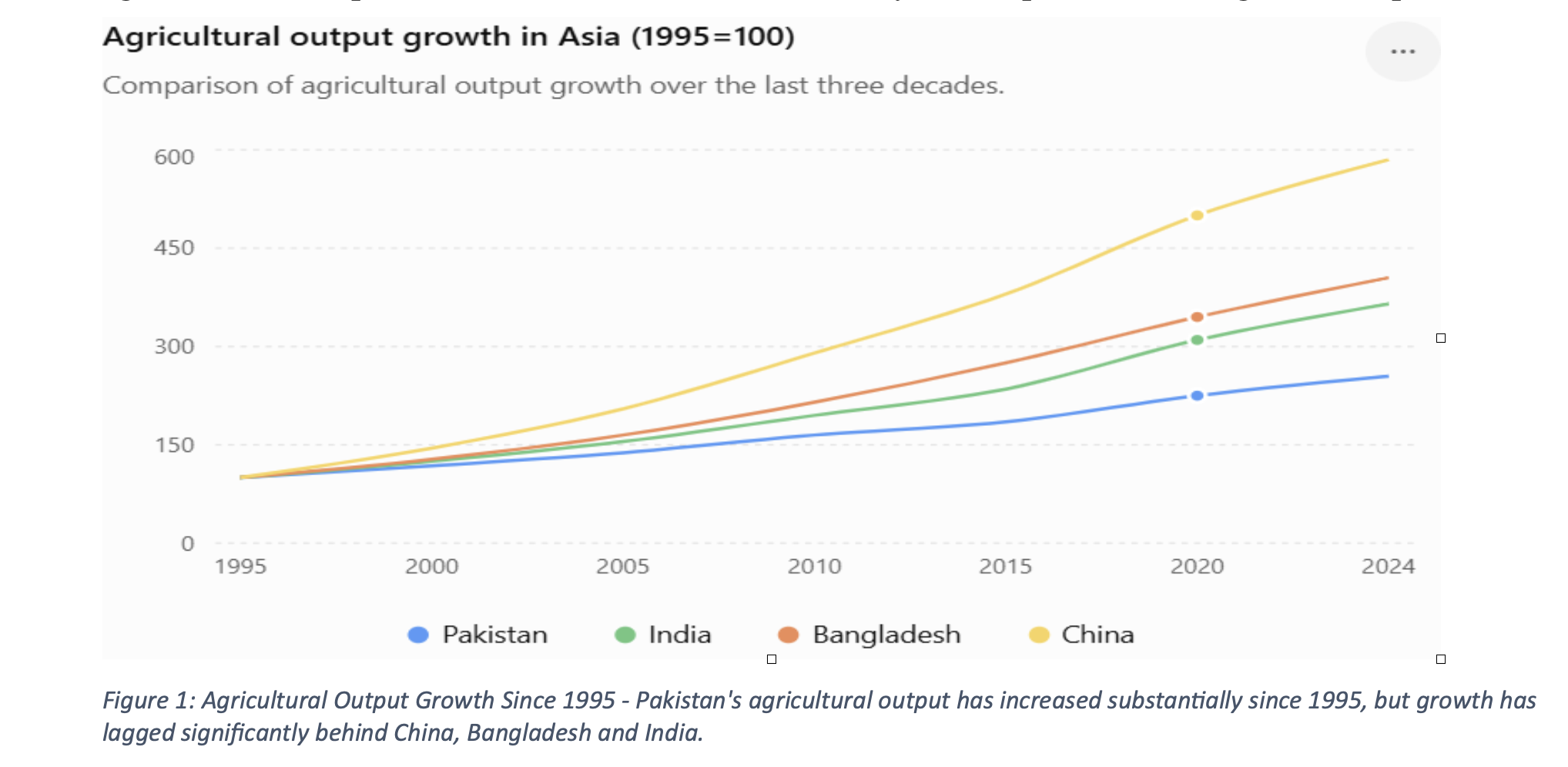
According to Mr Raheel Asghar, up until the 1960s Pakistan’s farm mechanisation was comparable with India and other countries in the region. Since 1995, Pakistan's agricultural output has grown by approximately 155 percent. While this growth appears substantial, it compares unfavorably with the performance of neighboring countries.
Over the same period, agricultural output in India increased by approximately 265 percent, Bangladesh by over 300 percent, and China by nearly 500 percent. These figures demonstrate that while Pakistan's agriculture has expanded, it has done so at a considerably slower pace than its regional competitors.
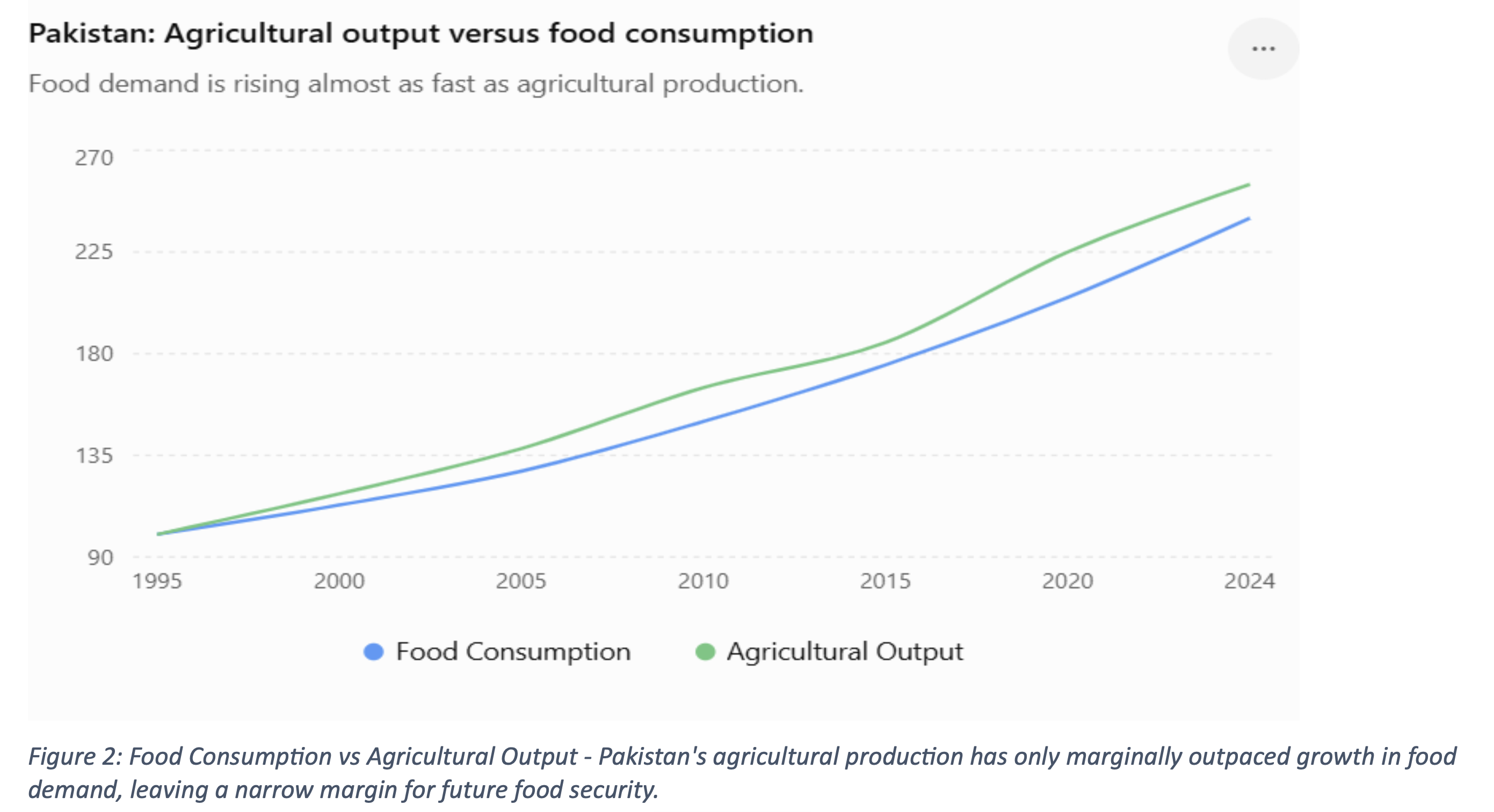
“This contrast becomes even more striking when agricultural growth is compared with food consumption growth. Food demand in Pakistan has increased rapidly due to population growth and gradual improvements in living standards. Estimates suggest that total food consumption has increased by around 140 percent since 1995, while agricultural output has increased by approximately 155 percent,” explains the Millat CEO. “In other words, agricultural production has only marginally outpaced food demand.”
By contrast, Bangladesh, India and China have achieved significantly larger gaps between agricultural output growth and food consumption growth. These countries have created what may be described as a productivity surplus, where agricultural production has expanded much faster than domestic food demand. Such a surplus provides greater food security, enhances export potential and strengthens resilience against climate shocks.
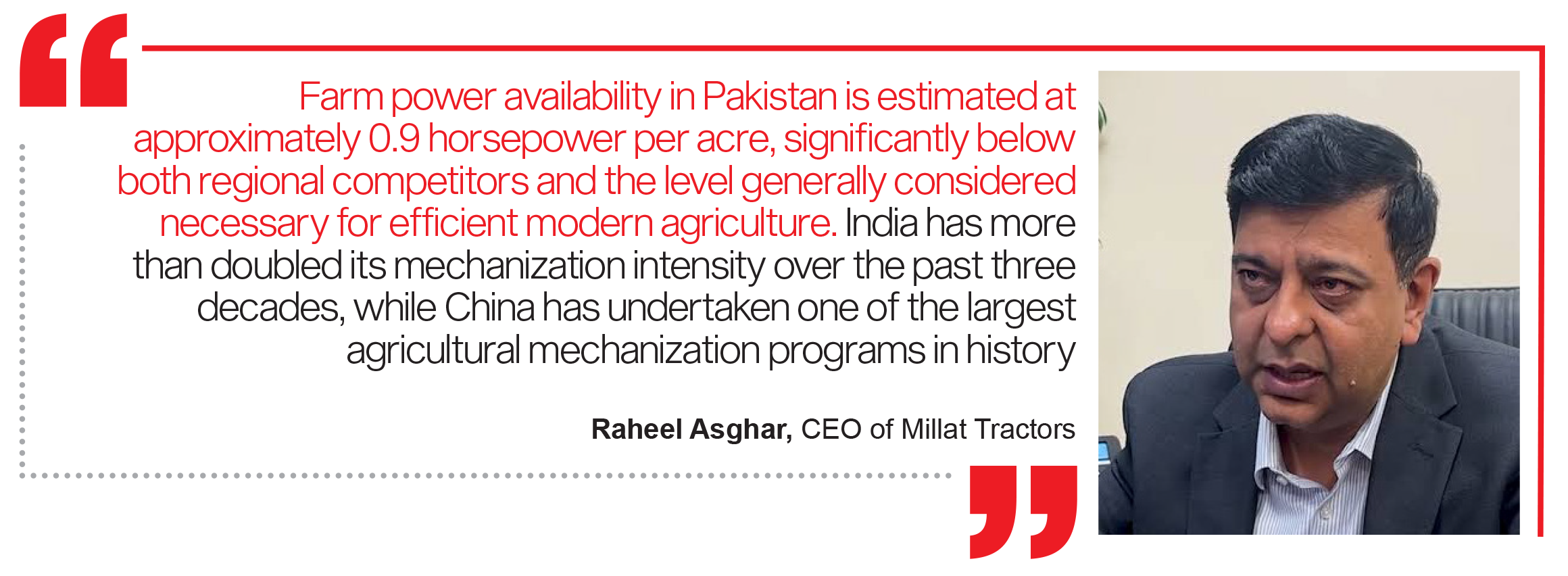
A big cause for this has been the mechanization gap. “One of the most important explanations is the country's relatively low level of agricultural mechanization. Farm power availability in Pakistan is estimated at approximately 0.9 horsepower per acre, significantly below both regional competitors and the level generally considered necessary for efficient modern agriculture. India has more than doubled its mechanization intensity over the past three decades, while China has undertaken one of the largest agricultural mechanization programs in history,” says Mr Raheel Asghar.
Country | Mechanization Level (HP/acre) | Agricultural Output Index (2024) |
Pakistan | 0.9 | 255 |
India | 2.8 | 365 |
Bangladesh | ~1.5 | 405 |
China | ~6.0 | 585 |
Table 1: Mechanization and Agricultural Growth - The countries that invested most heavily in mechanization achieved the strongest gains in agricultural productivity.
“The consequences are visible throughout the value chain. Pakistan has achieved substantial tractor penetration, but mechanization remains heavily concentrated in land preparation. Large gaps remain in planting, harvesting, spraying, precision application, post-harvest handling and fodder management.”
The problem at the field level
To understand what this means, step away from the national numbers and go to the field. Take the case of a small farmer in Punjab, Sindh or Khyber Pakhtunkhwa with three to five acres of land. On paper, he is part of Pakistan’s agricultural base. In practice, he is trying to run a food production unit without the basic tools of production.
The average farm size in Pakistan has already fallen to around 5.1 acres, while a large number of farmers operate on even smaller holdings. That means most farmers cannot justify buying a tractor, even if they could afford one. A tractor is not a small investment. Nor is a seed drill, a planter, a reaper, a thresher, a sprayer, a loader or a trolley. For a large farmer, these machines are assets. For a small farmer, they are distant objects that arrive only when someone else agrees to rent them out.
This is where the problem begins. A farmer without his own tractor does not control his own farming calendar. At sowing time, he waits for a machine. At harvest time, he waits again. If the tractor owner is busy on a larger farm, the smaller farmer loses his turn. If rain is expected, or the temperature is rising, or the wheat is ready to be cut, waiting is not a minor inconvenience. It is a direct loss of yield, quality and income.
The same problem continues after harvest. A crop does not leave the field by itself. It has to be cut, bundled, loaded, transported, cleaned, dried, stored and then sold. Each stage requires labour, equipment or cash. In the absence of machinery, the farmer pays more for manual labour, takes longer to complete each operation, and loses more produce before it reaches the market. The cost is not only on the farm. It travels through the supply chain.
This is one reason the arthi remains so powerful. The small farmer needs money before the crop is sold. He needs cash for seed, fertiliser, diesel, labour, pesticide, irrigation and transport. Formal credit is hard to access, especially for farmers without clean land titles, collateral or banking history. The arthi fills that gap. But the price of that convenience is dependence. The farmer often borrows from the same intermediary who later buys or arranges the sale of his crop. Mechanisation, in this setting, is not just about horsepower. It is about bargaining power.
Informal tractor rental adds another layer. In many villages, tractors are rented through local arrangements. A farmer may pay by the hour, by the acre or through a favour returned later. This keeps farming going, but it also makes the system inefficient. Rental costs rise during peak season. Machines may not be available when needed. The farmer may delay sowing because he cannot get a tractor in time, then harvest late because the same machine is tied up elsewhere. A small delay at the start of the season becomes a smaller crop at the end of it.
This is where Pakistan’s approach differs sharply from countries that have treated mechanisation as public policy. India has not solved all of its agricultural problems, but it has spent years building subsidy schemes, farm machinery banks and custom hiring centres aimed at small and marginal farmers. Under official mechanisation programmes, financial support has been provided for machinery purchases, custom hiring centres and village-level machinery banks, with higher assistance in some cases for collective models. The purpose is clear: if every small farmer cannot own every machine, he should still be able to use one when he needs it.
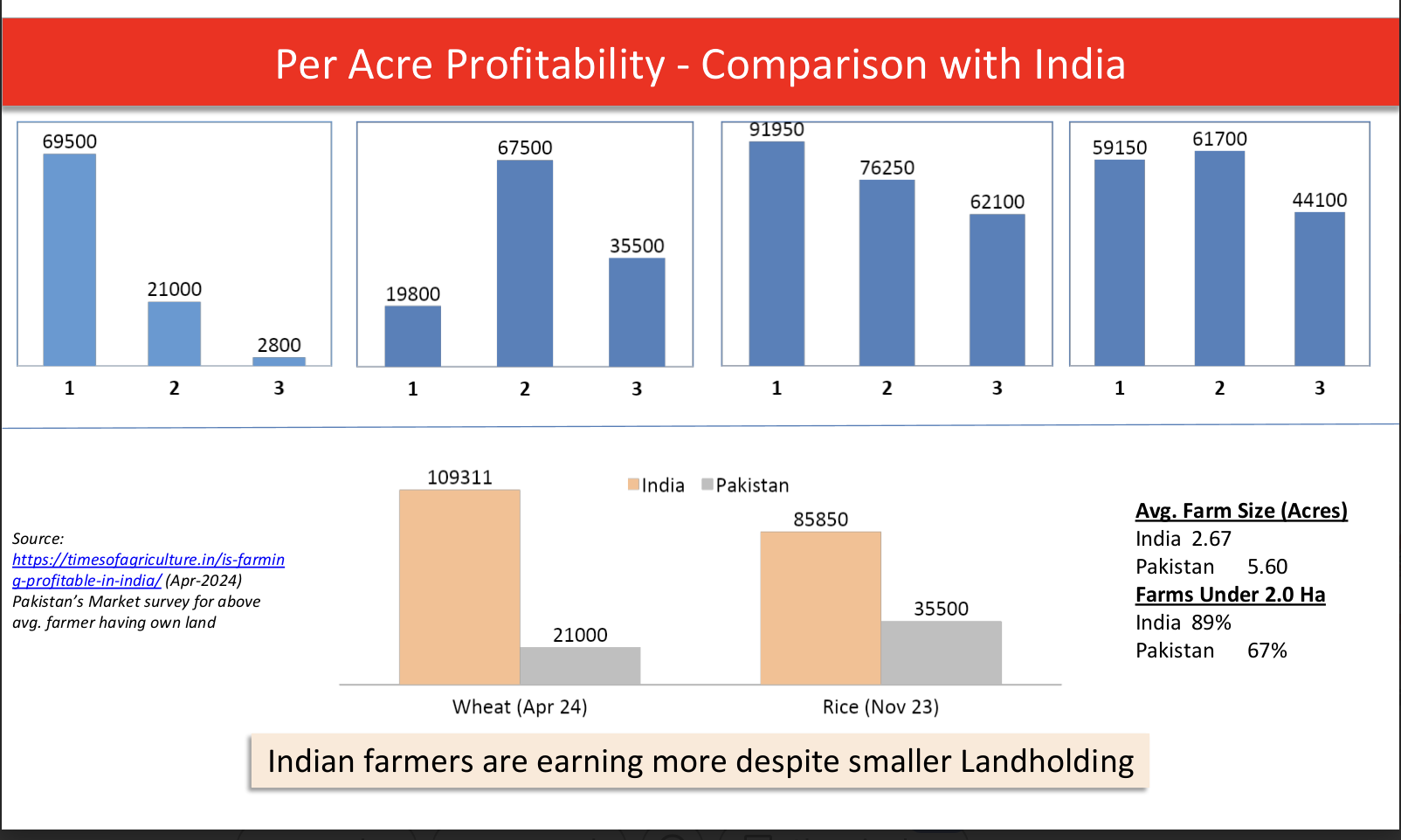
The Indian example is actually one that Mr Raheel Asghar believes Pakistan can learn from. “One of the most successful features of India's mechanization strategy has been the development of Custom Hiring Centres (CHCs). These centres function as farm machinery rental hubs, allowing farmers to hire tractors, harvesters, planters, seed drills and other equipment on an hourly or acreage basis rather than purchasing them outright,” he says. According to Millat’s CEO, India's national mechanization programs provide financial assistance for establishing such centres, while many states operate additional support schemes.
“Thousands of CHCs and Farm Machinery Banks now serve farming communities across India, particularly benefiting small and marginal farmers. The relevance of this model for Pakistan cannot be overstated. More than ownership, access is the key challenge facing small farmers. A network of professionally managed Custom Hiring Centres, operated through private entrepreneurs, cooperatives, farmer organizations and machinery dealers, would enable farmers to use modern equipment without assuming large debt burdens. Such a system would also improve machinery utilization rates and accelerate the diffusion of new technologies”
It is not hard to see the allure of something similar for Pakistan. The answer is not to hand out tractors every few years and call it reform. The answer is to build a machinery services market around small farmers. A properly designed hiring centre can keep tractors, planters, laser levellers, harvesters, sprayers, threshers, balers, loaders and transport equipment in one place. Farmers can book machinery by the hour or by the acre. Operators can be trained. Mechanics can be employed. Young people in rural areas can find work not only as labourers, but as machine operators, repair technicians, logistics workers and service providers.
These centres can also become investment opportunities. Local entrepreneurs, farmer groups, cooperatives, manufacturers and banks can all have a role. A village-level machinery hub does not only serve one farmer. It serves an entire cluster. It reduces the cost of timely sowing, brings down harvesting losses, improves transport from field to market, and creates a reason to build repair workshops, spare parts networks and fuel or charging infrastructure around it.
The next step is to connect these hiring centres with storage. If accredited warehouses and electronic warehouse receipt facilities are located close to machinery hubs, the farmer’s relationship with the market changes. Instead of selling immediately after harvest, when prices are often weakest and cash pressure is highest, he can store the crop, receive a warehouse receipt, and use that receipt to obtain bank financing. Pakistan already has an electronic warehouse receipt framework under which eligible commodities can be stored in accredited facilities and used as collateral for financing.
This is how mechanisation begins to change the entire ecosystem. The farmer gets timely access to machines. The village gets jobs and services. Banks get a cleaner asset to finance. Traders get better quality produce. Processors get more reliable supply. The state gets lower post-harvest losses and a more documented agricultural economy.
At the field level, then, the problem is not simply that Pakistan has too few tractors. It is that the small farmer has too little control over time, cost, credit, transport, storage and sale. Mechanisation will matter only when it gives him that control back.
Finding a way out
The starting point has to be a national farm mechanisation policy. Pakistan has run tractor schemes, subsidy programmes and credit windows at different times, but it has not treated mechanisation as a long-term pillar of food security. That is the gap the tractor industry is now trying to fill.
During our interview, Mr Raheel Asghar told Profit about a recent proposal by Millat Tractors for a National Tractor and Farm Mechanization Policy 2026-31 sets out the case in direct terms. The proposal begins by shining light on the fact that agriculture contributes 23.9% to GDP and employs more than 37% of the workforce, yet Pakistan’s mechanisation level remains low at around 0.9 horsepower per acre. It also points out that Pakistan has never had a national tractor and farm machinery policy to promote mechanisation.
The proposal’s targets are straightforward. It calls for annual tractor production and sales to reach 50,000 units in the short term and rise to 100,000 units by FY2031. It also aims to lift mechanisation from 0.9 to 1.2 horsepower per acre, while supporting employment, industrial growth, localisation and farm productivity.
Its policy instruments are also familiar but important. The proposal calls for a consistent sales tax rate, targeted federal subsidies, farm machinery financing schemes covering 35% to 50% of cost, and reduced financing markup at around one-third of KIBOR. For small farmers, it proposes farm machinery hiring centres and a Yellow Tractor Scheme for young entrepreneurs at reduced interest rates of 0% to 3%. For the local industry, it seeks duty-free import of farm machinery for local development, a 20% duty differential to discourage old imported machines, and preference for locally produced machinery.
There is a logic to this. Pakistan already has a domestic tractor industry with high localisation, vendors, workers and export potential. A national policy can use that base to expand mechanisation without turning the entire programme into an import bill. It can also create rural machinery services rather than simply adding more tractors to large farms.
But the policy will need to be wider than a tractor policy. Pakistan’s problem is not only land preparation. The real gaps are in precision sowing, harvesting, spraying, fodder management, post-harvest handling, storage and transport. Any national plan must therefore support the full chain of machinery that takes a crop from soil to market.
It must also be designed around the small farmer. Subsidies should not disappear into politically connected purchases. Hiring centres should be mapped by crop zones, monitored digitally and linked to trained operators, repair networks, warehouses and formal credit. The policy should also use consistent measurement, clear annual targets and climate criteria, so that machinery supports water saving, timely sowing and reduced losses.
This is where the food security question returns. Pakistan cannot keep importing its way out of weak productivity. Nor can it keep asking underpowered farms to feed a growing population. Mechanisation will not fix seed quality, water management or market distortions on its own. But without it, none of those reforms will travel far enough. If Pakistan wants more food, cheaper food and better rural incomes, its farms need horsepower. More importantly, they need a system that makes that horsepower available where it matters most.
Abdullah Niazi is senior editor at Profit. He can be reached at [email protected]
View all articles →1 Comment
No comments yet. Be the first to join the discussion!