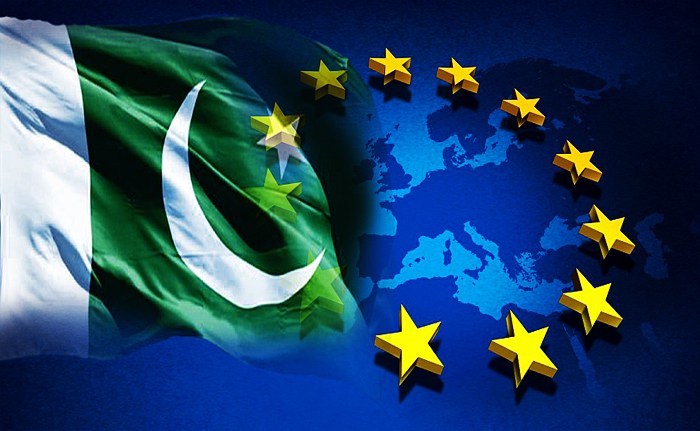
EU flags setbacks in Pakistan’s compliance with GSP+ obligations
Report says progress remained limited during 2023-2025 as concerns persisted over human rights, rule of law and freedom of expression


Pakistan has faced persistent compliance problems under the European Union’s GSP+ programme, with regression recorded in several areas and limited progress during the 2023-2025 monitoring period, according to a report released on Thursday.
The fifth report on the implementation of the EU’s Generalised Scheme of Preferences was jointly issued by the European Commission and the EU High Representative for Foreign Affairs and Security Policy. It assesses Pakistan’s implementation of 27 international conventions linked to continued GSP+ access.
Pakistan has benefited from the Special Incentive Arrangement for Sustainable Development and Good Governance since 2014 and remains its largest beneficiary. GSP+-eligible exports to the EU reached €7.5 billion in 2024, led mainly by textiles and clothing, while tariff exemptions were estimated at €732 million.
Pakistan’s exports to the EU have increased 91.45% since the country received GSP+ status in 2014, reflecting the scheme’s role in supporting export growth.
The report said EU imports worth €7.1 billion from Pakistan entered under GSP+ preferences in 2024, with a utilisation rate of 95.1%, indicating extensive use of duty-free access by Pakistani exporters.
However, the EU said trade gains had been accompanied by continuing economic fragility, climate vulnerability and negative political developments.
During the monitoring period, Pakistan made progress in some legislative and administrative areas, including steps to establish a National Commission for Minorities, reduce the scope of the death penalty and retain the de facto moratorium on executions.
The country also adopted implementing rules for the Anti-Torture Act and introduced a Domestic Violence Bill for Islamabad. The report described Pakistan’s first marital rape conviction as an important milestone.
It said the National Commission for Human Rights, together with the Ministries of Law and Justice and Human Rights, had emerged as a key institution in Pakistan’s efforts to meet its human rights obligations.
Progress on labour rights included the ratification of the International Labour Organisation’s 2014 Protocol to the Forced Labour Convention, 1930, and the expansion of monitoring mechanisms.
New action plans were also adopted to address child labour, although the report said child labour rates were declining only slowly and enforcement of labour protections remained weak.
It noted that most advances were legislative or administrative and had yet to produce sufficient improvements on the ground.
The EU raised concerns over the rule of law and the shrinking space available to civil society. It said enforced disappearances and extrajudicial killings had increased without accountability for those responsible.
Freedom of expression also deteriorated following amendments to cybercrime, anti-terrorism and blasphemy laws, according to the report. It said broadly defined provisions had been used against dissidents, human rights defenders, journalists, minorities and ordinary citizens.
The measures included criminal and administrative proceedings that could lead to imprisonment, asset confiscation or restrictions on foreign travel.
The report said recent constitutional amendments had been criticised for weakening judicial independence, compounding concerns over fair trials and access to justice. Forced labour also continued to affect a large number of people.
To retain GSP+ eligibility and comply with international commitments, particularly under revised GSP rules expected from 2027, the EU identified several priorities for future engagement.
These included ensuring accountability for human rights violations, intensifying efforts against torture, reforming prisons and capital punishment, and reversing negative trends involving enforced disappearances and freedom of expression.
The report also called for stronger action against violence targeting women, improved access to education for children, an end to child marriage and effective implementation of provincial and territorial plans to eliminate child labour.
Other priorities included enforcing laws against forced labour, curbing discrimination against minorities and strengthening the independence, impartiality and operational capacity of federal and provincial anti-corruption bodies.
Pakistan has maintained its ratification of all 27 conventions required under GSP+ and introduced no new reservations during the monitoring period.
Although the country was largely compliant with its reporting obligations to international monitoring bodies, the EU said Pakistan lacked an effective system to follow up on treaty bodies’ concluding observations and maintained limited engagement with United Nations Special Procedures.
The report placed Pakistan’s GSP+ performance within a broader political, security and economic context.
It said Pakistan’s complex federal structure, provincial imbalances and the military’s role in politics and the economy presented challenges to development. Rising domestic militancy, terrorism and tensions with neighbouring countries also added to security pressures.
Pakistan was involved in a brief but intense military conflict with India in May 2025. Relations with Afghanistan became highly tense from October 2025, resulting in the closure of the border, terrorist attacks originating from Afghan territory and Pakistani airstrikes inside Afghanistan.
The report said Pakistan’s political environment during the 2023-2025 monitoring cycle was marked by continuing complaints over the integrity of the 2024 electoral process, strict measures against opposition leaders and supporters, and a further increase in military influence.
Economically, Pakistan avoided a debt default in July 2023 after facing severe external payment pressures, depleted foreign exchange reserves, import restrictions, record inflation and negligible economic growth.
The World Bank estimated that 47.2% of Pakistan’s population lived in poverty in 2025. Floods in 2022 and 2025 also caused significant economic and social damage, while Pakistan ranked first on the Global Climate Risk Index 2024.
Despite these pressures, the EU remained Pakistan’s largest export market, accounting for 28% of the country’s total exports.
EU imports from Pakistan peaked at €9.4 billion in 2022 before falling to €7.9 billion in 2023 and recovering to €8.3 billion in 2024, reflecting broader weakness in European demand.
Textiles and clothing accounted for around 70% to 76% of Pakistan’s exports to the EU in 2024.
Around 90% of EU imports from Pakistan between 2022 and 2024 were eligible for GSP+ preferences. The average utilisation rate stood at 93% and recovered to 95% in 2024 after an unusual decline in 2023 caused by supply-chain disruptions and weaker demand for clothing and home textiles.
The €732 million in tariff savings generated through GSP+ in 2024 was equivalent to around 9% of Pakistan’s export value to the EU.
On the import side, the EU was Pakistan’s sixth-largest supplier, with goods worth €2.7 billion. China remained Pakistan’s largest supplier, accounting for imports of €14.7 billion in 2024.
Across the wider programme, the EU imported nearly €60 billion worth of goods under its GSP arrangements in 2024, up from around €52 billion in 2023.
The report said 65 developing countries currently benefit from the scheme, including 44 least developed countries covered by the Everything But Arms arrangement. Together, these countries represent more than three billion people, including over one billion living in least developed countries.
GSP beneficiary countries received an estimated €5 billion in tariff savings in 2024, of which more than €3 billion went to Everything But Arms beneficiaries.
The report also reviewed progress among other GSP+ countries. Kyrgyzstan, Uzbekistan, Sri Lanka and Pakistan strengthened legislation against domestic violence, while Bolivia, Mongolia, Uzbekistan and the Philippines introduced child-protection reforms.
Pakistan reduced the scope of the death penalty, adopted rules to implement the Anti-Torture Act and passed new Child Marriage Restraint Acts in Balochistan and Islamabad.
Several beneficiary countries also introduced environmental and governance reforms. Bolivia, Kyrgyzstan, Pakistan and Sri Lanka adopted updated anti-corruption policies.
However, economic crises in Bolivia and Sri Lanka and natural disasters in Pakistan, the Philippines and Sri Lanka weakened implementation capacity and intensified structural challenges.
The report also highlighted the Trade for Decent Work project, funded jointly by the European Union and Finland and implemented by the ILO during 2019-2021 and 2022-2024 with a budget of €6 million.
The initiative supported implementation of fundamental ILO conventions in Bangladesh, Cabo Verde, Madagascar, Mongolia, Mozambique, Pakistan and the Philippines under the EU’s GSP+ and Everything But Arms programmes.
Comments
No comments yet. Be the first to join the discussion!