February 23, 2026
Pakistan’s banks have agreed to give hefty discounts on loans to exporters. Here's why
The PBA announcement to give a 3 point reduction on loans to exporters has come only after the government decided to loosen the strings on CRR money that the SBP holds from commercial banks at zero percent interest

February 23, 2026
Two things can be true at the same time. The recent unanimous decision by Pakistan’s banking sector to charge a lower interest rate on the Export Finance Scheme (EFS) is an example of private business stepping up to bat for the national interest before their own bottom line. The decision, announced by the Pakistan Banking Association (PBA), is one that has been taken in the best interest of Pakistan’s economy.
And while this is all well and good, it is also worth looking into the prevailing conditions that have allowed the banking sector to make what cannot have been an easy decision to get unanimous agreement on. Part of the reason that the banks have willingly made this decision comes hot on the heels of the SBP reducing the required Cash Reserve Requirement (CRR) from 4% to 3%.
The CRR is essentially a percentage of a bank’s deposits that it is supposed to park with the central bank. Since cash is a non-earning asset for the banks, the idea is that the central bank must ask the banks to always have a minimal amount of cash required to honour withdrawals by depositors. And SBP holds this cash for the banks and gives zero percent interest on this money. However, over the years CRR has been turned into a monetary policy tool by the central bank. By reducing the percentage from 4% to 3% (which is the daily minimum — the average minimum is higher and has been reduced from 6% to 5%) the SBP is giving the banks a little more money that they can now lend and earn interest on it.
The equation is simple enough. The 1% reduction in the CRR freed up around Rs 300 billion in liquidity for the banking sector. They can then lend this money and earn over Rs 30 billion from it. The reduction in markups for the Export Refinance Facility also amounts to around Rs 30 billion.
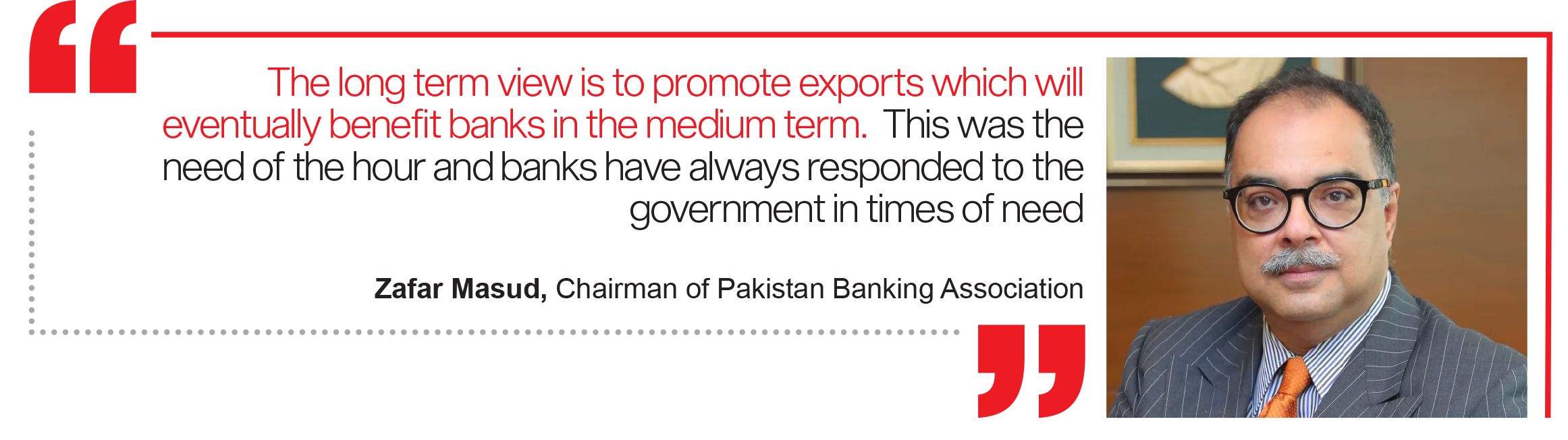
According to Zafar Masud, President of Bank of Punjab and Chairman of the PBA, the industry got the leeway due to favourable CRR adjustment. “We have been asking for this for a while as it was not helping market liquidity. The thought was that it would be a good idea to pass on to attract more profitable businesses and also reinforce ourselves as responsible and patriotic entities,” he told Profit.
The good-for-Pakistan reasoning
Essentially, the reduction in the CRR has opened up liquidity that can now be sent in the areas the economy needs it. This is being achieved through the Export Finance Scheme, which is a concessional financing scheme administered by the SBP.
Under the EFS, the SBP lends liquidity to exporters at a capped subsidised rate, through commercial banks, and the objective is to reduce financing costs for export-oriented businesses.
Say, for example, a textile exporter gets a confirmed export order (or LC/contract) from a foreign buyer and needs working capital to buy yarn, pay labor, and ship goods. The exporter goes to its bank and applies for financing under EFS, which is a short-term facility, and the financing tenor can go up to 180 days.
When approved, the bank will finance the exporter at the applicable EFS end-user rate. Normally this would be 3% below the policy rate (7.5% under current policy rate). The bank in turn gets refinance from SBP at the applicable refinance rate under the scheme, which is even lower, such that the banks could make between 1-2% spread, depending upon the type of exporter.
So the exporter gets cash upfront, uses it to fulfill the order, ships goods, and later when the export proceeds are realized, pays back within the time period. The bank then settles/refinance obligations with SBP on maturity. Much like any other loan, if the exporter’s cycle goes beyond 180 days, the bank can still finance the extra period, but from its own funds, not SBP refinance, and those penalties would be reflected in whatever conditions the bank offers to the exporter.
Earlier, banks were charging 3 points below the regular interest rates, which meant the markup was 7.5%. Now, banks will voluntarily charge 4.5 points below the policy rate, meaning exporters can avail financing at 6% markup under the EFS.
‘’The long term view is to promote exports which will eventually benefit banks in the medium term. This was the need of the hour and banks have always responded to the government in times of need starting from the PIA restructuring, to circular debt restructuring, to setting a level playing field for remittances, to agreeing to pay higher tax rates as a quid pro quo to get rid of the market distortive move of Advances-to-Deposits-Ratio tax,” explains Zaffar Masud.
According to him, the move will be beneficial for the banks in the long run because it will be beneficial to the economy. The idea is that if exporters have cheaper access to financing it will help them grow their business, and if exporters sell more Pakistani products abroad which will bring in foreign exchange and improve the balance of payments, which in turn will bring stability to the economy.
It is also an easy way to go about it because it doesn’t require huge mop-ups or liquidity adjustments by the state bank and it helps the economy, such that the cost is low and the benefit is high for the central bank. The SBP actively helps push the EFS and has more than Rs 440 billion in EFS outstanding, with a limit of over Rs 1 trillion (Over $3.5 billion).
Because when exporters borrow under EFS, they eventually generate dollar inflows. Those inflows pass through the banking system, creating additional business opportunities. Banks will earn fees on trade transactions, foreign exchange conversions, and related services. Exporters will also maintain operational accounts, which can become stable, low-cost deposits for banks in the future — another benefit.
“Inflows are profitable transactions as they help in offering better rates on imports and attaching current accounts,” explains Zaffar Masud.
The good-for-business angle
The banking sector, of course,has been trying to get rid of the CRR for some time. Before November 2021 it had been at 3% but was raised to 4% during Reza Baqir’s tenure as Governor of the SBP. It has needled at the sides of the sector since then.
Previously, the banks did not need to do much, during the high policy rate era. All they had to do to make record profits was to hold onto their funds and lend to the government. During this time, even the EFS was giving the end user an 18% interest rate, which is not good enough to be internationally competitive, especially with a falling domestic currency.
Since the monetary easing has kicked in, the banks have felt the need to do more. Falling profits and falling margins could have pushed them to branch out and explore but actually reducing their margins has only been made possible by the adjustment in the CRR.
As things stand, if the banks are to give an additional 3 points reduction on the EFS, and the EFS’ limit is Rs 1.05 trillion, the amount of money the banks will need, to subsidise their voluntary EFS is approximately Rs 30 billion — the same amount they will be able to earn upon the freeing up that 1% from the CRR.
When the State Bank lowered the CRR by 1%, it effectively unlocked billions in previously frozen cash. That money moved from “earning nothing” to becoming deployable capital.
And deployable capital, even at a modest lending rate, is infinitely better than sterile reserves. And, by the looks of it, instead of giving banks a free hand with that freed up money, the SBP made an arrangement with the PBA, to instead use that money for increased liquidity for exporters.
The situation, of course, has not been easy for the banks. The CRR was raised in 2021 and it has not been reduced; it has just been brought back to the old percentage. On top of that the banks are now voluntarily reducing the markup on EFS even if it is after easing in the CRR.
According to Zaffar Masud, more than anything else, the move aims to address the biggest national concerns that exist today. “The biggest national concern at the moment is the near-stagnant growth in exports coupled with an ever-widening trade deficit. In such a situation, banks, as key stakeholders in the economic ecosystem, must contribute their share by further reducing the Export Refinance Facility (ERF) rate,” he says.
“This step would certainly help leverage export growth and provide much-needed relief to exporters, enabling them to compete more effectively through improved margins. While this may impact banks’ profitability in the short term, taking such a hit on their P&L would serve the larger national interest by supporting economic stability and external account sustainability”
Questions that remain unanswered
Most of the reform policy in Pakistan is basically throwing wet paper towels till one of them sticks. This seems like another one of those attempts. While Banks are not acting outside their commercial logic. They are also aligning commercial incentives with macro policy objectives, a slope that is slippery to walk.
But what this episode really reveals is a temporary alignment between regulation, liquidity, and political need. The reduction in ERF pricing may still support exporters, and it may still serve a macroeconomic purpose, but it also exposes how much of Pakistan’s policy architecture depends on negotiated incentives rather than transparent, durable frameworks.
That is why the most important part of this story is not the announcement itself. It is the uncertainty sitting behind it.
How far are banks actually willing to compress margins? How long will the sector step in to do the state’s job? How long can preferential pricing continue? What happens if fiscal pressures intensify again? Those are not side questions. They are the central questions, and for now, they remain unanswered.
ERF, in that sense, is best understood as a lever, not a cure. It can create breathing room. It can shift incentives at the margin. It can even help buy time for exporters. But whether that time is used to push real industrial reform is a separate question entirely.
1 Comment
No comments yet. Be the first to join the discussion!