Pax Sinica or Judaica?
Is the USA out of the Gulf?
AT PENPOINT
One of the consequences of the US attack on Iran has been handwringing within the media about the end of the American Empire. This does not yet appear to have seeped into Academia, but Academia figures have started appearing in the media expressing this view.
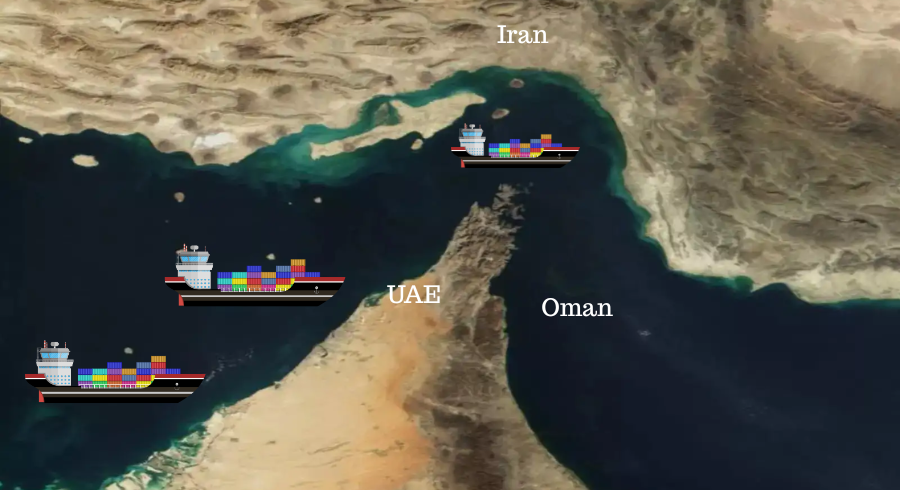
A larger number sees the USA as losing out to China. This seems mainly because China has a very big stake in the conflict, as it receives the largest portion of its oil imports from the Straits of Hormuz. Though Chinese oil production is not insignificant, it can only meet about a quarter of its consumption. While oil exporters like the USA or Russia are mainly hurt by the Hormuz Strait closure because that drives up fuel costs for its domestic consumers, China faces the strangulation of its industry. Already hit by Trump’s tariffs in its largest market, already hurt by the overall economic slowdown, China is peculiarly vulnerable to Hormuz closure.
This might explain why there are some scholars who seem reluctant to predict that China will emerge as the successor to the USA. They have an extremely different choice, but there is some logic behind it, and they think that Israel is expanding its regional position, and is aspiring to replace the USA in the region as the hegemon.
The analysis about China is fairly obvious. First, there is a Sino-US tension which makes it likely that China would like to replace the USA as world hegemon. One role has been keeping the world’s oil supply secure, a role first performed by the UK, then by the USA. However, the world seems to be experiencing a change which will leave oil behind, and make magnets and the rare-earths that power them as crucial as oil used to be, and still is. China has established such a stranglehold on them that it has successfully used them to force the USA to dial down its tariffs recently, by threatening to put restrictions on them.
Second, China has been on the side of Iran in this confrontation. While it has not contributed any forces, its help has been useful. Also, it wants Taiwan. Taiwan is a former Chinese possession, and is only separate because of US help, even though it has developed and capable armed forces. It is a leader in the manufacture of computer chips, and thus is of a value to China if it falls into its hands intact, or at least with minimal damage. This would enable China to develop a monopoly over Artificial Intelligence, which means control over the technology that is expected to act as the central pillar of the world’s future growth.
China’s wide interests seem to be positioning it for the role of the adult in the room, the power that plays the role of peacemaker and peacekeeper. The USA has been playing this role, the best example being the 1962 Indo-Chinese War. When the Indian military position collapsed, and China seemed poised to take the war into Indian territory, Indian PM Jawaharlal Nehru made an appeal to US President John F. Kennedy, who conveyed to China his support of India.
Now it is China’s turn to take its place in the limelight, and though India would have liked to, it is irrelevant to the whole scenario, except peripherally as one of the countries depending on oil from the Hormuz Strait. If any other country has been mentioned as a successor to the USA, it has been Israel.
At first, that might seem counter-intuitive. The USA is vast, Israel is not. However, Israel has been the loyal US mercenary, and there are a number of precedents where mercenaries have taken over themselves. There are two developments which indicate that Israel is positioning itself for a bigger role in the Middle East than it has.
First, it seems engaged in its first territorial expansion since 1967, when it took over the West Bank from Jordan and the Gaza Strip from Egypt, thus taking the rest of the old British mandate of Palestine, which it had missed in1948. Its latest incursion into Lebanon, under the cover of suppressing Iranian proxy Hezbollah, during the war with Iran, represents its first bid for territorial expansion since 1967.
The Golan Heights were occupied from Syria in 1967, and annexed in 1981. That annexation has been recognized only by the USA, and that in 2019, by the Trump Administration, which moved the US embassy to Jerusalem. There are now 25,000 Jewish settlers in the Golan Heights. They now outnumber the 20,000 Druze who still live there.
Syria and Lebanon were under French occupation after World War I, Palestine under the British. Israel is now trying to create more defensible boundaries for itself by occupying lands and ultimately annexing them. But there is the map of the ‘Greater Israel’ which includes large patches of Egypt and reaches into Saudi Arabia, down to Madina. This is much more ambitious than the more recent ‘Greater Israel’, which is supposed to cover only the Biblical Kingdoms of Judah and Samaria, as it includes both the lands of the Egyptian captivity (Egypt) and the Jews of Yathrib.
Apart from the search for secure boundaries, Israel has the expansionist attitude of all colonialists, and is thus naturally inclined to expanding its territory. But apart from its desire to expand territorially, it also needs to make itself important to the region, and that is through the Hormuz Strait. The strait itself could fall into its greatest extent possibly, but that would be so far into the future that it is of no immediate use, or even medium-term use. More to the point, a pipeline could be built transporting oil from the Gulf to the Israeli coast, from where it could go all over Europe, and even to the Far East, though the Suez Canal.
Israel has already laid the groundwork, with its treaties with Egypt and Jordan allowing it Suez Canal passage and possible access for a pipeline. Getting the UAE and Bahrain into the Abraham Accords also brings potential pipeline users into the plan. If only Saudi Arabia would join the Abraham Accords, with the other Gulf Cooperation Council members following suit, the producers presently depending on the Hormuz Strait would also be lined up.
The Abraham Accords is also a framework in which Israel will assume the role of a guarantor of the flow of oil, at least for the Middle East (who will act as guarantor in the Indian and Pacific Oceans?). At the moment, the Arab monarchies are seeking security guarantees, now that the US guarantees, which replaced the British after World War II, have become shaky.
They have not disappeared, but the US ability to enforce its will is no longer as certain as it was. The handover by the British to the USA provides a template that might be used now. It hinges on regime stability. The oil sheikhdoms are, like Iran, interested in regime survival. The dynasties ruling them do not want a scenario resembling World War I, where crowns tumbled all around Europe, including the Ottoman Caliph. If Israel can keep the dynasties going, then the Abraham Accords are the path to be chosen.
It is interesting that there are doubts cast about the legitimacy of the Iranian regime the USA is trying to overthrow, and none of those of the Gulf regimes it is trying to defend. Oil is on its way out, and though there are innumerable teething troubles, renewables seem the most likely option for the world. Oil is a finite resource, but it is likely that before the last drop is burnt, the planet would have polluted itself to death.
It is possible that what the world is seeing is not just the last gasp of the American Empire, but also some of the death throes of the oil era.

Comments
No comments yet. Be the first to join the discussion!