Development spending stays stagnant at Rs 1 trillion
Pakistan’s PSDP allocation has remained at the Rs 1 trillion mark for the last 3 years, but the real story is in the details

Pakistan’s development budget seems to have stagnated at the 1 trillion mark for the last few years. The same allocation was repeated this year in the federal budget compared to the revised expenditure of 820.5 billion from the previous year. It is important to remember that the initial allocation for the last year was also at Rs 1 trillion.
The total development outlay stood at Rs 3.675 trillion, down from last year’s Rs 4.1 trillion. This is owed to a major drop in the provincial development budget from Rs 2.9 trillion to Rs 2.2 trillion.
This is now a concurrent trend in which the government continues to keep PSDP lower down on its priority list in the budget. While a country always needs to repay debts and run the civil government, it is often the development expenditure that is credited with increasing a country’s output in terms of productivity, be it health, education, vocational training or the construction/ facilitation of facilities that make progress possible.
Following is a breakdown of this year’s PSDP and the things that it is being spent on.
What is this year’s PSDP being spent on?
One thing becomes immediately clear from the Public Sector Development Programme in the budget for the coming year: the government’s development priorities remain anchored in transport infrastructure. Even a cursory reading reveals hundreds of road-building, rehabilitation and connectivity projects scattered across the document.
The clearest indication is the Rs224 billion allocated directly to the National Highway Authority, equivalent to almost a quarter of the entire federal PSDP. But this does not capture the full scale of road-related spending.
A majority of the Rs16 billion allocated to Housing and Works will also finance critical road-improvement projects. A substantial proportion of the federal PSDP share assigned to provinces has similarly been directed towards roads and connectivity, while several schemes classified under other ministries are, in practice, aimed at expanding the same infrastructure network.
Outside the allocations for provinces and special areas, the largest spending head belongs to the Water Resources Division, whose allocation has risen from Rs101.6 billion to Rs103 billion, an increase of almost 17%. Much of this money will carry forward projects already under construction. The most significant among them is the Dasu Hydropower Project, which has received Rs15 billion. Other major allocations include Rs22 billion for the Mohmand Dam, Rs10 billion for the Diamer-Bhasha Dam and Rs10 billion for the Greater Karachi Bulk Water Supply Scheme.
The next-largest share, after provinces and water resources, has gone to the Cabinet Division. Its allocation stands at Rs64.08 billion, of which Rs63 billion will be distributed among members of the National Assembly under the Sustainable Development Goals Achievement Programme (SAP) for schemes in their respective constituencies. The fund has repeatedly attracted criticism over its discretionary character and the suspicion that development money is being channelled according to political calculations rather than a coherent strategy.
In a departure from the restraint seen in previous years, the Higher Education Commission has also received a significantly larger allocation this year. Its development funding has risen to Rs46 billion from Rs34.9 billion last year. Among the largest projects are the PhD Scholarship Programme under the Pak-US Knowledge Corridor, allocated Rs1.5 billion, and hostel construction at the University of Engineering and Technology Lahore, allocated Rs1 trillion. Other schemes include scholarships for students from the former Federally Administered Tribal Areas (FATA) and Balochistan, alongside a range of university expansion projects. Taken together, the allocation appears more evenly distributed across access, infrastructure and advanced study.
The Federal Education and Professional Training Division has also received an increase, with its allocation rising from Rs26.6 billion to Rs36.3 billion. This head includes programmes such as the Prime Minister’s Youth Skill Development Programme and the Prime Minister’s Pakistan Fund for Education.
Railways has emerged as one of the budget’s most visible gainers. Its development allocation has increased by more than 120%, rising from Rs18.5 billion to Rs40.6 billion. The increase gives rail development a larger place in a PSDP, mainly targeting the coal rail connectivity from Port Qasim, maintenance of existing tracks and procurement of newer high-capacity bogie wagons.
The National Food Security and Research Division has also secured a considerable increase, with its allocation rising from Rs1.6 billion to Rs4.2 billion. The allocation for National Health Services has increased more modestly, from Rs13 billion to Rs16 billion.
Among the smaller ministerial and divisional allocations, the Special Investment Facilitation Council has also notably received Rs479 million under the PSDP. The detailed budget documents place the entire amount under a single head titled “Invest Pakistan”.
Not every institution benefited. SUPARCO, the Revenue Division and the Petroleum Division were among the few PSDP heads to receive lower allocations than in the previous year.
The most notable gainers, meanwhile, include Railways, the Ministry of Religious Affairs and Interfaith Harmony, and the Kashmir Affairs Division. Together, these allocations reveal the political and economic hierarchy embedded in the development programme.
Roads remain dominant, water projects continue to absorb large sums, constituency-based schemes retain their place, and several social and institutional sectors are left to compete for what remains.
The three stages of Pakistan’s development expenditure:
While the allocated value is a real metric to gauge commitment to development, it is often not the full picture of what is going to be spent on the people in Pakistan.
Previous years show us that there is almost always 3 levels of Pakistan’s PSDP. First comes the amount that the govt allocates in the budget, this is what the aforementioned is all about.
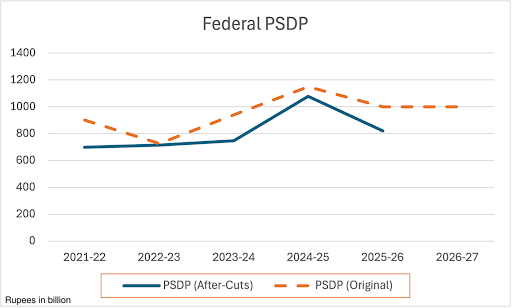
Second happens when the IMF asks the govt to trim it down, this usually happens after the budget speech or in the first two reviews of the IMF after the budget. A prime example of this was in 2024-25 when the government reduced its own PSDP before passing the budget from Rs 1.4 trillion to Rs 1.1 trillion.
Finally comes the figure that the government ends up spending and is represented in the summary. Historical reports have suggested that even that expenditure is often flowing over into the next year but at least that is the PSDP that we can claim, saw the light of day.
Even in the last financial year, the revised PSDP of 820.5 billion was considerably less than the allocated PSDP of Rs 1 trillion.
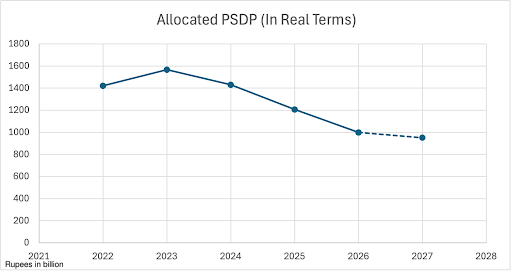
The real value of PSDP
While the PSDP allocation, year on year, contrary to other budget items is not steadily upwards. It is also not unclear. The earlier graph indicates that our PSDP spend is circumstantial and shows no possible trend.
However, expenditure is always mapped based on inflation. That is the reason why the budget always increases and the major heads’ nominal values shows an upward trajectory. However, another picture is presented when we map the PSDP like that. The government’s commitment to progress through the PSDP can be noted through looking at the real value of the PSDP, i.e; the value adjusted for inflation.
Comments
No comments yet. Be the first to join the discussion!