Pakistan’s next tech export could be digital independence

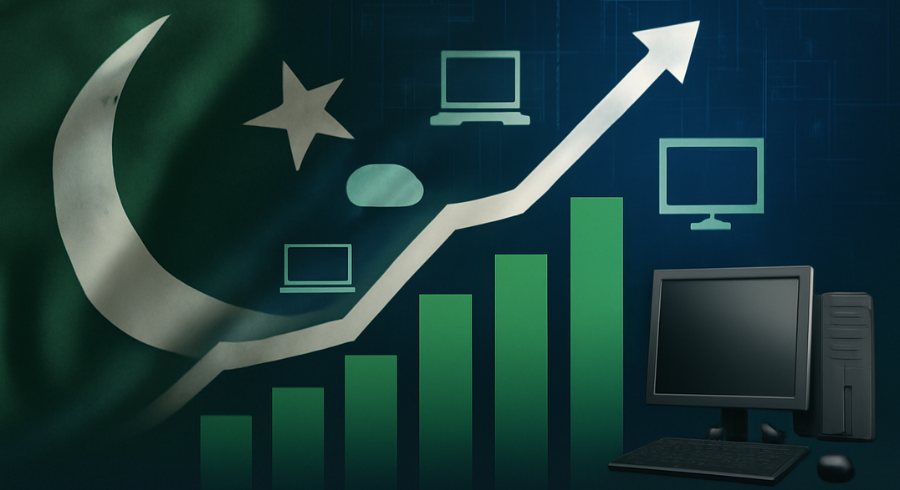
Pakistan’s IT and IT-enabled services exports have reached US$4.6 billion, up from US$3.8 billion last year, with the sector posting a trade surplus of roughly 86 percent of export receipts. That is a real achievement, and proof that Pakistani technology companies and professionals can compete globally. But it also makes the next disruption more urgent. As analyst Adil Husain recently noted, AI is sharply reducing the cost of routine software work. For countries like Pakistan, whose technology exports still depend heavily on selling skilled labor and coding capacity into foreign markets, the old labor-arbitrage model cannot be taken for granted.
Fortunately, the same technological shift offers an alternative: Pakistan can use AI to build locally controlled digital infrastructure, reduce dependence on expensive foreign software licenses, and create a potentially lucrative new export capability.
At the heart of this opportunity is a fundamental shift in who owns the technology we use. For decades, governments and businesses have relied on expensive, foreign-owned proprietary software. Think of proprietary technology like paying endless rent on a fully furnished mansion where you are not allowed to change the locks. Today, however, "open-source" software and freely available AI models, which are catching up to expensive commercial models at an astonishing pace, provide the public architectural blueprints to build your own digital mansion. In the past, taking these free blueprints and building a system that could rival commercial giants took years of expensive human labor. Now, AI changes the math. AI acts as a fast, low-cost construction crew that already has those blueprints memorized. This construction crew still needs human supervision and reliable infrastructure for completion of work. So open-source software is not free in the sense of requiring no money or expertise; it is free in the more strategic sense that there is no foreign license-holder controlling its use. And crucially, the same is true of the construction crew itself: extremely capable AI models can now be downloaded and run on servers you own and control, which means you can not only own the mansion, your construction crew stays on your premises.
Take the example of two recent Chinese models. Z.ai's GLM 5.2 now rivals leading OpenAI and Anthropic models on several coding and long-context benchmarks. And just this month, Moonshot AI's Kimi K3 has drawn serious attention: in independent blind testing by Arena, developers preferred it over every leading American model for front-end coding. Moonshot says its weights will be released by July 27. This is part of a broader pattern: independent trackers now put the open-weight lag behind frontier models at a matter of months.
Similarly, Postgres, a powerful database system that has been around since 1996, is now a credible alternative to databases such as Oracle - the best-known commercial database in the world. The real story is not merely that these tools are powerful. It is that GLM, and potentially Kimi once its weights are released, are open-weight models, while Postgres is an open-source database. These are among thousands of tools and technologies that can be deployed without recurring proprietary license fees, provided an organization has the infrastructure and expertise to run them.
Combining open-source and AI has some real advantages. AI tends to perform better where code, documentation and usage examples are public. Open-source systems therefore have a practical advantage over opaque proprietary systems: there is simply more public material from which both humans and models can learn. As a result, when you ask AI agents to work with an open system like Postgres, they already have a deeper understanding of how it works. For a large class of routine migrations, tasks that once consumed years of manual implementation can now be compressed into months with AI agents. But the governance and judgment wrapped around it do not automate so easily: deciding what to migrate, verifying the result is correct, and owning the outcome when it breaks. That irreducibly human layer is exactly where the durable, exportable expertise lies.
This kind of AI-driven acceleration is already documented at scale. Back in 2024, using models far less capable than today's, the e-commerce giant Amazon turned its own AI agents loose on 30,000 internal applications, modernizing their code in what it estimates would otherwise have taken more than 4,500 years of developer work, and now saves it roughly $260 million a year.
Pakistan’s resource constraints can become an advantage if they push us towards lower-cost, locally controlled technology instead of expensive proprietary systems. If we develop the capability to use AI to migrate from proprietary platforms to locally owned and operated open systems, Pakistan could become a credible model for other countries pursuing digital sovereignty. It would also reduce our own technology import bill. More importantly, the expertise built through these migrations could itself become an exportable service for governments and organizations seeking greater control and lower costs.
The number of such governments and enterprises has rapidly gone up in the past couple of years for a few reasons. First, strained diplomatic relationships between the EU and the USA have made European and other countries realize their risky dependence on proprietary American technology. Across Europe, policymakers are increasingly discussing digital sovereignty because public institutions depend heavily on a small number of foreign cloud, software and AI providers. Second, proprietary technology poses the additional risk of being weaponized in geopolitical conflicts. Reports that OpenAI has discussed giving the US government a stake show how closely frontier AI may become entangled with state power. For countries dependent on foreign AI infrastructure, that is a strategic risk. MIT's Christian Catalini has made a similar argument, describing open-weight models as soft-power infrastructure, the dollar and SWIFT of intelligence, and warning that concentrated control over frontier AI strengthens incumbents at the expense of broader innovation.
The opportunity is viable but there are a few critical challenges. First, software and AI are much higher layers in the digital value-chain. The foundational layer is the energy needed to feed the compute-hungry data centers. Pakistan’s problem is not merely megawatts on paper. Data centers need reliable, affordable and preferably clean power delivered continuously where the infrastructure sits. Second, data centers require enterprise-grade hardware which is expensive and in limited supply even if it could be afforded. Third, open software and AI still require governance which mandates real technical skills, talent and experience.
There are silver linings on all fronts.
Pakistan is now one of the fastest adopters of solar power around the world. We can connect this growth to reliable data center power through storage, grid upgrades, long-term power contracts and efficient cooling.
The hardware challenge is harder to resolve. Still, the cost of training AI is high but the cost of using it (called inference in technical terms) is rapidly going down. We don't need the multi-billion-dollar supercomputers required to build AI; we only need affordable, accessible servers that can run it. And with Chinese hardware providers offering cheaper alternatives, the barrier to entry is getting lower. Established operators in Pakistan are already eyeing this opportunity. We have seen significant recent growth in new, potentially green data centers in Pakistan, including Data Vault Pakistan’s AI-focused data center in Karachi, Gul Ahmed’s planned Tier III data center, Indus Cloud’s partnership with Huawei, and Sky47's data center. These are encouraging trends and need to pick up momentum.
It is fair to ask whether this simply trades dependence on American technology for dependence on Chinese technology. This does not eliminate dependence on Chinese technology; it changes its character. Hardware dependence remains real through firmware, spare parts, drivers, maintenance, replacement cycles and security risks. But it is different from continuous dependence on a foreign cloud service or software license. The policy question is not how to achieve perfect independence but how to reduce the number of foreign actors with continuous operational control over critical systems.
The talent question puts Pakistan at a real advantage. While we may not have the abundance of deep computer science skills or digital infrastructure for creating indigenous AI, we do have a large base of trainable software talent. The required capability is not mere prompting or short-course certification. It is a practical engineering discipline: database migration, server administration, cloud operations, cybersecurity, model deployment, testing and public-sector accountability.
The government's role is not to build everything itself. It is to create the conditions and the demand: become the anchor buyer for locally operated sovereign systems, set open standards in procurement, require security audits and data-governance rules, and fund migration pilots in departments willing to measure what actually matters, namely cost, reliability and local capability. The first projects should be deliberately unglamorous. A provincial government, a public university or a state-owned enterprise could start with non-sensitive workloads: document management, internal dashboards, archival databases, procurement portals, school information systems. The aim is not symbolic sovereignty. It is measurable savings, working local competence, and a migration playbook that can be repeated a hundred times.
In parallel, the state must clear the path: accelerate clean energy for indigenous data centers, ease the hardware imports they require, and train young people in open-source software, open-weight AI, cybersecurity and infrastructure operations. None of this can wait, because the capability itself will not stay scarce for long. Whoever masters this transition early will be selling it to everyone else. Pakistan has paid rent on other people's technology for decades. For the first time, the blueprints are public, the construction crew is affordable, and the lease is ours to break.

Comments
No comments yet. Be the first to join the discussion!