Millat Tractors makes a big bet on Pakistan and beyond
The historic tractor manufacturer will become the first automotive company in Pakistan’s history to export its own brand to other countries. But even as they look towards expanding their horizons, challenges persist at home. Can a National Tractory Policy help address them?

Sometime in the not-so-distant future, tractors assembled under the brand name “Millat” will be shipped from Pakistan to farms in Africa. Millat Tractors, the historic tractor maker that manufactures and sells Massey Ferguson tractors in Pakistan, reached an agreement with Massey Ferguson Corp (MFC) in December last year to sell their tractors abroad under their own “Millat” branding.
With this agreement, Millat will become the first Pakistani automotive company to export their own product to any part of the world. The feat is more impressive considering that unlike the rest of the automobile industry in Pakistan, tractor manufacturing has achieved near complete localisation rates.
Pakistan makes its own engines and transmission systems for tractors as well as all the easier parts, and overall tractor localisation stands at around 94%. Millat has actively been exporting tractors since 2015. Their main market has been Africa, but they have recently also sealed a deal to export tractors to Mexico. Over time the share of exports in Millat’s overall revenue has been rising. From 6% in FY2019-20, it has risen steadily with a few dips in between. In 2023-24 they marked a milestone of 2500 tractors exported in a year, and exports accounted for 10.2% of revenue in 2024-25, and in the first half of 2025-26 exports are already making up 14.1% of Millat’s total revenues.
The increasing importance of exports in Millat’s bottomline is natural. As the largest player in Pakistan’s tractor industry (the second biggest player is Al Ghazi), Millat commands more than 60% of the overall market share. This pecking order has been long established in Pakistan, but a close look at tractor production and sales in Pakistan will show you that erratic policies, inconsistent tax regimes, and pressures on agriculture have left Millat and other tractor manufacturers with a market that is not growing at the pace they would like.
Last year, for example, Millat produced 18,637 tractors. Their overall capacity is from 30,000-40,000 tractors when operating on a double shift. The year before that production was 30,479. Before that it stood at 19,022. The pattern is quite obvious. Since 2007 the company has seen a seesaw between single and double shifts. Production rises and falls erratically. Take a peak behind the curtain and it becomes obvious that any time the government makes changes to the sales tax, floods hit the country, crop losses increase, or inflation increases or decreases there are serious fluctuations in demand and subsequently in production.
The uncertainty is an unfortunate situation for an industry that holds a unique position in Pakistan. Not only is the tractor industry vastly localised, it is also vital to agricultural growth — perhaps the most important sector in Pakistan’s economy which has been shrinking and changing in recent years under the pressures of climate change. Despite the availability of locally manufactured tractors, Pakistan’s farm mechanisation rate is well below what it should be, particularly for an agrarian economy. Add to that shrinking farm sizes and you have a scenario where the business environment is stifling. While the tractor industry has localised almost entirely, they still do not produce many other associated products like harvesters and hundred horsepower tractors.
This explains why there is an increasing shift towards exports. Pakistan produces, according to the industry, the cheapest tractors in the world on a dollars per horsepower basis. And while exports are an increasingly lucrative part of business, industry leaders are clear on the need to increase the number of tractors out in Pakistan’s agricultural fields. To this end, the industry has been advocating for a National Tractor Policy. In the past few months they have gotten some success as well, with the Engineering Development Board drafting a policy that will be part of the upcoming budget in June. The policy as imagined by the industry creates financing incentives for tractors, gives local manufacturers tax breaks compared to foreign brands, and sets up hiring centres all over the country.
It is an ambitious plan and the first of its kind for the industry. It is also very long overdue. But just how far can it go?
The localisation dream
“Millat tractors is a huge Pakistani success story,” says Raheel Asghar, the incumbent CEO of Millat Tractors. “It started as a private company, it was nationalised, and when it was privatised again it became a shining example of what a management buyout can do. To this day Millat is an example of how this can work.”
The history he is referring to is indeed quite impressive. The foundation of Pakistan’s tractor industry was laid in Karachi in 1964 with the incorporation of Rana Tractors and Equipment Limited. Back in the day, this was a hot new company on Pakistan’s corporate landscape. Founded by Rana Khudad Khan, a Muslim League Member of Parliament from Sargodha, the new company was listed on the stock exchange in 1965. It began importing completely built units (CBU) of Massey Ferguson tractors into Pakistan, but only to start off. The company was already assembling semi knocked down (SKD) tractors themselves by 1967.
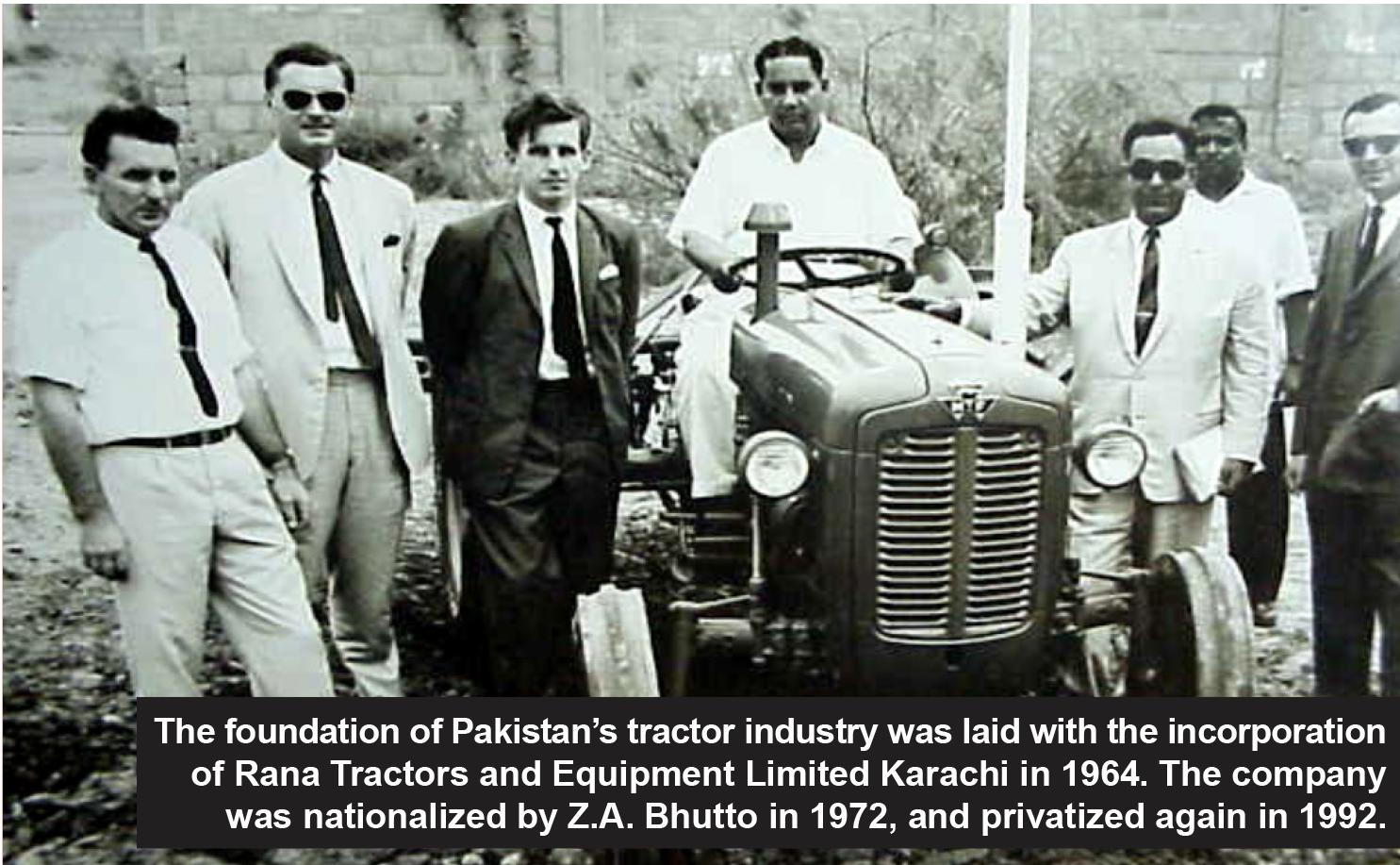
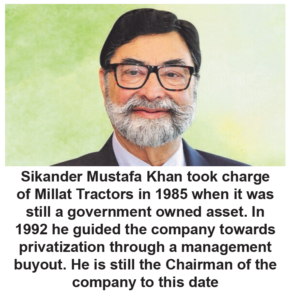
Then came the Bhutto Administration. Along with a slew of other businesses, corporations, and institutions Rana Tractors was also nationalised and incorporated into the Pakistan Tractor Corporation. Under this new body, the main goal was increasing localisation. The establishment of an Engine Assembly Plant in 1982 and a Machining Plant in 1984 paved the way for this localisation. In 1985, Sikander Mustafa Khan was appointed Managing Director of the company. A mechanical engineer by profession, he had a Masters Degree in Production Engineering from Imperial College. By all accounts he was the exact opposite of what public sector CEOs usually are: educated, very specifically qualified for the job, and up to the task. During his tenure Millat Tractors consolidated localisation. The idea was simple: the cheaper domestic tractors Pakistan could produce the more they would sell in a country where farm mechanisation is low but agriculture is the main economic activity.
In 1975, around the time the company was nationalised, the overall number of tractors in Pakistan was 35,700. By 1985, when Sikander Mustafa Khan took charge, this had gone up to 1.57 lakh tractors. And by 1992 this number had risen to around 2.5 lakh tractors all over Pakistan. This was a time of growth, and much of this growth was pushed by localisation.
In 1992 the first Nawaz Sharif administration began the process to right the wrongs of nationalisation. One of the companies up for privatisation was Millat Tractors. What made this privatisation particularly special was that the company was bought out by the management. Sikander Mustafa Khan is still the Chairman of Millat Tractors to this day.
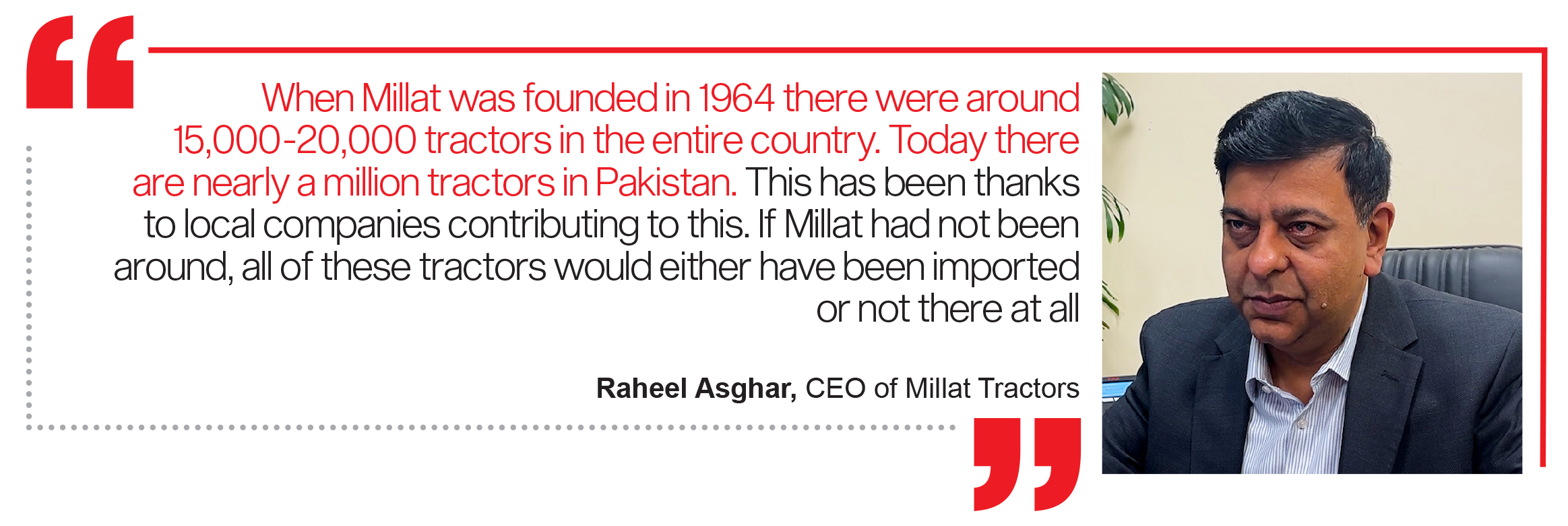
“When Millat was founded in 1964 there were around 15,000-20,000 tractors in the entire country,” says the company’s CEO Raheel Asghar. An engineer by profession with a Masters degree from Cambridge, he spent more than a decade at Honda in the United Kingdom, before coming to Pakistan and working for Toyota Indus Motors. He was CEO of Al Ghazi Tractors for a couple of years and became CEO of Millat in 2023. Unlike in other industries, despite being direct competitors the tractor industry’s interests are largely common. A complete lack of any cohesive policy has meant there is little time for competition. “Today there are nearly a million tractors in Pakistan. This has been thanks to local companies contributing to this. If Millat had not been around, all of these tractors would either have been imported or not there at all,” he adds.
The growth has been the result of a single-minded focus on localisation. The first year after the management buyout, Millat bought out Bolan Casting, which manufactures grey and ductile iron castings for tractors and buses. The company’s direction was clear from here: diversify into different parts of tractor manufacturing and become an integrated entity with end to end production capabilities. The company established Millat Equipment and Millat Industrial Products, and by 2011 hit record tractor production of more than 40,000 units in a single year. This was the late peak of a boom period that started in 2001 and ended around 2008. “In this time Pakistan’s tractor population per hectare was on par with India. But after 2008 the government’s policies were rapidly changing. There was no consistency, and that is when you start to see fluctuating demand,” explains Raheel Asghar.
The field changes
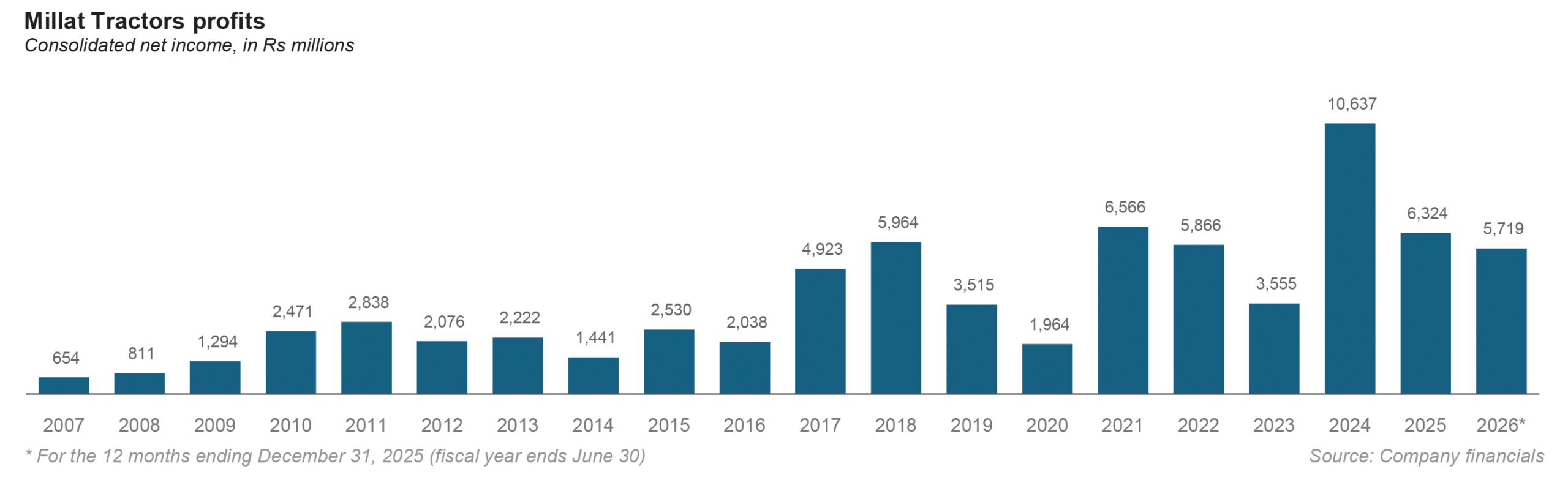
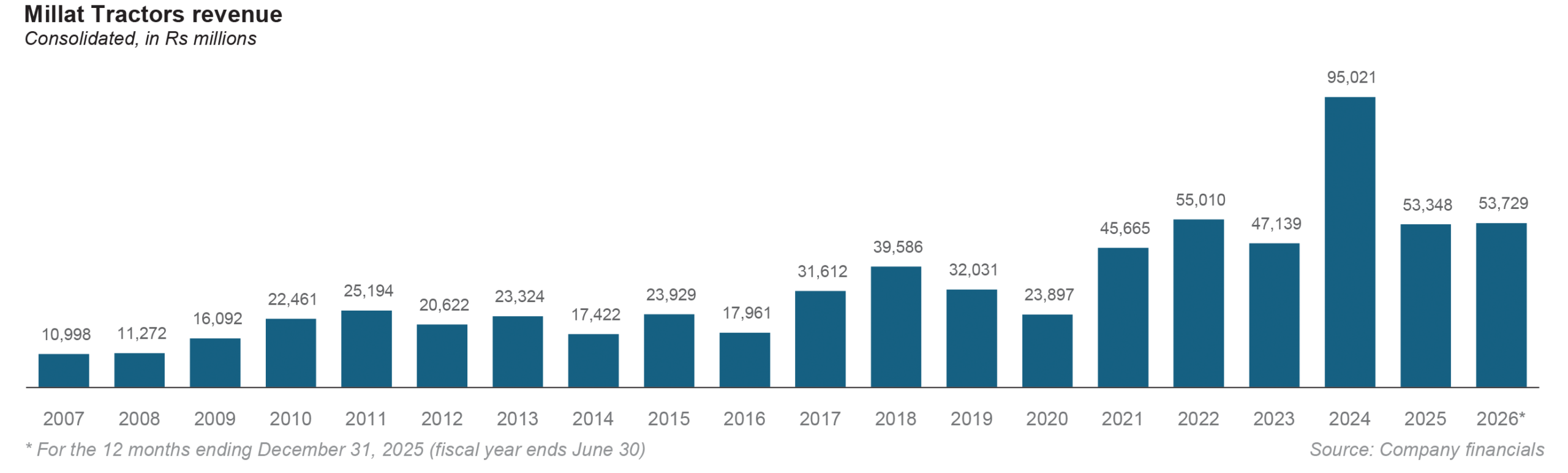
Take a look at Millat Tractors headline numbers over the past 20 years and it is clear that this is a company that makes money. It has consistently been profitable, with a consolidated net income of Rs 65.4 crores in 2007, and peaks of Rs 10.6 billion in 2024. Last year the company’s profit stood at Rs 6.32 billion.
What does become immediately apparent, however, is the fluctuation Raheel Asghar was talking about. Since 2007 there have been seven years where Millat’s revenues and profits have fallen rather than risen from the previous year. And the falls have not always been small. Compare just the last two years: profits fell by more than 40% year on year.
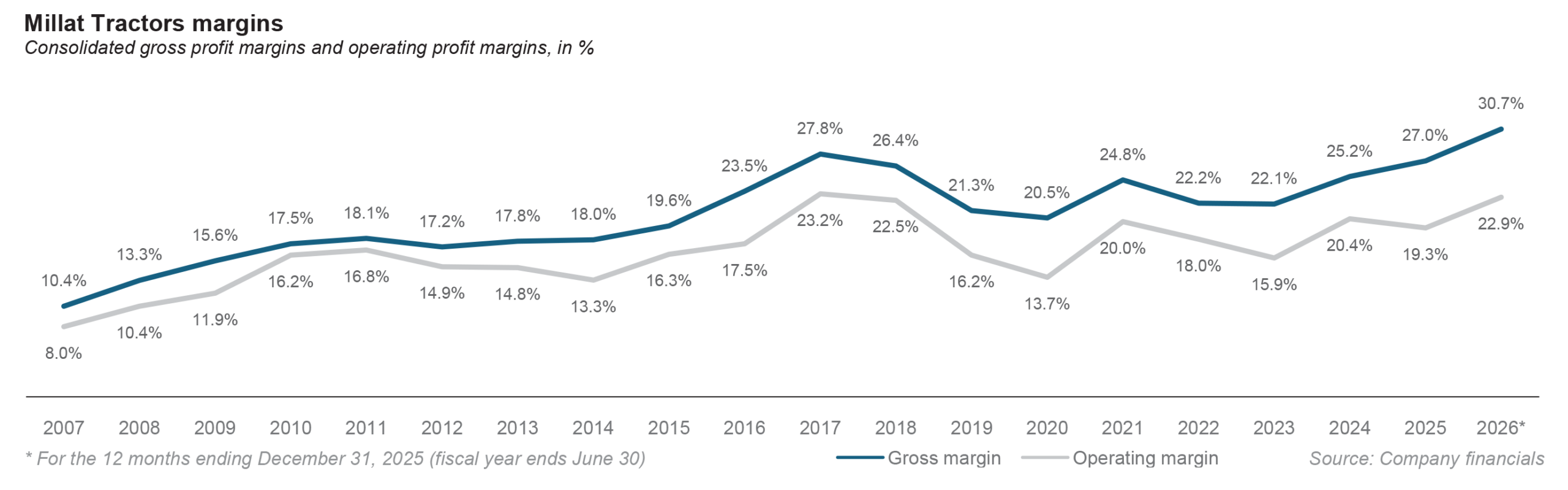
While the revenue and profit numbers are revelatory, perhaps nothing captures this fluctuation better than Millat’s capacity utilization numbers. It is a complete rollercoaster ride that naturally corresponds to the falling revenue and profit numbers. From 2007 to 2013 Millat was operating at capacity with double shifts. Their lowest capacity utilization during this period was 90.3% in 2007 with 27,081 tractors produced, and their best year was 2011 with a capacity utilization of 140.6% and 42,188 tractors produced. Then in 2014 the production capacity fell to just over 70%. Since then it has been a story of spikes and quick falls in production. Every couple of years capacity falls by more than a quarter. The lowest it hit was 63.4% in 2023, when in the aftermath of devastating floods farmers were not buying a whole lot of machinery. Rises associated with subsidy schemes from the government like Punjab’s Green Tractor Scheme result in rises, and then there are years like 2025 when capacity utilization has gone as low as 62.1%.
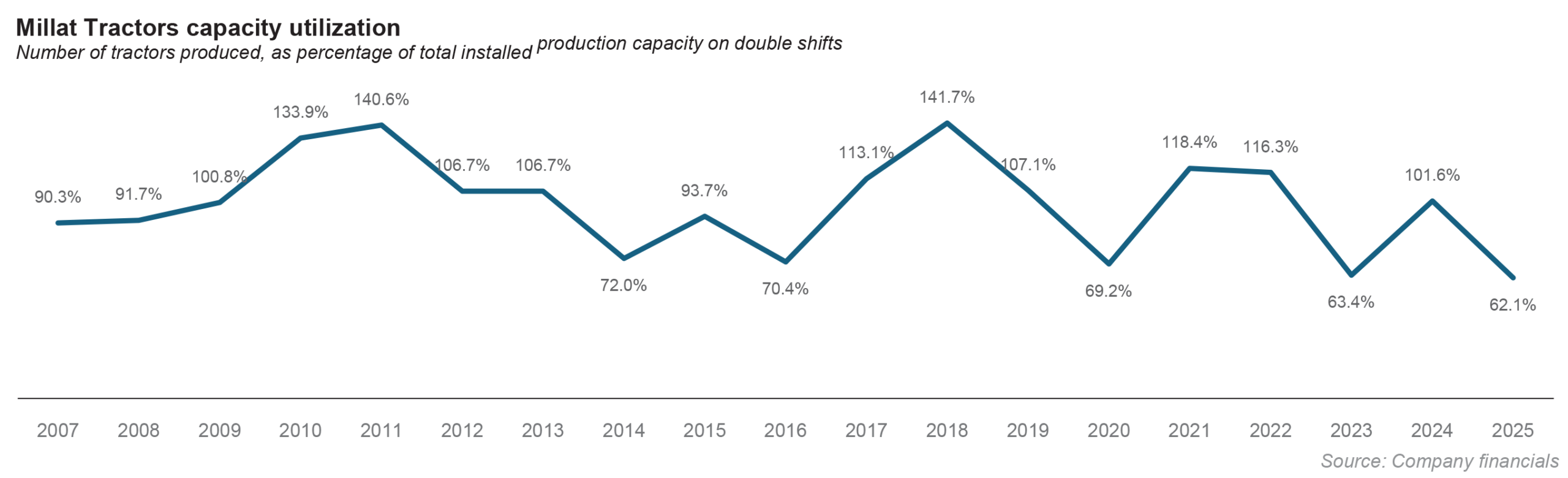
“There has been no consistency. Up until 2010 there was no sales tax on tractors. This made sense — farmers need it, agriculture needs tractors. Then the government imposed sales tax and we saw a fall. One year the sales tax is 17%, then it is changed to 5%, then it goes back up to 10% — farmers do not buy because of the burden of these taxes,” says Raheel Asghar.
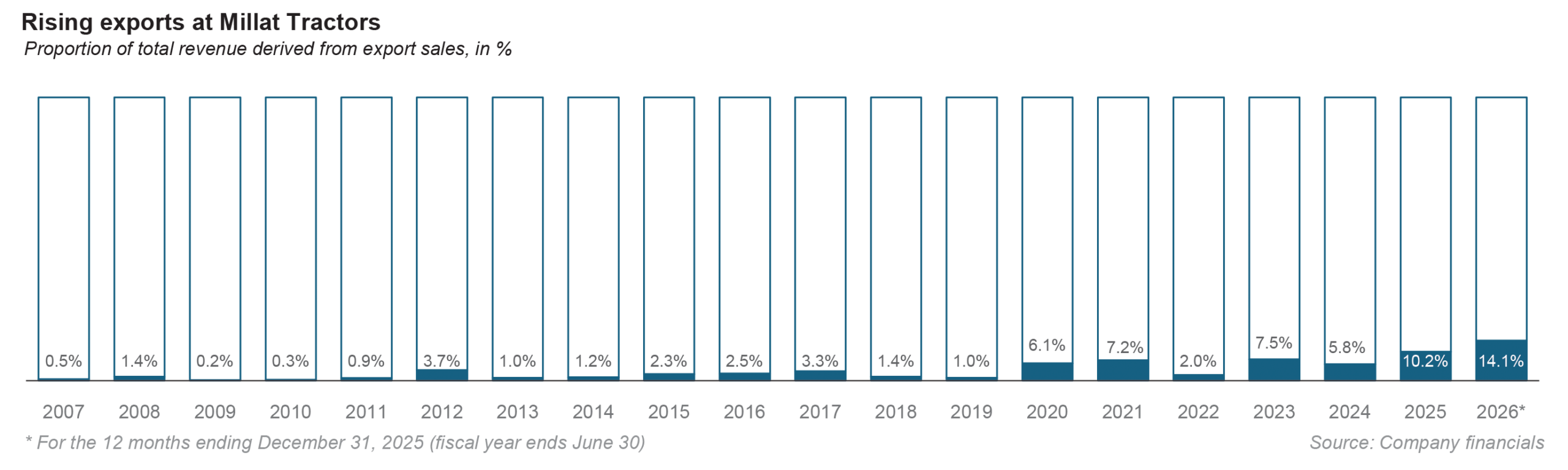
The effect of sales tax is obvious and telling. But this inconsistency is possibly also why the tractor industry has shifted towards exports to diversify their business. In 2007 99.5% of Millat Tractor’s revenue came from domestic sales. That number remained largely consistent with some small changes up until 2023 when the first significant change came at exports accounting for nearly 8% of total revenue. In 2025 this crossed 10%, and in the current fiscal year it looks to be crossing 15%. The milestones are clear. In 2020 1000 tractors were exported, in 2021 this rose to 2000, and 2024 marked the export of 2500 tractors. With the recent agreement to sell Millat brand tractors in Africa, the exports are expected to go up.
Wanted: Stability and Consistency
In Millat tractors and tractor manufacturing, you have the example of an industry that has managed to achieve localisation, has a willing and ready customer base, and is at a stage where it is ready to sell to other parts of the world as well. But despite this, they remain unsatisfied with how business is done at home. That is why, perhaps, the upcoming budget is so important for them. According to Raheel Asghar, they have had very promising and encouraging conversations and engagements with the government.
“Our main submission is that tractors are the core of mechanisation. They are vital for agriculture growth,” he says. Pakistan’s need to mechanize is also a cause for concern. Currently the country’s mechanization ratio is below 1 horsepower per hectare. The recommended rate as per the UN’s Food and Agriculture Organisation is at least 1.4 horsepower per hectare. Compared to Pakistan, India is at 1.37, China is at 1.57, and Japan is at 2.83.
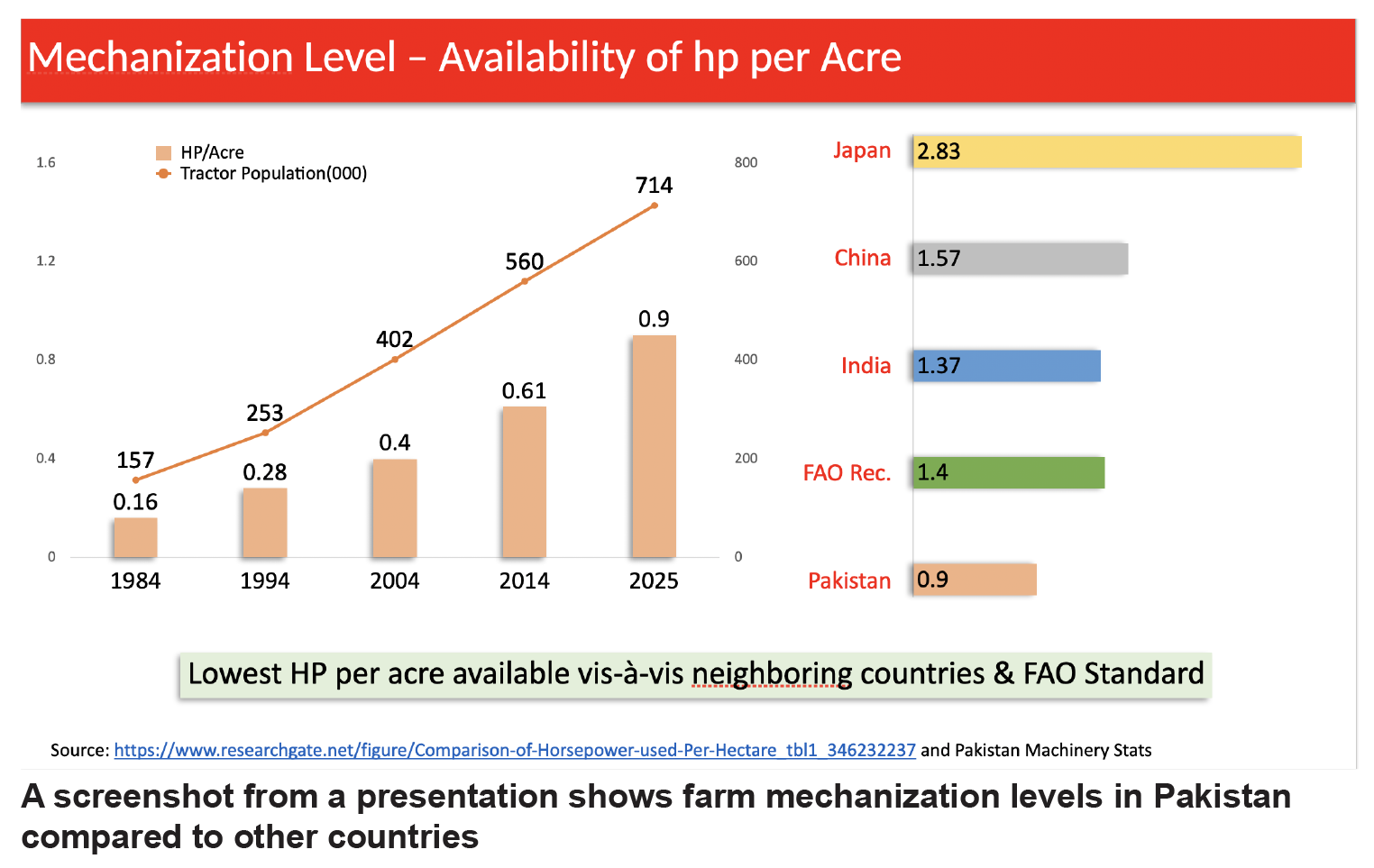
“There was a time up until 2007 when we were on par with India. But since then they have hurtled ahead and our industry has stayed behind compared to them,” say Raheel Asghar. This, he says, is despite the fact that Pakistan makes the cheapest tractors in the world. “Our customers might disagree with this because they have seen prices rising in recent years, but Pakistan’s dollar per horsepower cost is lower than the rest of the world. That is why exports are also feasible,” he says.
According to an industry report, Pakistan manufactures tractors at around $140 per horsepower unit. China’s production is at $155, India is at $180 and countries like Belarus and Brazil that are known for their tractors are making them at over $350 per unit of horsepower.
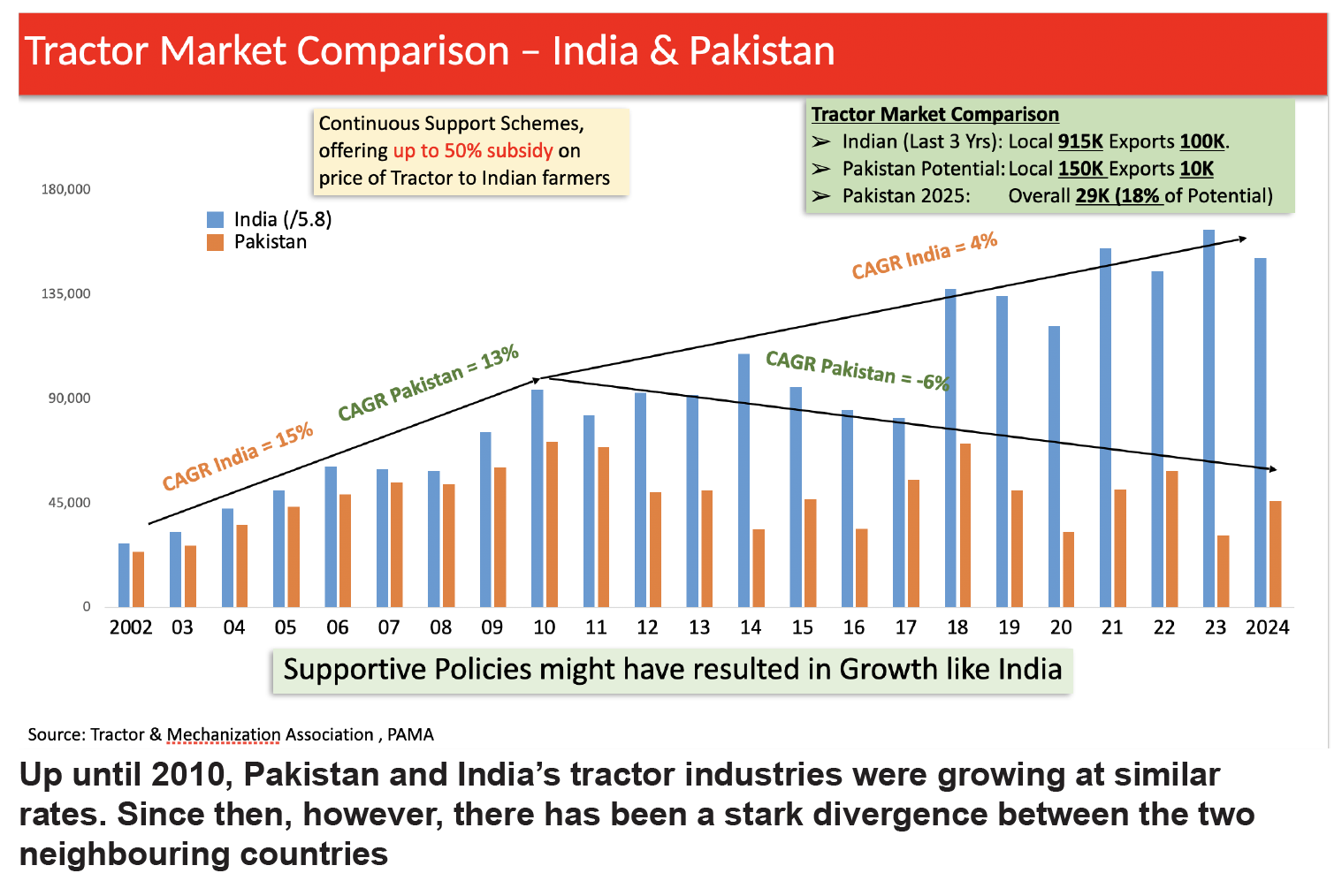
With the low cost, Pakistan’s potential is much higher than where it is at. Not only are we currently not meeting current capacity, we are far far behind what the actual potential could be. Up until the year 2010, the CAGR for the tractor market in India was 15% and in Pakistan it was 13%. Since then, however, India’s CAGR has been 4% while Pakistan’s has dropped to -6%. In the past three years, India has produced 9.15 lakh tractors for their domestic market, and exported another 1 lakh tractors. If Pakistan had stayed on the same growth trajectory it would have had the potential to make 1.5 lakh tractors for the domestic market and export 10,000 tractors a year. However, at current rates Pakistan is barely producing 18% of this. The resultant effects on Pakistan and India’s farm productivity are obvious. India’s per acre profitability for wheat is three times higher than Pakistan and for rice it is more than double according to 2023 numbers. This is despite the fact that the average farm size in India is 2.6 acres while in Pakistan it is 5.6 acres.
The Indian example is the spectre that haunts the Pakistani tractor industry. It is where they could have been but they feel hamstrung. “India’s profitability on farms is much higher. They get a lot of other subsidies on fertiliser, and those subsidies are given directly unlike here. This means their farmers can actually afford the tractors unlike ours,” explains Raheel Asghar.
What comes next?
This focus on affordability is the cornerstone of the proposed National Tractor Policy. According to the Millat CEO, tractors are not a luxury for farmers, they are a tool they need to compete and survive. “Pakistani tractors are the cheapest in the world but our farmers do not always have the means to buy them.”
And that, essentially, is what the entire proposal hinges on. Exports are well and good but the industry feels the best way to grow it to its full potential is by making it affordable. The first part of this proposal requires larger agricultural reforms. According to Raheel Asghar, Pakistan should follow the Indian model of giving subsidies. “India has 5-6 subsidies working at any given time and all of them are targeted towards small landowners and given for specific things. Our subsidies are usually across the board.”
The concept is simple. Farmers with larger landholdings can probably afford tractors anyways. It is those without the means to do so that need to be given more targeted subsidies. The biggest example of this, of course, is the subsidy given to fertilizer companies. The government has long provided subsidised gas to fertiliser companies which then sell to all farmers. Some companies like Engro themselves have been advocating to change this and instead give direct subsidies to farmers with land less than 5 acres. While some changes have been made because of the IMF in the past few years with gas prices for these fertilizer plants being rationalised, there is a long way to go and subsidies in Pakistan are more general than specific.
Then comes what can be done specifically for tractors. Currently, the SBP provides financing for tractors at around 7% under different schemes. According to Raheel Asghar, this should be adjusted regularly with the existing interest rate. “This facility was given when the interest rate was at 20%. Today it is at 10% so the benefit has been reduced.”
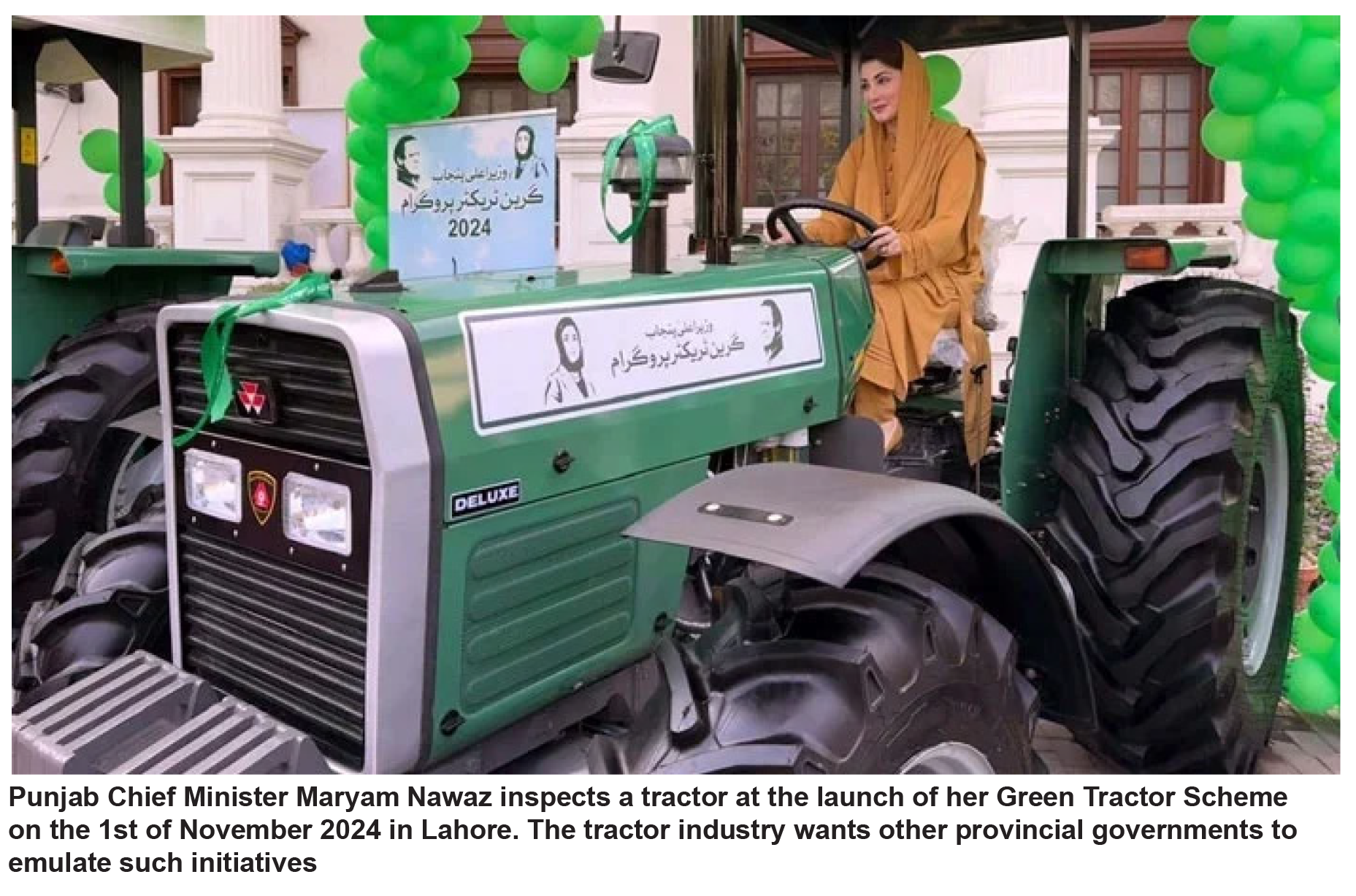
Then there are other kinds of direct subsidies. “The Green Tractor Scheme by the Punjab Government is a very good idea to make farm mechanization affordable for those that really need it. As part of the policy, other provincial governments should also be given the tool to create a roadmap for similar subsidies,” says the MIllat CEO.
The other big demand which requires investment are hiring centers. Because farmers do not necessarily have the capital or for that matter the space to store tractors when they are not needed, formal means of renting them should be available. Tractors are rented privately all over the country but the policy calls for the establishment of formal hiring centres. “We talk so much about our youth bulge and growing literacy,” says Raheel Asghar. “This country needs better yields. Why not give financing to young, educated people to set up proper hiring centres where people can come get tractors? If they invest in this, we will also be able to make harvesters, larger tractors, and other products that are capital intensive and not easy to buy for people.” In Indian Punjab, half the size of Pakistan’s Punjab, there are 11,000 such centres. On this side of the border their presence is negligible.
Then there are the general demands which most local industries have. They want protection from imports and a higher import duty on imported and CBU units. While the domestic industry dominates in Pakistan, some larger machinery has to be imported. Similarly the tractor industry wants export benefits — by that what they mean is they want the money they are owed on time. The government regularly holds off on tax refunds and is slow to return money, creating cash flow crunches and restricting growth. According to Millat, even now they have around Rs 6-7 billion stuck with the government’s tax officers yet to be released.
The aims of the policy are clear and not overstated as we have learned of them up until this point. What form will it emerge in when the budget rolls around? Only time will tell, but Profit has been told that already there was a proposal to merge the tractor policy into the larger automobile policy that the government has been working on. However, with resistance from the tractor companies, this idea has been abandoned. The commerce minister and other relevant parties seem committed to releasing this policy. If it comes out in the shape that it is in and is implemented, Pakistan might get back on track in an industry that was thriving not so long ago.
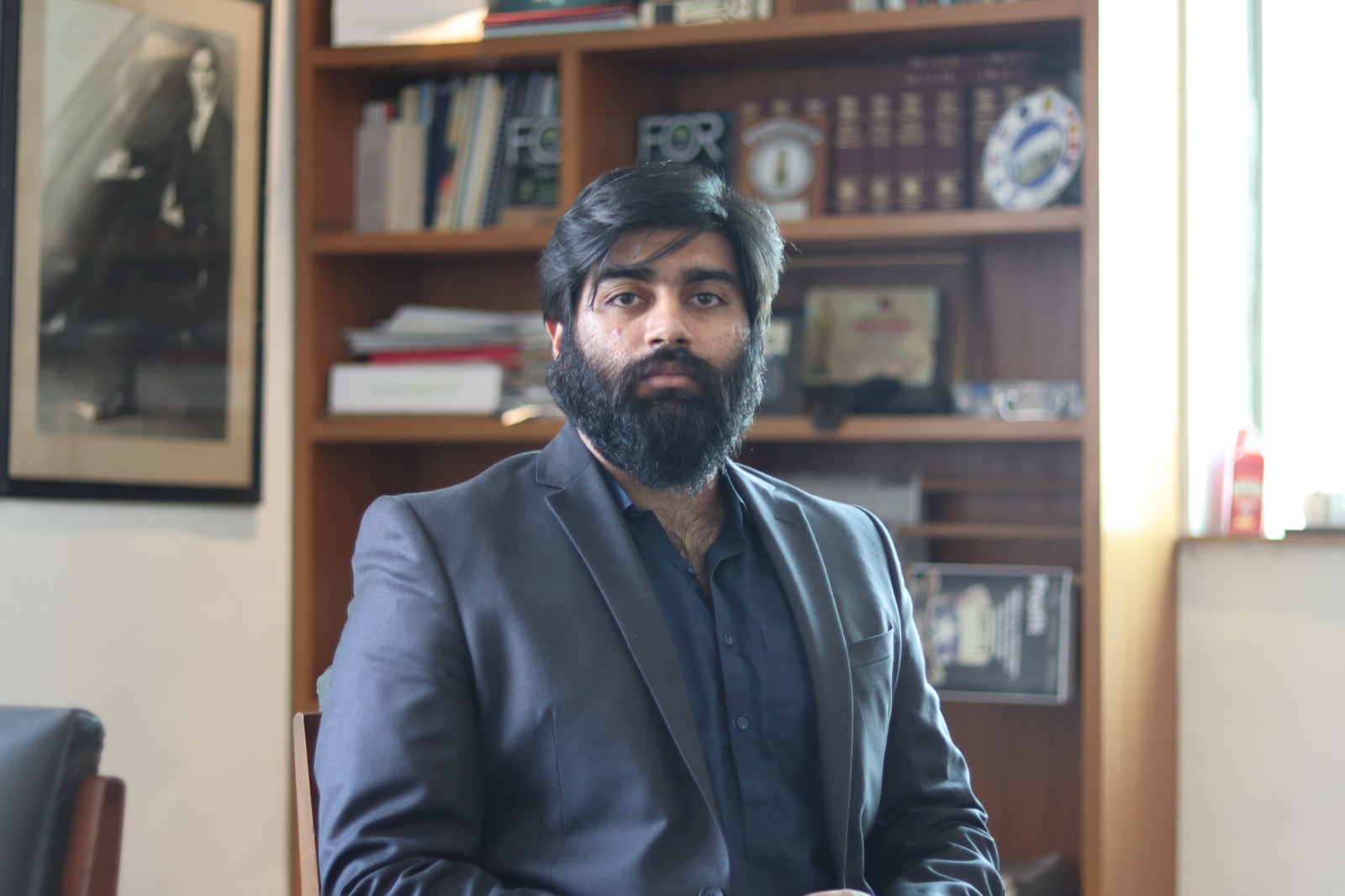
Abdullah Niazi is senior editor at Profit. He can be reached at [email protected]
View all articles →6 Comments
No comments yet. Be the first to join the discussion!