
Murree Brewery’s long pour goes global

On April 29, 2026, Murree Brewery ran the kind of newspaper advertisement that would once have seemed almost implausible in Pakistan: a call for distributors to help export its brews.
For most companies, a distributor search is a routine commercial notice. For Murree, Pakistan’s oldest and largest brewery, it reads more like the opening of a locked door. The company has made beer, spirits and malt beverages through war, partition, prohibition, regulatory suspicion and social discomfort. It has continued to operate in a country where alcohol is barred for the Muslim majority, permitted only through exceptions for non-Muslims and foreigners, and kept away from formal advertising. For nearly half a century, it could sell alcohol at home to a limited audience, but could not send it abroad.
That has now changed. After Pakistan’s export policy was amended last year to allow alcohol exports to countries outside the Organisation of Islamic Cooperation, Murree has begun testing foreign markets. It has already sent beer shipments to the United Kingdom, Portugal and Japan, while looking at other destinations including the US and Canada. The company also has an advantage that did not exist in its earlier history: it has already been exporting non-alcoholic drinks to more than a dozen countries, giving it relationships with distributors who know the brand, the paperwork and the supply chain.
For a 165-year-old company that has spent much of its modern life learning how not to attract too much attention, the shift is significant. Murree has survived by keeping its head down, making space for itself in a constrained domestic market, and expanding into non-alcoholic products that could travel more easily through Pakistan’s mass consumer economy. Its results for 2024-25 show how well that strategy has worked. The company crossed $100 million in annual revenue for the first time, reported higher margins and increased profit, and continued to use its non-alcoholic business as both a hedge and a growth channel.
The question now is what happens when Murree is no longer confined to the market that taught it restraint. If beer and spirits are its highest-value products, and if exports finally give those products a route to larger legal markets, the company may be entering the most important commercial moment of its post-1977 history.
From Ghora Gali to Rawalpindi
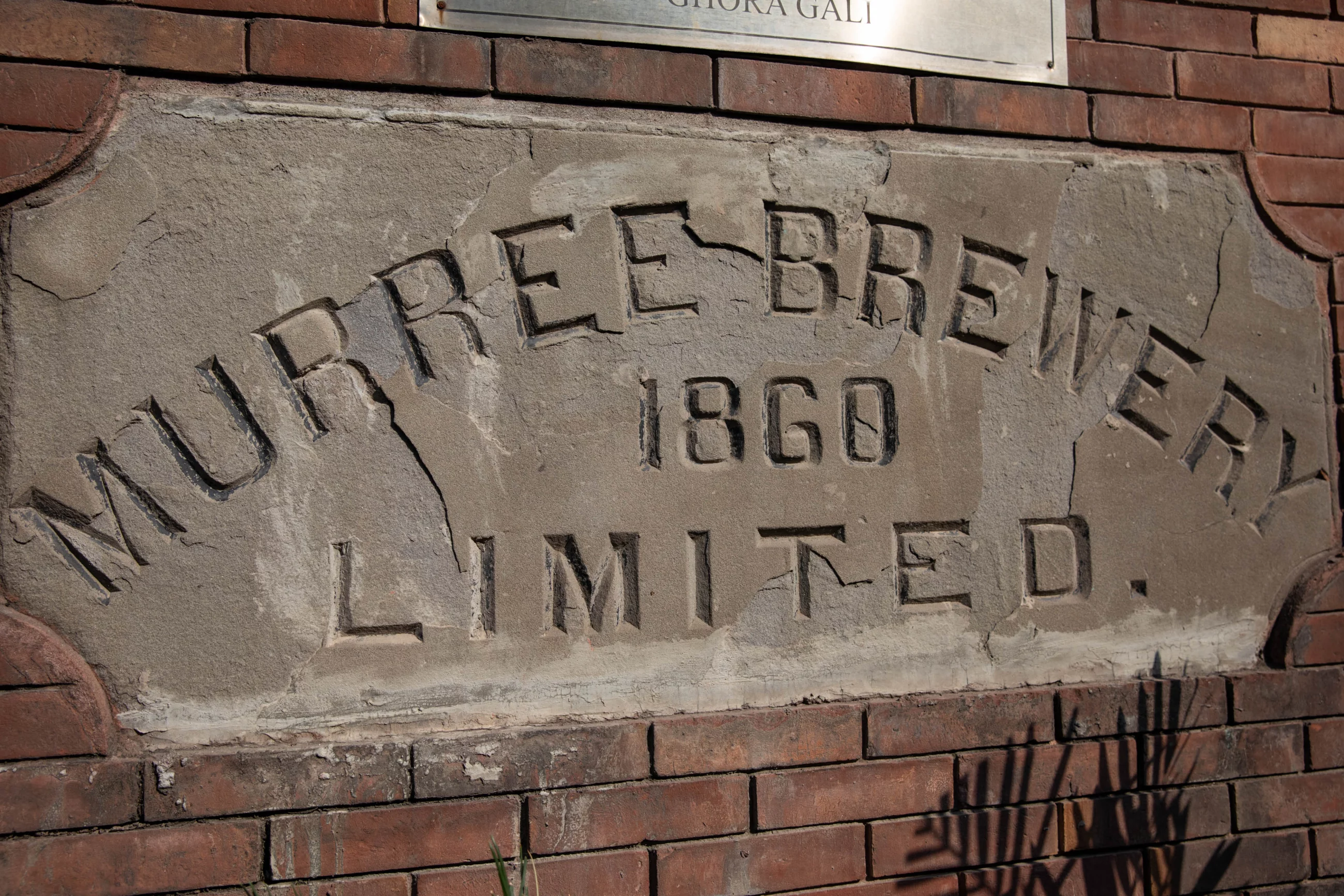
Murree Brewery’s history begins in 1860, in the hills near Murree, where it was established at Ghora Gali to supply British civil and military personnel during colonial rule. Like many industrial concerns founded during the Raj, it was built for a specific imperial economy. Unlike most, it survived the end of that economy, the violence of partition and the creation of a new state whose identity would make its core product politically sensitive.
The company’s operations later shifted largely to Rawalpindi, where its red-brick industrial presence became an iconic part of the city’s commercial landscape. The original hill property was eventually sold, while other assets were lost to history: the Quetta distillery was destroyed in the 1935 earthquake, and the Ghora Gali site was burned in 1947. The business endured, passing into the hands of the Bhandara family, Parsis whose minority status would become central to the company’s ability to remain in the trade after Pakistan’s creation.
[caption id="attachment_233426" align="aligncenter" width="2560"]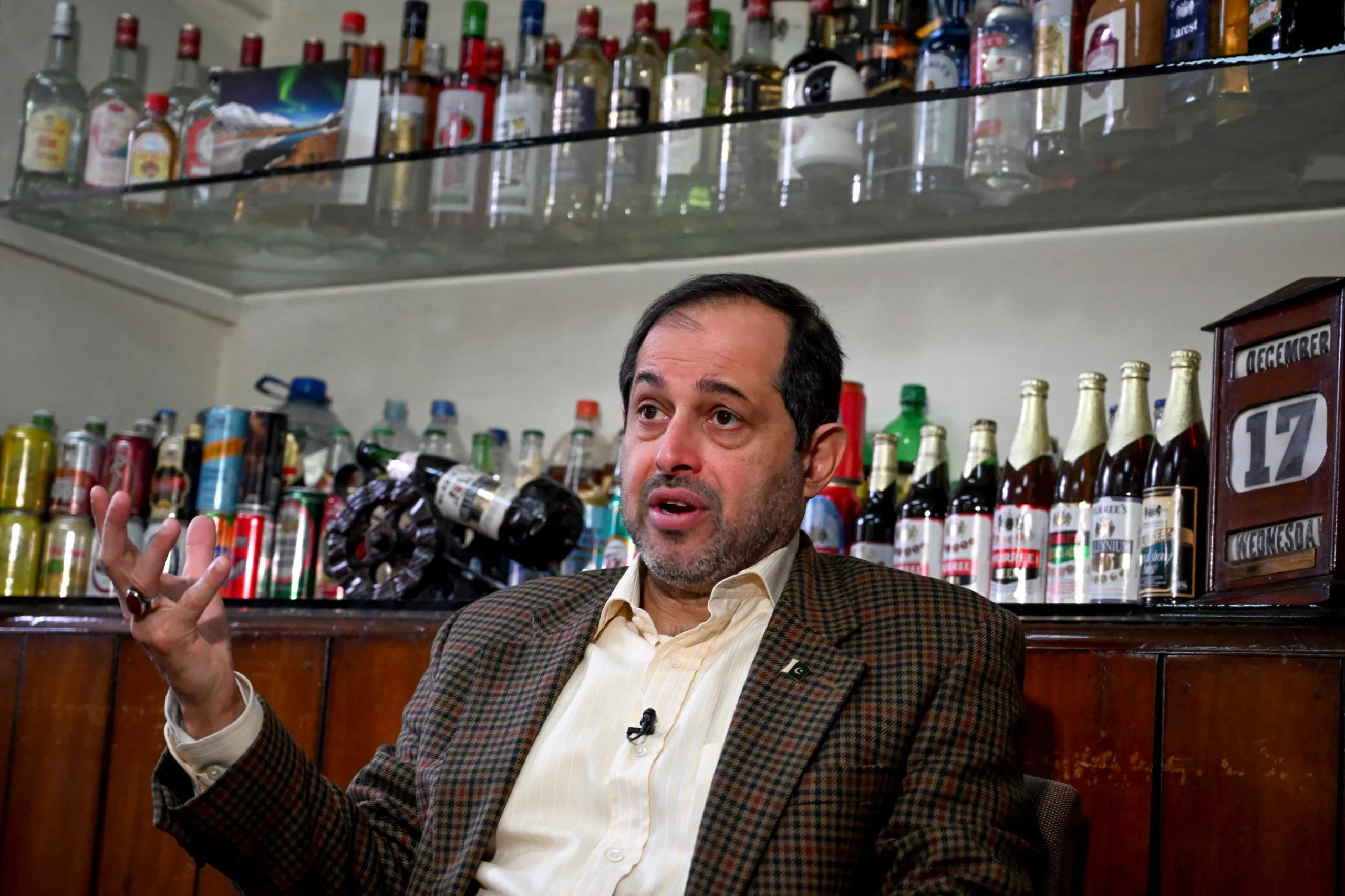 Isphanyar Bhandara is the third generation of the Bhandara family to run Murree Brewery, and it is under his watch that exports have once again been allowed. He is also a member of the National Assembly.[/caption]
Murree’s endurance has always depended on operating inside a contradiction. Alcohol is legally available in Pakistan, but only within a narrow framework. Non-Muslims may purchase limited quantities through permits, foreigners may access it through authorised channels, and licensed outlets exist in specific markets. At the same time, alcohol is banned for the Muslim majority, cannot be advertised normally, and remains socially and politically sensitive. This left Murree with a formal market, but a small one; legal continuity, but little room for public assertion.
The defining rupture came in 1977, when prohibition was imposed under Zulfikar Ali Bhutto and later tightened under Gen. Muhammad Zia-ul-Haq. Murree was allowed to keep operating for permitted customers, but exports of alcoholic products were effectively shut off. Before that, the company had sold abroad, including to India, Afghanistan, Gulf countries and the United States. After the ban, it became a brewery with a foreign history but no foreign future.
The company adapted by narrowing its posture and widening its portfolio. It continued to make beer and Pakistan-made foreign liquor, including spirits such as whisky, vodka, gin, rum and brandy. It also grew non-alcoholic lines including malt drinks, juices, carbonated soft drinks, bottled water and glass bottles. Over time, that combination turned Murree into something more complex than a brewery. It became a brewer-distiller, a soft-drinks maker and a packaging manufacturer.
Its formal structure reflects that dual identity. Murree organises itself into three divisions: Liquor, Tops Juices and Glass. The Liquor division includes both alcoholic and non-alcoholic beverages, meaning the word “liquor” in the company’s accounts is not the same as alcohol alone. Tops covers juices, aerated soft drinks and mineral water. Glass bottles and jars serve both Murree’s own production and outside customers.
The arrangement helped Murree grow in a market where its most profitable products were legally constrained. Alcohol gave it pricing power and margins. Non-alcoholic beverages gave it reach, visibility and a wider consumer base. Glass gave it an industrial backbone. The company’s long survival came from balancing those three identities, not from relying on one.
How Murree built scale at home
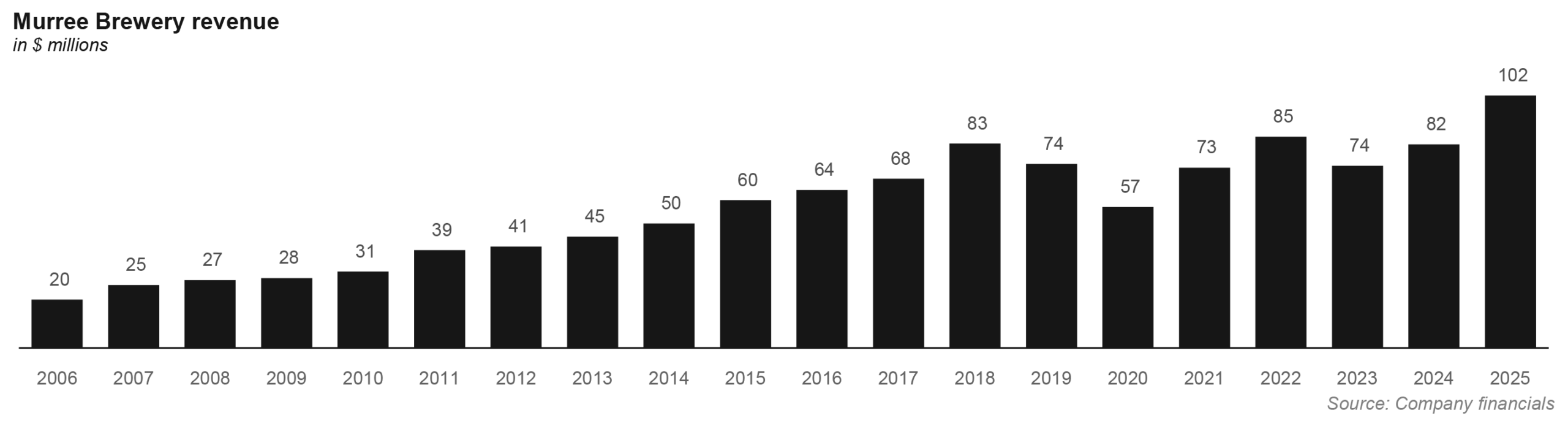
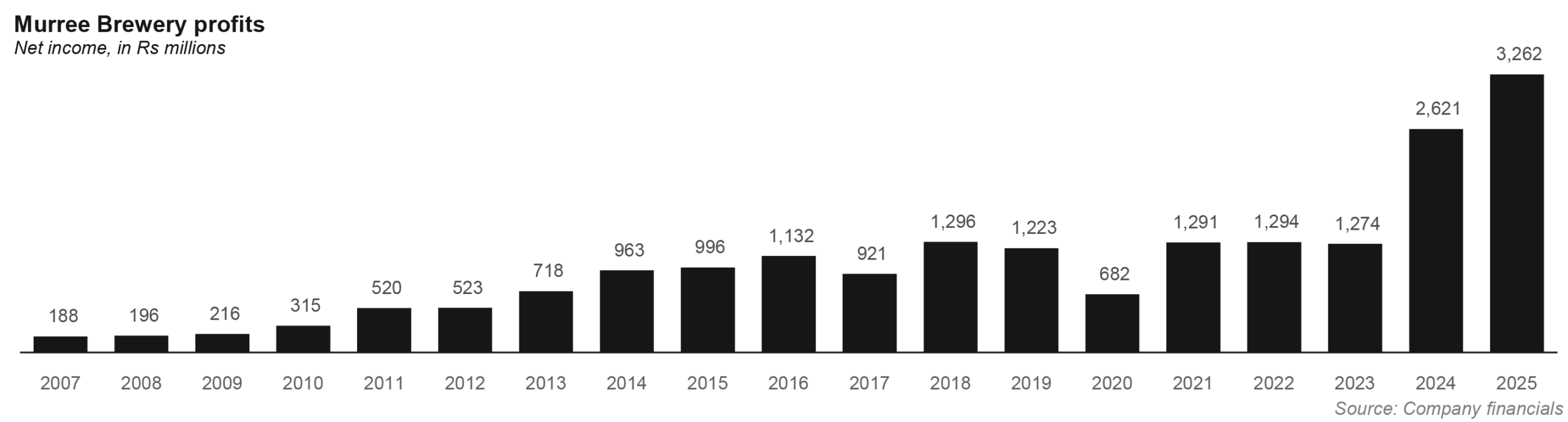
Murree’s recent performance shows that the balancing act has not merely kept it alive, but allowed it to thrive. For the year ended June 30, 2025, Murree Brewery reported net revenue of Rs28.6 billion, up 20% from Rs23.8 billion a year earlier. Net profit rose 24.4% to Rs3.3 billion. In dollar terms, the top line translated to roughly $102 million, putting the company above $100 million in annual revenue for the first time in its history.
The profit story was even more revealing than the sales number. Gross profit rose 31.3% to Rs7.4 billion, lifting the gross margin to 25.8% from 23.6%. Operating profit increased 32.6% to Rs4.5 billion, while the operating margin improved to 15.9% from 14.4%. Net margin edged up to 11.4% from 11%. Earnings per share rose to Rs117.9 from Rs94.8, and the full-year dividend reached Rs41.5 per share after interim payouts and a recommended final cash dividend.
Those numbers matter because they came during a period of cautious consumer spending. Pakistan’s households have been dealing with inflation, high borrowing costs and pressure on disposable income. Yet Murree managed to grow revenue, improve margins and maintain shareholder payouts. Part of that came from selective price increases. Part came from scale. Higher throughput reduced unit costs in brewing and bottling, while a richer product mix supported margins.
The company’s portfolio explains the result. Alcohol is not necessarily the largest business by units sold, but it remains the bigger revenue and profit ticket. About 55% of revenue in 2024 came from alcoholic beverages, while Murree Beer itself accounted for 19.3% of revenue. Much of the alcoholic beverage revenue came from PMFL, the company’s spirits and hard liquor portfolio. By volume, however, non-alcoholic products play a much larger role, with distributors and company officials indicating that roughly half of beverage units sold are non-alcoholic.
That creates a useful split. Alcohol gives Murree high-value sales in a restricted market. Non-alcoholic drinks allow the company to compete in normal retail channels, broaden its customer base and reduce dependence on a politically sensitive category. The Tops portfolio, including juices, soft drinks and water, has therefore become more than an accessory business. It is a strategic hedge.
Murree’s own product development points in that direction. Its recent reports have highlighted new non-alcoholic launches, including Bigg Orange, while media coverage has noted its push into energy drinks, juices and malted beverages. Malt-79 and other malt products sit alongside carbonates and juices that can be sold to the mass market. These are lower-margin categories compared with beer and spirits, but they are larger, less restricted and more visible.
Geography also matters. Karachi has emerged as Murree’s most important domestic market, contributing roughly one-third of domestic revenue last year, more than all of Punjab combined. The city offers density, formal retail channels and a licensed outlet ecosystem that is difficult to replicate elsewhere. Murree’s domestic strategy has therefore rested heavily on winning Karachi, while layering on volume from the rest of Sindh and major urban centres in Punjab and Khyber Pakhtunkhwa.
But Pakistan still imposes clear limits. The formal alcohol market is small because the eligible consumer base is small. There are around 9 million non-Muslims in Pakistan, less than 4% of a population of about 250 million. Tourists, diplomats and foreigners add demand, but not enough to make the domestic legal alcohol market truly scalable. Murree can improve pricing, packaging and distribution, but it cannot change the size of the permitted market at home. This is why exports don’t just add another sales channel, they change the height of the ceiling Murree has been working under.
Export licence changes equation
For years, Murree’s export ambition had the shape of a family campaign. Isphanyar Bhandara, the company’s chief executive and member of the National Assembly, has said that his father and grandfather tried to secure permission to export but could not. In an earlier interview with AFP, he described the approval as “another happy milestone,” adding that earlier attempts failed.
The company had reason to feel the contradiction sharply. It could produce alcohol at home for licensed buyers, but could not export to countries where alcohol is legal, regulated and taxed. The argument against exports had less to do with production and more to do with perception. In an earlier interview with NPR, Bhandara said the theory behind the ban was that an Islamic country should not be seen as exporting a vice.
[caption id="attachment_233430" align="aligncenter" width="1300"]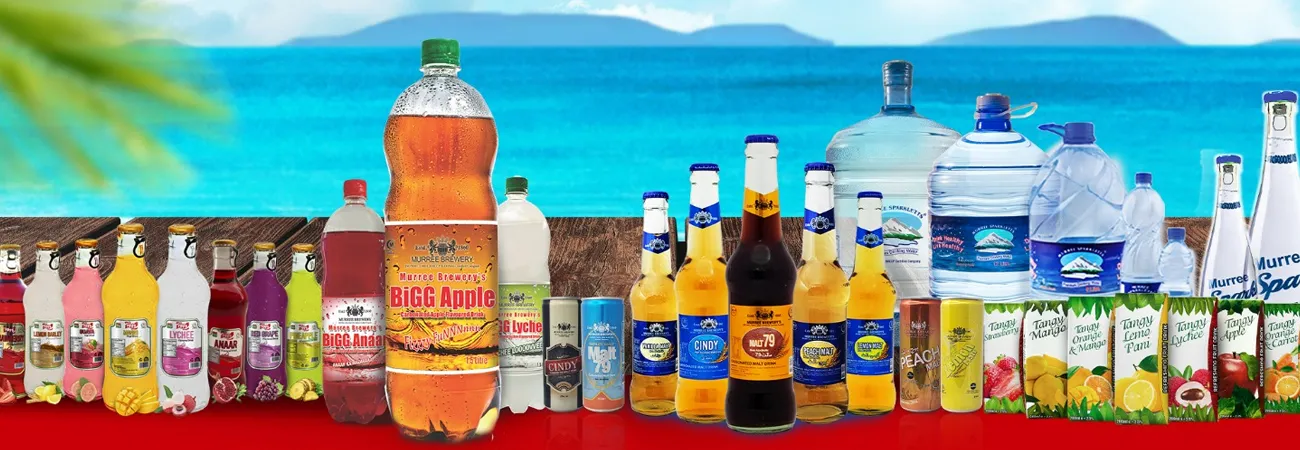 In addition to its alcoholic products, Murree Brewery has survived in Pakistan by producing a wide range of products including carbonated soft drinks, Tops Juices, and Murree Springlet mineral water.[/caption]
The economic case has now won more space. Pakistan’s 2022 export policy change allowed alcohol exports to non-OIC countries, and the approvals that followed have reopened a path closed for nearly 50 years. Murree’s first test shipments have been modest, but the distributor advertisement suggests a more deliberate phase is beginning.
The advantage is not starting from zero. Murree has already been exporting alcohol-free products since 2020 to more than a dozen countries. That gives the company more than familiarity with export documentation. It gives it to existing buyers. In an earlier interview with NPR, export manager Ramiz Shah said the first distributors in the United Kingdom and Japan to buy Murree beer were already importing some of the company’s non-alcoholic products. “They are easy to target because they know us,” he said.
That relationship may be the hinge on which the next phase turns. For a brewery from Pakistan, entering foreign alcohol markets will not be straightforward. Beer shelves in Europe and North America are crowded. Craft brewers, legacy brands, global giants and regional specialists compete fiercely on price, taste, identity and distribution. Murree cannot simply arrive with age and expect shelf space. It will need importers willing to tell the story, place the product and build a consumer base.
But Murree does have a story. It is one of the oldest industrial companies in Pakistan, a colonial-era brewery that survived partition, prohibition and decades of regulatory caution. In foreign markets, especially those with South Asian diaspora populations, that history could become part of the brand. At home, Murree cannot advertise alcohol in any meaningful way. Abroad, it can use heritage as a commercial asset.
Exports also sharpen the importance of its highest-value products. Domestically, Murree’s alcohol lines are constrained by licences, taxes and the size of the permitted consumer base. Internationally, those products can enter markets where the category is normal, even if competition is intense. Beer and PMFL products may therefore move from being high-margin but domestically boxed-in categories to products with external growth potential.
That does not mean Murree should abandon the careful portfolio logic that got it here. The non-alcoholic business remains central. It provides domestic scale, export relationships and insulation from regulatory risk. But exports alter the equation by allowing the alcoholic side of the company to pursue growth without depending solely on Pakistan’s limited formal market.
The company’s future strategy is therefore likely to rest on four linked moves.
First, it will have to widen its foreign distribution base, beginning with markets where South Asian consumers already know the Murree name or may be curious about it. The United Kingdom, Japan and Portugal are early tests, but North America and parts of Europe could offer larger diaspora-linked opportunities.
Second, it will need to preserve pricing power in alcohol while avoiding overreach. Murree has long operated with an instinct for caution. In an earlier interview with NPR, Bhandara said he was brought up with the idea of not expanding the brewery too visibly and not appearing to flex while producing liquor in an Islamic country. That restraint remains relevant at home, even if the company becomes more ambitious abroad.
Third, it must continue building non-alcoholic products. Export permission may make beer and spirits more exciting, but Tops and malt drinks remain the company’s mass-market face. They also open doors with overseas distributors who can later carry alcoholic lines where legally permitted.
Fourth, Murree must navigate taxes, levies and input costs. The company has already dealt with super tax, water-use charges and the cost pressures that come with packaging, energy, barley, resin and glass. Exports can bring dollar revenue, but they also bring compliance costs, logistics expenses and market-building risk.
Still, the timing is favourable. Murree enters this export phase with record revenue, stronger margins, a functioning domestic base and an established non-alcoholic export network. It is not a distressed company searching overseas for survival. It is a profitable company looking abroad because its domestic alcohol market has always been smaller than its production history.
That is what makes the newspaper advertisement notable. It is not merely a sales notice. It is a signal that Murree is ready to test whether a company shaped by constraint can now grow through the very product it had learned to keep quiet.
For 165 years, Murree Brewery has adapted to whatever Pakistan asked of it: colonial demand, post-Partition survival, prohibition, silence, diversification and scale. Its next challenge is different. It must learn how to be visible abroad while remaining careful at home. If it manages that balance, the export licence may not just add revenue. It may allow Murree to become, for the first time in half a century, the international brewery it once was and the one it was never quite allowed to be.
2 Comments
No comments yet. Be the first to join the discussion!


