Pakistan’s energy is twice the price of its neighbours’. Here’s how we cut it down
Pakistan pays Rs58 per unit, more than double that of India and Bangladesh. The article traces policy failures behind high costs and circular debt, then highlights solar adoption as a path to cheaper, stable power.

Pakistan stands at a critical economic crossroads, pulled down by a "catastrophic" power crisis. At Rs 58 (approximately 21 cents) per unit, the cost of electricity in Pakistan is now more than double that of its regional neighbours, India and Bangladesh, where costs hover around 9 to 9.5 cents.
This disparity has led to a stark divergence in economic health. While Pakistan’s GDP growth has languished around 2% over the last four years (a third of what it was before 2005 and the lowest since 1947) its neighbours have seen their GDPs grow to be 70% higher than Pakistan’s. The human cost is equally severe, with a national poverty rate of 26% compared to just 5% in India. As per the HIES survey, most people blame increased electricity costs for their poverty.
To avert a future as an uncompetitive state, reliant on loan and overseas remittances, Pakistan must pivot from the failed policies of the past toward a technically sound, solar-centric energy future. The government is fast running out of economic runway, as highlighted by the 15 economic indicators in the table below.
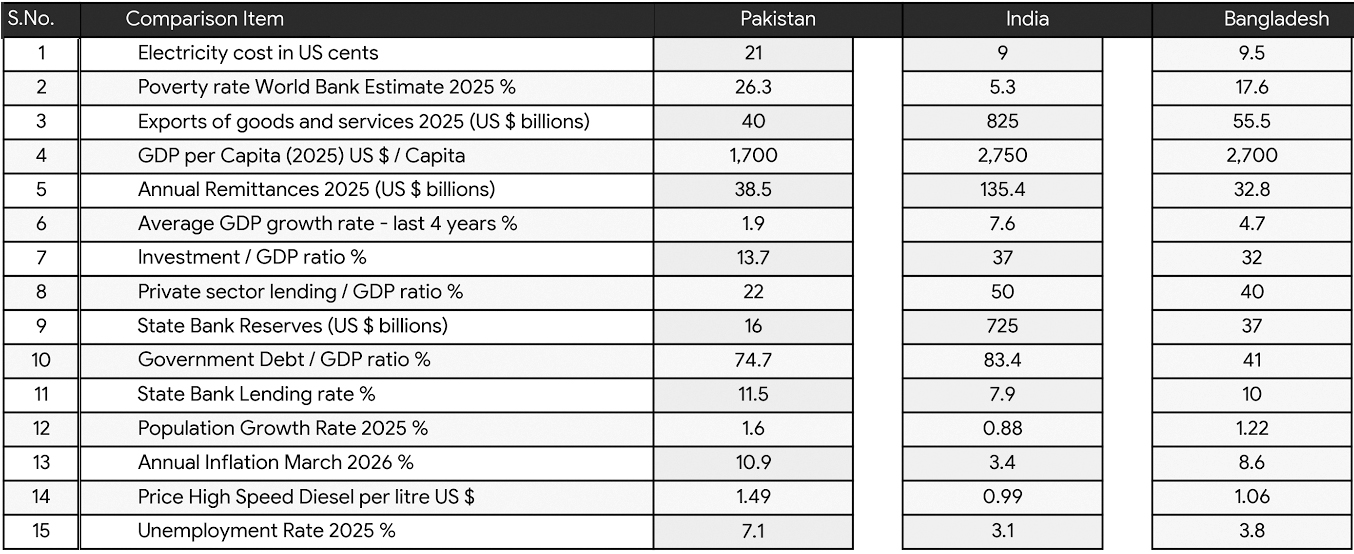
Pakistan simply cannot improve its balance of payments by increasing exports; the government is being delusional by stating that it will attract foreign investments or increase exports to $100 bn by 2030. Because, as compared to their neighbours Pakistani exporters, have to pay 220% more for electricity, 45% more for transport, have half the availability of bank loans, while interest rates are 15-45% higher, and foreign exchange is scarce. The same goes for talented salaried staff that must pay more for utilities and transportation on a lower salary and higher taxes.
The Legacy of the Power Policy
The current high cost of electricity is not a result of international market fluctuations but a "direct result" of several pernicious power policies, particularly the 2015 Power Policy. This policy established over 10,000 MW of "hyper-expensive" power plants reliant on imported fuel. Crucially, these projects were locked into "take or pay" contracts with dollar-based fuel and capacity charges. Because the electricity is sold domestically in rupees, this mismatch has depleted foreign exchange reserves.
This was a missed opportunity of historic proportions. Had the government prioritised the development of 4,000 MW of indigenous Thar coal instead of 10,000 MW of imported coal and LNG, the price of power today would be lower by Rs 15 per unit, and the nation would have saved foreign exchange. In contrast, India’s reliance on indigenous coal for 70% of its power (remaining is hydel and renewable) allows it to generate electricity at a mere 4.25 cents per unit.
Another crisis is circular debt, by 2025 this had increased to 2.3 trillion, the government paid 1.3 trillion borrowed from the market for - which every consumer is paying a Rs 3 surcharge in his bill, now again it has increased to 1.7 trillion. The gas circular debt - due to imported LNG has ballooned to 3.5 trillion, combined the two circular debts today are Rs 5.2 trillion ($ 18 bn or 4.3% of GDP) - plus 1.3 trillion previous loan.
The Grassroots Solar Revolution
While formal policy has struggled, the Pakistani public and industry have already begun their own transition. There are currently approximately 38,000 MW of solar power installed across the country, with another 8,000 to 10,000 MW being added annually. An estimated 12% of households—roughly one in eight—now have solar installations.
This shift is driven by economic necessity. The "purchase point" for the Pakistani consumer is approximately 8 cents (Rs 24); when prices exceed this, demand for grid power falls as consumers migrate to solar. Currently, solar accounts for over 25% of power generating 45 TWh compared to 127 TWh from non-solar sources. Industry leaders are also leading the way; for example, Cherat Cement and Lucky Cement integrated solar with Battery Energy Storage System (BESS) to ensure an economical and stable power supply
Another significant failure noted is that the power sector has been led by economists, accountants, lawyers, and civil servants rather than engineers and technical experts. This has resulted in a lack of technical foresight regarding grid modernization and the integration of cheaper renewable energy.
Narrow Focus on Transmission and Distribution (T&D) Losses; The government narrative has focused heavily on T&D losses as the main issue. However, the sources argue that while these losses are high, they do not explain why Pakistan's electricity is double the cost of India's, where losses are only 1% lower. The true failure lies in an uncompetitive "whole chain" of production. Even if the target of 12% line loss is achieved the maximum it would save is Rs 2.5/ unit.
Failure to Modernise the Grid; There has been a lack of policy support and investment in an Advanced Distribution Management System (ADMS) and smart grid components, which are necessary to handle the transition to solar energy and address technical issues like "Reverse Load Flow", “Reactive power” and "Harmonic Distortion".
Based on regional benchmarks power should be produced at around 4-5 cents per unit (1.5 cents energy cost and 3 cents production - capacity) costs and sold at 8-10 cents after allowing for Transmission and Distribution (T&D) losses etc. In Pakistan our energy cost is Rs 9 (3 cents) and capacity charges around Rs 15 (5.4 cents) or a total of 8.4 cents and we sell at 20 cents. By comparison India relies on rupee based indigenous coal for 70% of its power, the rest is hydel, nuclear and renewable. Their energy production cost is 4.25 cent and sale price 9 cents respectively.
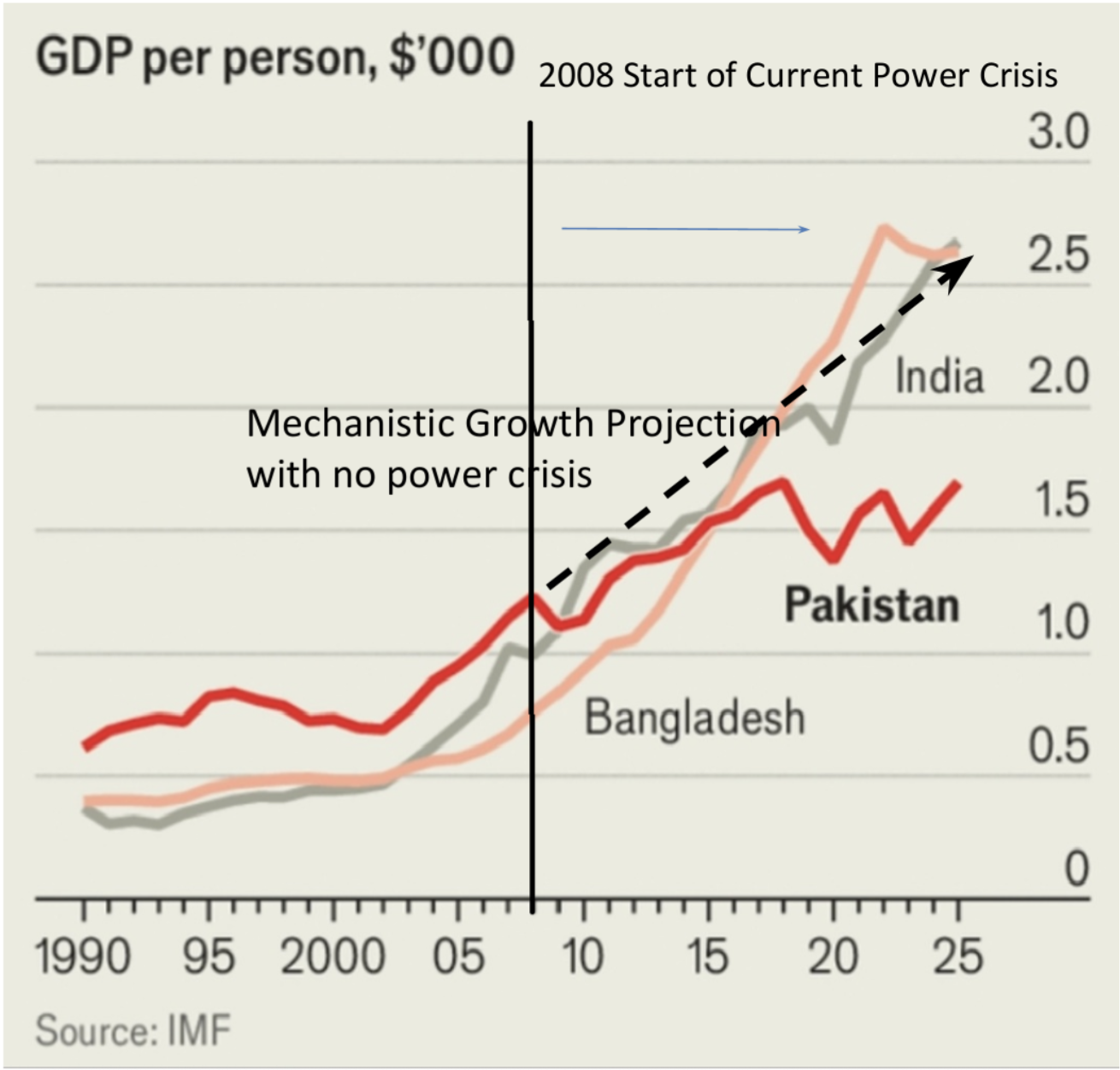
At 0.5 MW per capita power consumption per capita in Pakistan is very low. There is much potential for growth, provided of course that the prices are affordable. India is at 1.6 MW per capita, Bangladesh at 0.75 MW while Turkey and South Africa are around 3.5 MW per capita. Typical consumption for OECD countries is 6-8 MW per capita. With the advent of New Electrical Vehicles (NEV), general electrification as people move away from gas for heating and cooking, as well as data centres, the demand for electricity will only move upwards.
Technical Solutions for Solar Grid Integration
A common "urban legend" suggests that solar is too unreliable for the national grid. However, with modern technology up to 50% of total generation can be solar without compromising stability, provided the grid is managed by an Advanced Distribution Management System (ADMS). Transitioning to a solar-heavy grid requires addressing four primary technical constraints:
Reverse Load Flow: In a traditional system, power flows from a central generator to the consumer. Solar turns the consumer into a generator and that too is transient, requiring constant monitoring of individual feeders to prevent overloading or under servicing to avoid grid destabilisation.
Harmonic Distortion: Converting DC current from solar panels to AC via inverters can create "sinusoidal waves" that do not match the grid. This can be mitigated through high-quality inverters and harmonic filters.
Reactive Power: Unlike traditional rotating machinery, solar does not naturally produce the reactive power needed for industrial production. However, modern solutions like Variable Frequency Drive (VFD) motors reduce the need for this power, or it can be injected into the system, making targeted stabilization manageable.
Island Effect: Not knowing if the grid is live or not. This can also be addressed through the implementation of an ADMS.
To regain regional competitiveness, the goal is clear: Pakistan must reduce its power generation cost to approximately Rs 13.5 (4.8 cents) per unit and the sale price to approx. Rs 26.6 (9.5 cents). Achieving this would result in annual national savings of $12 billion—roughly 3% of the GDP—and save $3 billion in foreign exchange annually.
By reversing the "pernicious" policies of the past and leveraging indigenous resources and solar technology, Pakistan can lower its energy costs, revitalise its exports, and provide much-needed relief to its citizens requires several key policy and structural changes:
Shift in Leadership: The most fundamental policy change required to help deliver this challenge is to place the leadership of the power sector in the hands of engineers and technical experts rather than economists, politicians or bureaucrats.
Focus on Indigenous and Renewable Resources: A policy reversal that moves away from "hyper-expensive" imported and dollarized fuel plants and toward indigenous Thar coal, hydel, and solar energy, which are the cheapest available sources.
Investment in Advanced Grid Management: Policy must prioritize and fund the implementation of an Advanced Distribution Management System (ADMS) and associated Remote Energy Resource Management System (RERMS). This technical solution is necessary to manage the transition to a grid where up to 50% of generation could be solar and would facilitate Virtual Power Plants as well as micro grids.
Infrastructure Modernization: Enabling the grid for solar requires investment in the distribution system to reduce line losses, specifically by placing distribution networks underground. Additionally, the grid must be upgraded with smart components, micro grid controllers, harmonic filters, and Battery Energy Storage Systems (BESS) to ensure grid stability.
Regulatory Oversight and Standards: A strong regulatory agency is needed to oversee utility monopolies and prevent them from taking advantage of customers. Furthermore, policies should enforce higher quality standards for inverters to reduce harmonic distortion and encourage the use of Variable Frequency Drive (VFD) Motors in industry to minimize the need for reactive power.
For the past ten years, I have been involved as project delivery director - now as consultant with King Salman Energy Park (SPARK), a Saudi Aramco subsidiary that is the third mandated distributor of power in KSA. SPARK has installed one of the most advanced utility distribution systems using ADMS automation and smart components for its utilities. This has provided me with a unique insight as to how these systems may be used to help include roof top solar into the grid.
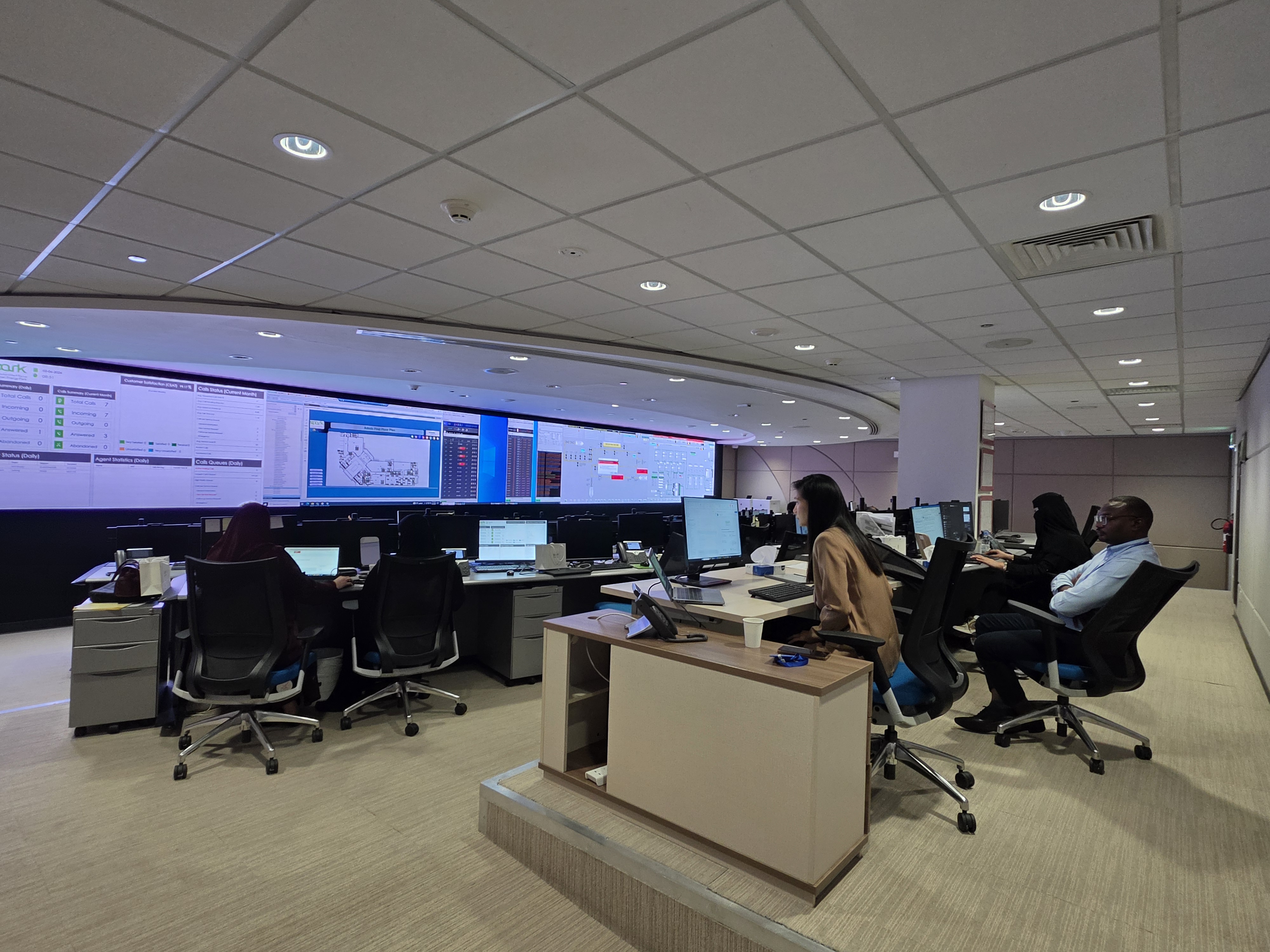
The SPARK control centre at the King Salman Energy Park is a Saudi Aramco subsidiary.
The point is we are where we are and need a solution rapidly, therefore based on my experience, a proposal has been developed pointing to how to lower the cost of electricity from the current Rs 58 to Rs 26.6 driven by a solar-centric energy future using modern technology for grid adaption. I am not by any means saying that this is the only solution, however instead pointing to the direction of travel required for a competitive energy price.
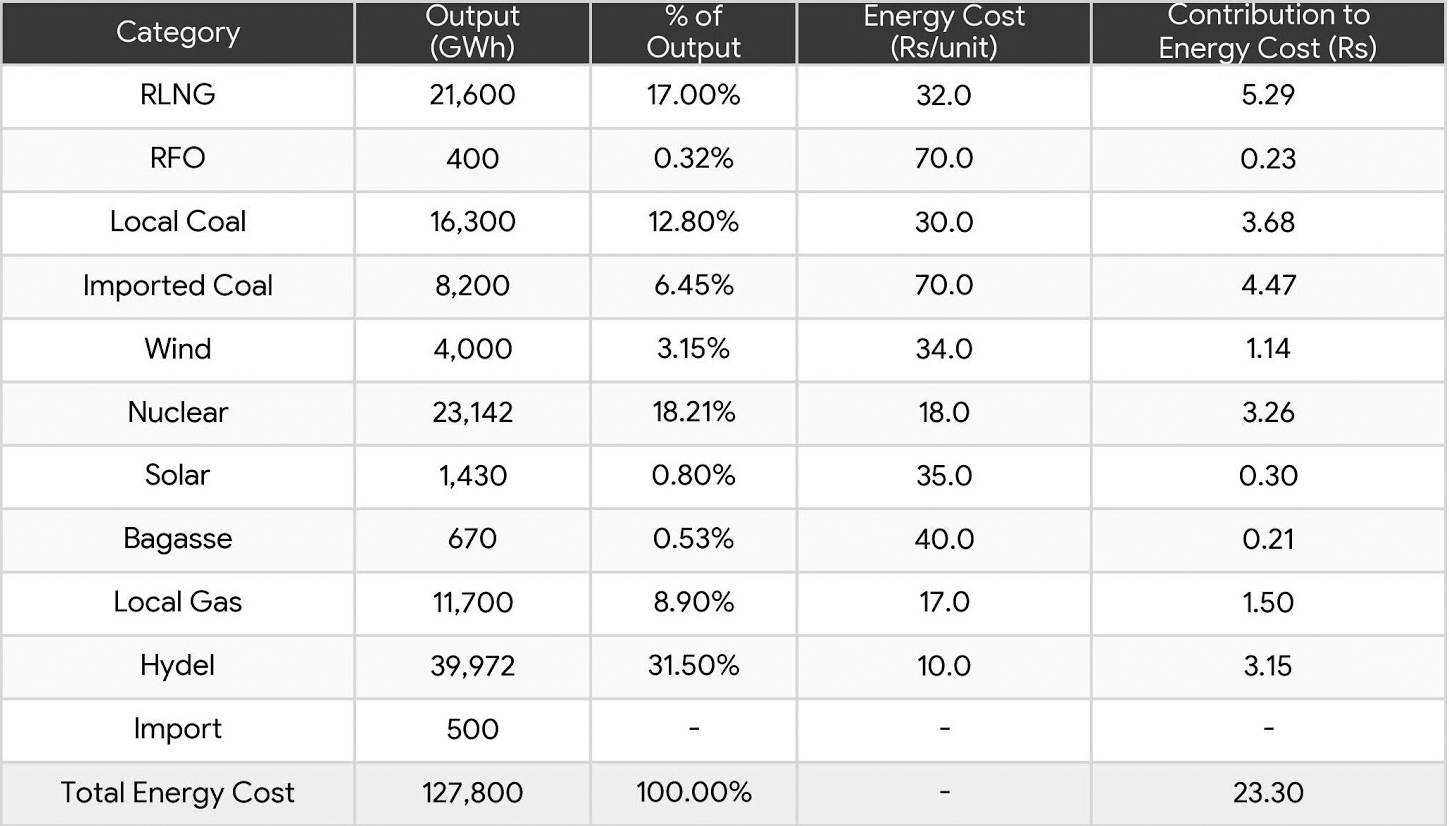
As a comparison based on data from 2025 the current cost of power per component is below. After accounting for taxes, line losses; DISCO costs and lifeline user subsidy etc the average electricity sale price today is around Rs 58/ unit:
Revised Profile after adapting grid solar power using ADMS system the price may be reduced to Rs 26.5 per unit, based on the distribution below:
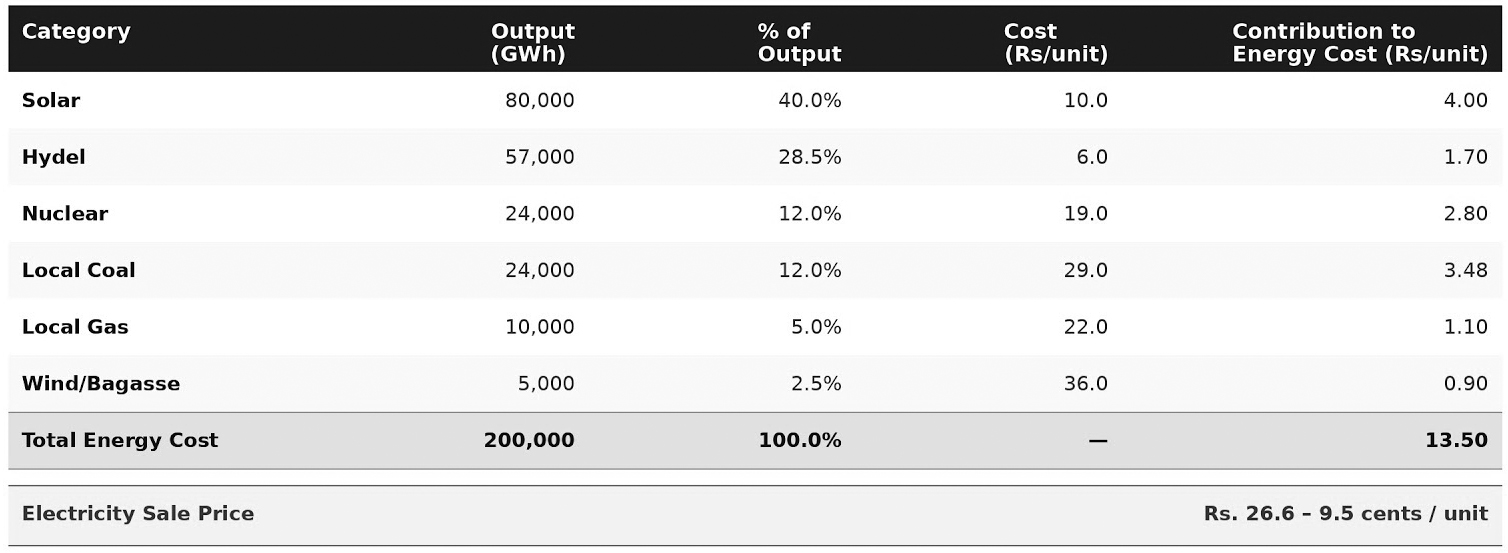
The model assumes 4,000MW (17,000 GWh) additional Hydel due for completion in 2027. It assumes that 400bn/year from the legacy capacity payments are transferred to a separate toxic assets account to be paid for by the government. All other capacity payments are accounted for, it also assumes reduction in line loss from current 17% to 13.5%.
Implementing connection solar to the grid is fiendishly difficult, which is why it is recommended to start a pilot project in a specified area and scale up with the lessons learnt. For a modern utility system the Automation Control is as important as the electrical engineering component, skills in Pakistan in such fields are gold dust. Another key element is financial incentive and access to capital for users to install more solar and storage.
As a rule of thumb the cost is important the cost of “smarting” the grid is approximately 70% of the solar so if we assume solar cost is $0.5m/ MW then the smart grid and associated automation would be around $0.35m/MW, so for 35 MW one is looking at $12 billion plus say another $2 billion for the BESS. Given that the country will be saving $12 bn per year the payback period sounds reasonable with most of the cost being the hardware itself.
With decreasing cost of solar panels and battery storage currently around $90-120/MWh or 25-35 rupees/ unit but falling, and the world may well be moving off grid but this won’t happen overnight and even if it does; it will leave a lot of vulnerable people at a loss. Otherwise, we are moving towards a country where about 30% or so of the population that can afford solar and storage will have a better quality of life, while the remaining 70%, will be condemned to poverty and deprivation.
No country can progress if, as compared with its competitors, it spends an extra 3% of its GDP on power. To revive our export and economy and alleviate poverty, it is imperative for the country’s leadership to urgently seek how it can reduce the price of power and the cost of business. Unless a solution is found quickly, the consequences for Pakistan are serious; including deindustrialization, unemployment and a dire security outlook, and unfortunately time is running out. However, given the vested interests at stake, I doubt if anything will actually happen.
The writer is Senior Consultant at SPARK.

The writer is an engineer and a cricket fan who works in the Middle East. He can be reached on Twitter at: @A3bbasHasan
View all articles →Comments
No comments yet. Be the first to join the discussion!