NEC approves 4% economic growth target for next fiscal year
Council targets 8.2% inflation, projects $3.6 billion current account deficit and approves sectoral development allocations


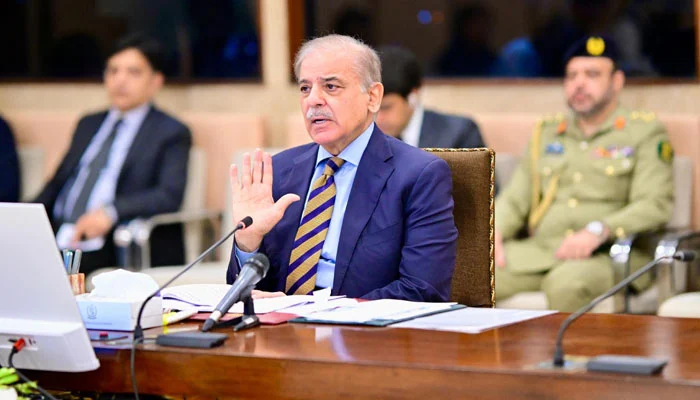
The National Economic Council (NEC) on Wednesday approved a 4% economic growth target and an inflation target of 8.2% for FY2026-27, alongside a Rs3.2 trillion national development programme and a set of macroeconomic targets for the next fiscal year.
According to the annual plan approved by the council, the agriculture sector is expected to grow by 3.8%, while large-scale manufacturing (LSM) is targeted to expand by 4.5%. Overall industrial growth has been projected at 4%, supported by expected improvements in manufacturing, mining and quarrying, construction and energy.
The services sector is projected to grow by 4.2%, driven by wholesale and retail trade, transport and communications, and financial services.
The NEC also approved a savings target of 14.3% of gross domestic product (GDP) and an investment target of 15% of GDP.
Read This: NEC approves Rs3.2 trillion national uplift plan as provinces agree Rs920 billion grant for Centre
For the external sector, the council approved a current account deficit target of 0.7% of GDP, equivalent to $3.6 billion, compared with an estimated deficit of around $1 billion in the current fiscal year.
Exports are projected to rise to $32.8 billion in FY2026-27 from an estimated $30.3 billion this year, while imports are expected to exceed $70 billion, up 5.6%. As a result, the trade deficit is projected at $37 billion.
Workers’ remittances are expected to reach $42.3 billion next year, reflecting an increase of 2.7%, amid uncertainty in the Middle East.
Briefing journalists after the meeting, Planning Minister Ahsan Iqbal said the NEC had approved 11 initiatives aimed at addressing structural economic challenges, including low investment, weak exports, resource mobilisation, productivity and value addition in agriculture and human capital development.
He also announced that the council would meet quarterly in future, saying the NEC should play a more active role in reviewing economic and development performance.
The NEC approved provincial development allocations of Rs749 billion for Punjab, Rs706 billion for Sindh, Rs455 billion for Khyber Pakhtunkhwa and Rs308 billion for Balochistan.
Sector-wise allocations include Rs206 billion for infrastructure, Rs180 billion for the social sector, Rs116 billion for energy, Rs103 billion for water resources and Rs13 billion for governance.
For federal ministries and divisions, Rs687 billion was approved for development projects, including Rs568 billion from local resources and Rs119 billion through foreign assistance.
The council also approved Rs313 billion for corporations, including the National Highway Authority (NHA) and power-sector entities, comprising Rs177 billion in domestic funding and Rs136 billion in foreign assistance.
Additional allocations include Rs88.8 billion for Azad Jammu and Kashmir and Gilgit-Baltistan, Rs74 billion for education, including Rs45 billion for the Higher Education Commission (HEC), Rs41.4 billion for information technology, Rs355.9 billion for transport and communications, Rs54.6 billion for physical planning and housing, Rs22.1 billion for health and Rs63 billion for Sustainable Development Goals (SDGs) programmes.
The NEC also approved Rs56.1 billion for the merged districts of Khyber Pakhtunkhwa, Rs12.6 billion for the production sector, Rs8 billion for industrial development and Rs4.6 billion for food and agriculture.
Comments
No comments yet. Be the first to join the discussion!