National Economic Council meeting postponed for third time
Forum was due to review Rs4.715 trillion development plans, growth target and revised federal-provincial allocations
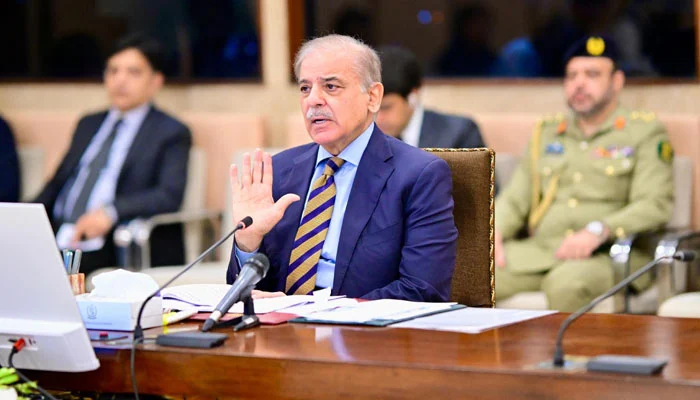
The National Economic Council meeting scheduled for Monday has been postponed for a third time as the federal government negotiates development allocations and fiscal targets with provinces and other stakeholders ahead of the 2026-27 budget, according to reports.
Prime Minister Muhammad Shehbaz Sharif chairs the NEC, which includes the four provincial chief ministers and four federal ministers. The council approves national economic targets and federal and provincial development programmes.
The meeting was expected to consider federal and provincial development plans totalling Rs4.715 trillion for the next fiscal year, although officials indicated that the allocations could be revised because of competing demands from the Centre, provinces, coalition partners and other institutions.
The government is also required to maintain a primary budget surplus of 2% of gross domestic product, or more than Rs2.8 trillion, under its commitments to the International Monetary Fund.
The Annual Plan Coordination Committee last week cleared a federal Public Sector Development Programme of Rs1.126 trillion and provincial annual development plans totalling Rs3.138 trillion.
Dawn reported, citing senior government officials, that the federal development programme could be increased beyond Rs1.3 trillion, while the combined size of provincial development plans could be reduced from the figure approved by the committee.
The PSDP summary placed before the government retained the Rs1.126 trillion allocation but sought authorisation from the NEC to enhance it.
Officials said the final allocations would be settled at the NEC meeting after the completion of political consultations with coalition partners and provincial governments.
The Centre had initially sought around Rs1.7 trillion in additional fiscal space from the provinces, besides a provincial cash surplus of nearly Rs2 trillion, equivalent to about 1.4% of GDP, for the coming fiscal year.
That demand has since been reduced by almost one-third to around Rs1 trillion, according to officials.
Allocations proposed for development schemes backed by coalition partners and parliamentarians from the ruling party are expected to remain mostly unchanged at Rs87 billion and Rs70 billion, respectively.
NEC agenda
The four-point NEC agenda included a review of the Annual Plan 2025-26 and approval of the Annual Plan 2026-27. The council was also scheduled to receive a presentation on major socioeconomic indicators across the four provinces.
Another agenda item covered the review of Public Sector Investment for 2025-26 and the proposed investment programme for 2026-27.
The council was expected to confirm changes made to the PSDP 2025-26 through addendums, corrigendums and other adjustments ordered by the prime minister, including a reduction of around Rs175 billion.
Chief secretaries from Punjab, Sindh, Khyber Pakhtunkhwa and Balochistan were due to present their respective annual development programmes.
The council was also expected to review a report on the work of the Central Development Working Party from April 1, 2025, to March 31, 2026.
The report covers projects approved by the CDWP and Executive Committee of National Economic Council during the same period.
Planning Commission was scheduled to brief the NEC on findings from its monitoring and evaluation of major development projects. The PSDP 2025-26 portfolio comprised 801 schemes being implemented by 40 ministries, divisions and state-owned enterprises. These included 734 ongoing projects and 67 new initiatives.
Of the 240 projects selected for monitoring during the fiscal year, 170 had been reviewed by March 2026, including cases assigned for separate examination.
The NEC was also due to review economic performance during FY26 and approve macroeconomic targets for the coming fiscal year.
Pakistan’s GDP growth target for 2026-27 has been proposed at 4%, while inflation is projected at 8.2%.
Commodity-producing sectors are targeted to expand by 3.9%, supported by projected growth of 3.8% in agriculture and 4.5% in large-scale manufacturing.
Overall industrial growth has been targeted at 4% for 2026-27, based on an expected recovery in large-scale manufacturing and expansion in mining and quarrying, construction, energy, gas and water supply. The services sector is projected to grow by 4.2%.

Our monitoring team diligently searches the vast expanse of the web to carefully handpick and distill top-tier business and economic news stories and articles, presenting them to you in a concise and informative manner.
View all articles →Comments
No comments yet. Be the first to join the discussion!