Asian markets turn cautious as US-Iran talks stall, yen hits 40-year low
Nikkei rises 0.8% while Kospi slips 0.9%; dollar strengthens after U.S. Treasury yields jump and Brent edges up to $73.19

SYDNEY: Asian markets began the new quarter cautiously on Wednesday as stalled U.S.-Iran talks, rising Treasury yields and a weaker yen weighed on investor sentiment.
Tehran said on Tuesday it would not meet senior U.S. envoys who had travelled to the region, with both sides still apart on a framework to fully reopen the Strait of Hormuz.
Bond markets remained under pressure after U.S. Treasury yields rose overnight, as futures increased the probability of further rate hikes by the Federal Reserve ahead of U.S. jobs data due on Thursday.
Investors are also waiting for remarks by Fed Chair Kevin Warsh at a European Central Bank conference later in the day for any indication on monetary tightening.
Futures imply a 33% chance that the Fed could raise rates at its next meeting later this month, while the probability of a September move is priced between 67% and 88%.
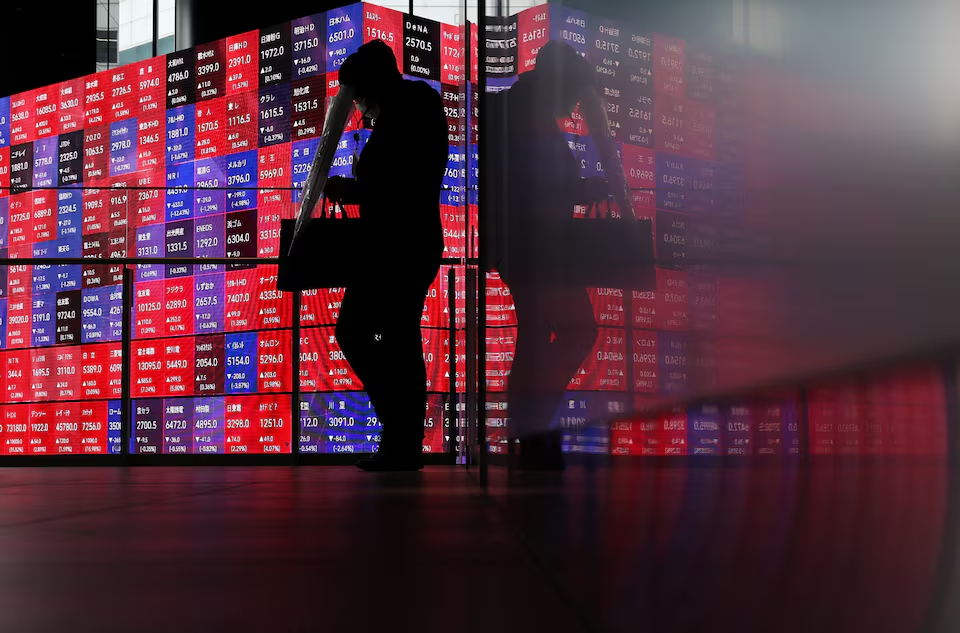
In equity markets, Japan’s Nikkei rose 0.8% after gaining 37% in the previous quarter, supported by demand for technology stocks.
The rally also helped lift sentiment among major Japanese manufacturers to the highest level since 2018, while manufacturing activity recorded its strongest quarter since 2014 as new orders increased.
South Korea’s main index fell 0.9% after a 68% rise in the second quarter on strong artificial intelligence-related demand for semiconductors.
South Korea’s exports recorded their fastest growth in nearly 50 years in June, with semiconductor shipments rising almost 200%. The country also became the fourth in the world to reach monthly exports of $100 billion, after Germany, China and the United States.
MSCI’s broadest index of Asia-Pacific shares outside Japan gained 0.2%, while Chinese blue chips rose 0.3%.
In Europe, EUROSTOXX 50 futures and DAX futures were flat, while FTSE futures fell 0.3%. S&P 500 futures and Nasdaq futures both eased 0.2% after gains on Wall Street overnight.
Wall Street has just recorded its strongest quarter since 2020, led by an 88% rise in the Philadelphia Semiconductor Index.
Chris Weston, head of research at Pepperstone, said the historical record favoured equity bulls, noting that Nasdaq futures had recorded only one negative July since 2008.
He said the upcoming earnings season would be important in determining whether earnings expectations continue to improve and whether portfolio allocations keep shifting towards technology.
Major banks will begin reporting earnings from mid-July. Goldman Sachs analysts said consensus expectations point to earnings per share growth of 22% year-on-year.
AI infrastructure stocks are expected to contribute nearly 60% of S&P 500 earnings-per-share growth, with Micron and Nvidia together accounting for more than 40%.
Higher bond yields remain a challenge for equities. The yield on 10-year U.S. Treasuries stood at 4.55% after rising nearly 9 basis points on Tuesday.
The rise in yields helped push the dollar to 162.84 against the yen, its strongest level in four decades.
The yen’s decline has renewed attention on possible intervention by Japanese authorities, although Tokyo has so far appeared reluctant to act after spending nearly 12 trillion yen in April and May with limited lasting impact.
Tim Baker, macro strategist at Deutsche Bank, said the latest move reflected dollar strength more than yen weakness, as the yen had remained broadly steady against other major currencies.
He said lower oil prices had helped Japan as a net energy importer and that real yield spreads had slightly moved in the yen’s favour.
The euro was steady at $1.1409, staying above its recent 13-month low of $1.1325.
European Union inflation data due later is expected to show inflation easing to 3.0% in May from 3.2% in the previous month.
Markets now assign only a 32% chance of a July rate hike by the European Central Bank and suggest that one further increase to 2.5% could mark the end of the tightening cycle.
In commodities, Brent crude rose 0.3% to $73.19 a barrel, far below its May peak of $126.41. U.S. crude increased 0.4% to $69.74 a barrel.
Gold remained under pressure after a weak quarter, falling 0.7% to $3,977 an ounce.
Comments
No comments yet. Be the first to join the discussion!