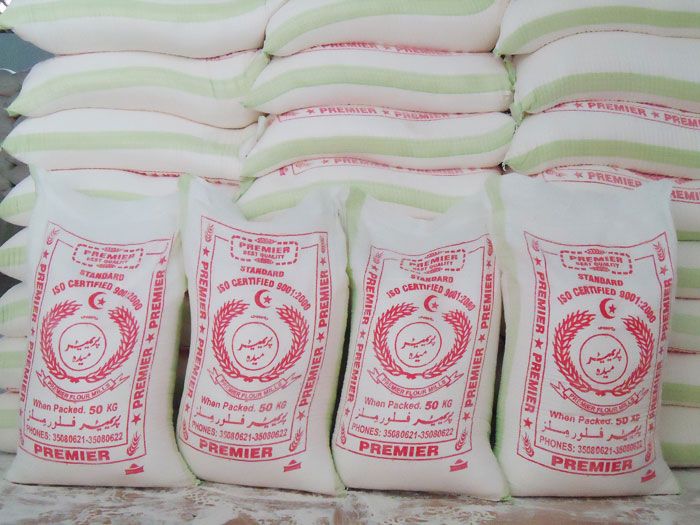
We’re going through a wheat shortage again. Is it hoarding or a bad harvest?
The government claims there is more than enough wheat to sustain Pakistan’s annual demand. But with prices rising and wheat disappearing from the markets, the familiar signs of hoarding season are emerging once more.

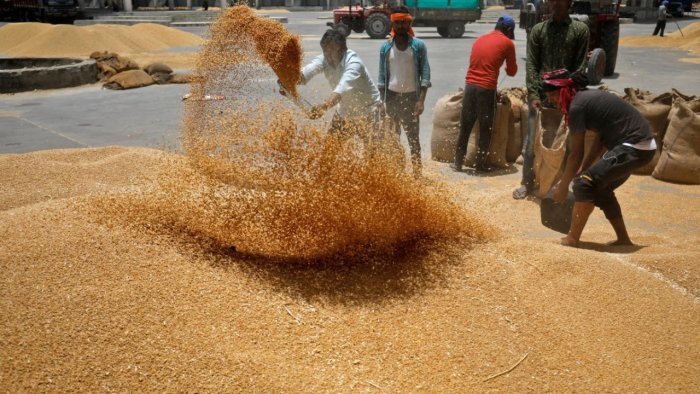
The price of roti has risen in Lahore. Recently, the United Nanbai Association announced an increase in the price of roti from 20 to 25 rupees and that of a naan from Rs 30 to 35. The reason cited was simple: increasing prices of flour, which for a 20 kg bag had risen to 2400 rupees. The government mandated rate of 16 rupees per roti, according to the association, was impossible to follow.
This hike in the prices of flour is not simply a Lahore phenomenon. In Peshawar, a 20 kg bag of flour is being sold at 3000 rupees in the retail market, and at 2900 rupees in the wholesale market. Rates of 2900 rupees per 20 kg of flour were also being reported in Karachi (compared to 1800 rupees a year ago). It was only a few days ago that the city government was able to fix the ex-mill price of flour at 2500 rupees. In fact, there are reports that in certain areas of Karachi, just like in Lahore, the price of roti has risen from 20 to 25 rupees.
But why are wheat prices rising? Very simply put, there is simply not enough supply of wheat to sustain the old prices. But whether that reduced supply is due to reduced wheat production or hoarding seems a question there is some contention on.
Earlier this week, for instance, in a meeting of the Wheat Board, representatives of flour mills, traders, farmers and the Cereal Association maintained that the wheat shortfall was estimated at 3.5 million tonnes, and that Pakistan might need to import at least 2 million tonnes of wheat to supply this deficit. In the meeting, the Federal Minister for National Food Security and Research Rana Tanveer Hussain pointed out that the prices per maund of wheat had risen to 4,400 rupees, 900 rupees higher than the support price established by the government.
Soon after this meeting, the federal government categorically denied the existence of any wheat shortage in the country. Rather, it said, it had achieved seasonal production targets and surpassed last year’s production by 1.36 million tonnes. Provincial representatives claimed that there were sufficient stocks in all regions to meet consumption requirements, and the government announced that it would be cracking down on hoarding and manipulated price hikes, effectively claiming that the shortage of wheat was engineered.
Why is there this conflict in claims then? Is there enough wheat produced or not, regardless of whether it is available in the market? While the government has started its crackdown on hoarding, whatever its extent, there seems to be some pressure at least on wheat stocks as well. But while that is for time to reveal, let us examine what has been happening that has pushed wheat prices to their current levels.
Wheat Procurement
Wheat is a complicated crop in Pakistan. It is both a necessity and the source of one of our oldest and deadliest addictions; wheat subsidies and support prices.
It began, of course, with the canalisation of the Punjab under British imperial rule. The Empire’s hunger for wheat dug canals, allocated lands to today’s jagirdars and waderas, and laid railway tracks to transport this wheat from Punjab all the way to Karachi and Mumbai’s ports.
Post partition, wheat is what Pakistani farmers continued to rely on. The crop made them good money and fed the country, which is why the government encouraged it. But this encouragement resulted in a new problem: suffering from success. Production was so high that farmers struggled to sell their crop. And here, the government made a decision. It would buy off the excess wheat from the farmers and store it for emergencies. The government would do this through the putting in place of minimum pricing. It would guarantee a minimum price to the farmers at which if they were unable to find a buyer in the market, they could simply sell their wheat to the government.
Support prices were a classic economic tool used by governments after the second world war. They were a means to sustain the production of the most basic and important commodities. Eventually, developed economies are weaned off this support. For Pakistan, it set of a six decade long addiction. Over time the government became the principal buyer of local wheat and the private sector’s role shrank.
And as time passed, this subsidy became laced with politics and favours. The system became quite charged with inefficiencies and bureaucratic red taping. Farmers with connections and political backing were often the ones that skipped to the head of the line while others were left to sell their crop cheaply to middle men. On top of this, it was also a massive burden for the government. Every year the provinces would borrow billions from banks to fund this purchase. By 2023 these borrowings had reached 680 billion rupees in a vicious cycle of circular debt, without the subsidy’s effects ever reaching the most deserving farmers. The details of thi system have been covered by Profit before.
Read more: The free market comes to Pakistan’s wheat crop
Then came 2024. The government, under pressure from the IMF, announced that wheat support prices would soon be a thing of the past. This was poorly received by a farming community that has grown used to the support. The problem is that without any storage capacity, farmers have to sell their wheat as soon as possible. Otherwise it would go bad and they would not have the means to plant their next crop. Without a legitimate buyer around, they can be exploited by middle men (“Arthis”) who have storage and transport facilities.
Last year, as part of these promised reforms, the Punjab government proposed a private sector led procurement model. The aim was to procure 3 million tonnes of wheat through 11 private companies, who were provided with incentives such as government-facilitated negotiation of bank loans, covering up of mark up costs, providing free storage in Food Department’s warehouses, and so on. Essentially, the government would help arrange financing for these companies to procure wheat at a set price.
The problem was that the system struggled to take off. The procuring companies and banks failed to reach meaningful agreements quickly enough about the financing rates. By mid-April, when wheat cultivation was picking up pace and the market was being inundated by wheat, the market prices fell below the minimum price set by the government at 3,500 rupees per maund (40 kg). Many farmers were forced to sell their wheat at distress rates, below the government-set support price. By May, it was reported by Dawn that at least 9 of the participating 11 firms had been unable to purchase any wheat at all. This was the case in Punjab, which accounts roughly for 2/3rd of the total domestic production of wheat.
The issue with timing, however, is that it determines price. Once, when there has been a surge in market supply, the balance is disrupted with large supply, it is then followed often by a steep decline in available stocks, which pushes prices back up. And this, at least partly, is what caused the prices of wheat to rise to levels higher than the government-mandated minimum price, in some instances to 3,700 rupees. And by then the farmers were unwilling to sell wheat to the government-mandated firms, since they – after having sold part of their wheat at distress rates – they could now find higher prices for their produce.
Other realities
On top of this, the crop itself has been under some pressure. Dawn, for instance, reported that in certain districts yields this cycle were lower by 3 to 5 maunds per acre, due to the alternation of a heatwave and untimely rains which disrupted the crop cycle, meaning that there was at least some pressure from the supply side on the price. Now, it is not clear whether the government's claims of having met wheat cultivation targets are based on a reduced estimate, or whether these lower yields in some markets were offset by higher yields in other districts.
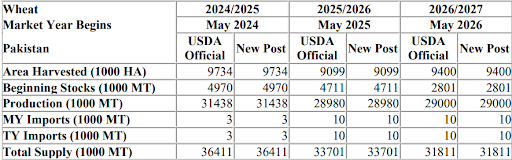
There is some truth to claims about lower general availability of wheat as well. According to a report by the US Department of Agriculture, total production this cycle (May 2026) was 29 million tonnes, merely 120,000 tonnes higher than the figure in 2025, but lower by almost 4.4 million tonnes from the figure in 2024. On top of that, a crucial issue has been that the opening stocks this cycle were 2.8 million tonnes, which were 1.9 million tonnes less than what they were in the previous cycle, and 2.1 million tonnes less than in the cycle before that. The result was that total wheat supply this cycle was 31.8 million tonnes, almost 2 million tonnes lower than in 2025, and almost 5 million tonnes lower than in 2024. There was, therefore, at least some upward pressure on wheat prices, which was exacerbated by the issues associated with the ineffectiveness of the procurement strategy.
Now the procurement strategy’s failure to adequately account for local production of wheat obviously resulted in speculative pricing. In 2025, concerns over hoarding the grain during peak supply season and then offloading them in the winter before new year’s harvest came into the market were already raised. In fact, it was reported that the price of wheat had almost doubled from early summer (April-May) to mid-winter (December-January), seemingly rewarding those who had hoarded the grain in excess storage. Expectations about similar gains this year also likely motivated middlemen and mill-owners with sufficient storage to keep the grain under wraps, creating artificial shortage in the market. This is also what the recent government pronouncement about there being no real shortage of wheat seems to point at.
But there is another factor that’s been pushing these manipulators into fixing ‘artificial’ prices for wheat. And that’s the US-Israeli war on Iran. With the closure of Hormuz in the past couple of months and the disruption in fertilizer supply chains, the prices of multiple crops rose due to production pressures. And wheat too saw its price rise. So, there was at least some pressure from that too. And now that signs are not looking too great and the threat of war is already lurking over the region, they might have had some justification in pushing the prices higher.
In any case, the government – as always, late – seems to be concerned foremost with the likelihood of hoarding going on and already, as we have seen in Sindh, has started crackdowns on those suspected of hoarding grain. Sindh seems particularly to have been affected by these ‘shortages’. The province had planned to procure 1 million tonnes of wheat, but by June had been able to procure only 81,348 tonnes. Part of the reason has to do with the timing; the government efforts took some urgency only after prices in the open market were higher than the 3,500 rupees per maund it had established as a support price. The buyers consequently were refusing to sell to the government because the prices were already high.
The crackdown, at least on the surface, appears to be yielding some results. On 14 July, for instance, the government announced that following its efforts to curb hoarding, the price per maund of wheat in Karachi had fallen from 4,600 to 4,100 rupees. Hoarding, after all, is not a new or an uncommon phenomenon. Even last year, the Punjab government did a crackdown on wheat during July and was able to recover hundreds of thousands of tonnes of hidden wheat, which hoarders had hid in order to inflate prices. Something on a similar scale, now the government is vowing to do.
But whether that will be enough to supply the shortfall and rein in the gnashing prices of wheat, it remains to be seen. The government in a recent meeting of the Wheat Board was told that the supply gap had to be covered through imports and that it could not be covered by anything else. Bickering already had started over which segments would benefit from these imports, and which would not. For now, however, the government has vowed to crack down on hoarding and wait for the next meeting in two weeks of the same Board to determine the needed course of action.
Comments
No comments yet. Be the first to join the discussion!