A Strategic Wake-Up Call
More than 90% of Pakistan’s FDI comes from just five countries

Pakistan's latest Foreign Direct Investment (FDI) statistics reveal a challenge that extends far beyond the volume of capital entering the country. The more revealing story lies not in how much investment Pakistan attracted during FY2025-26, but in who chose to invest and, more importantly, who chose not to.
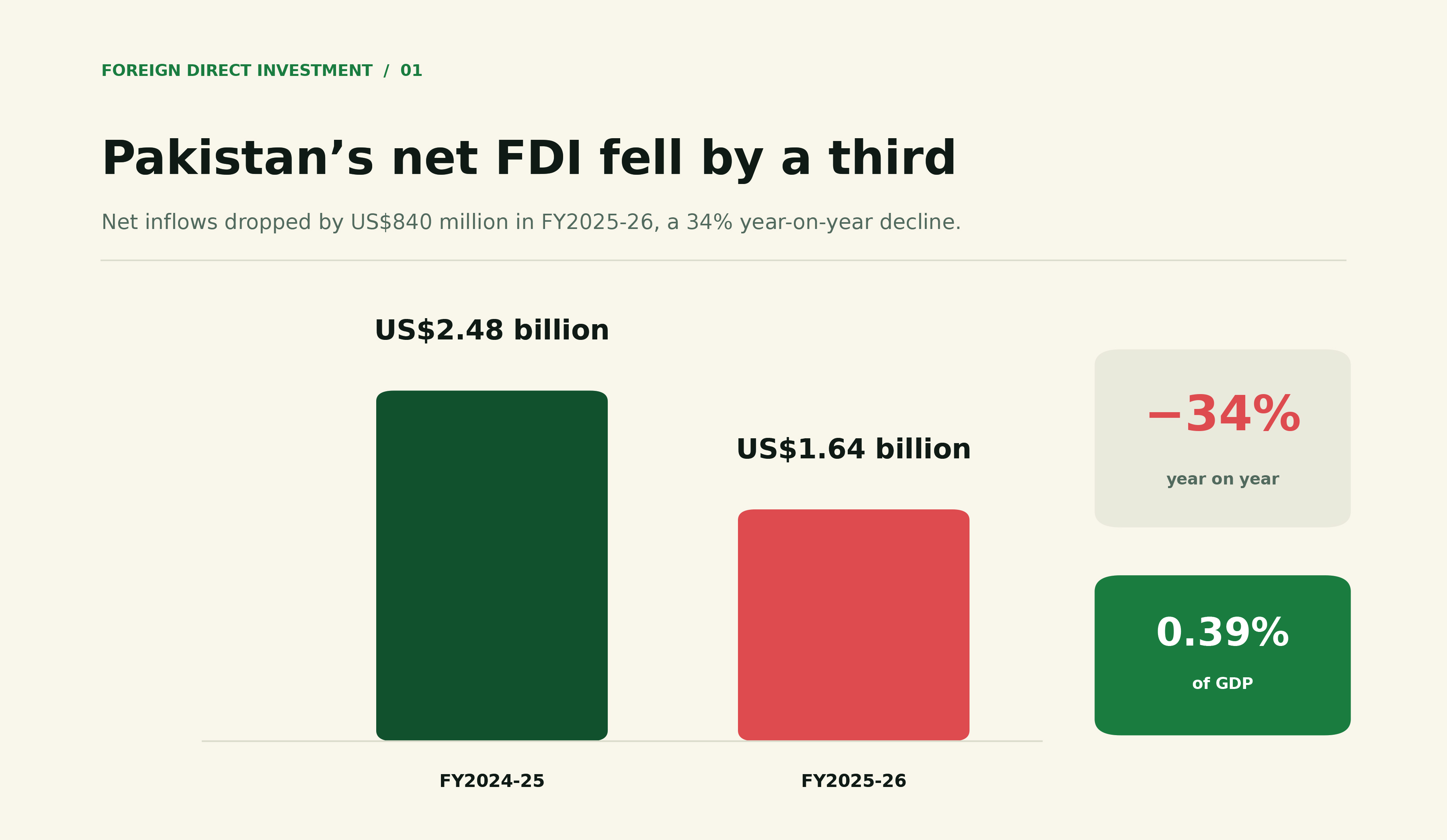
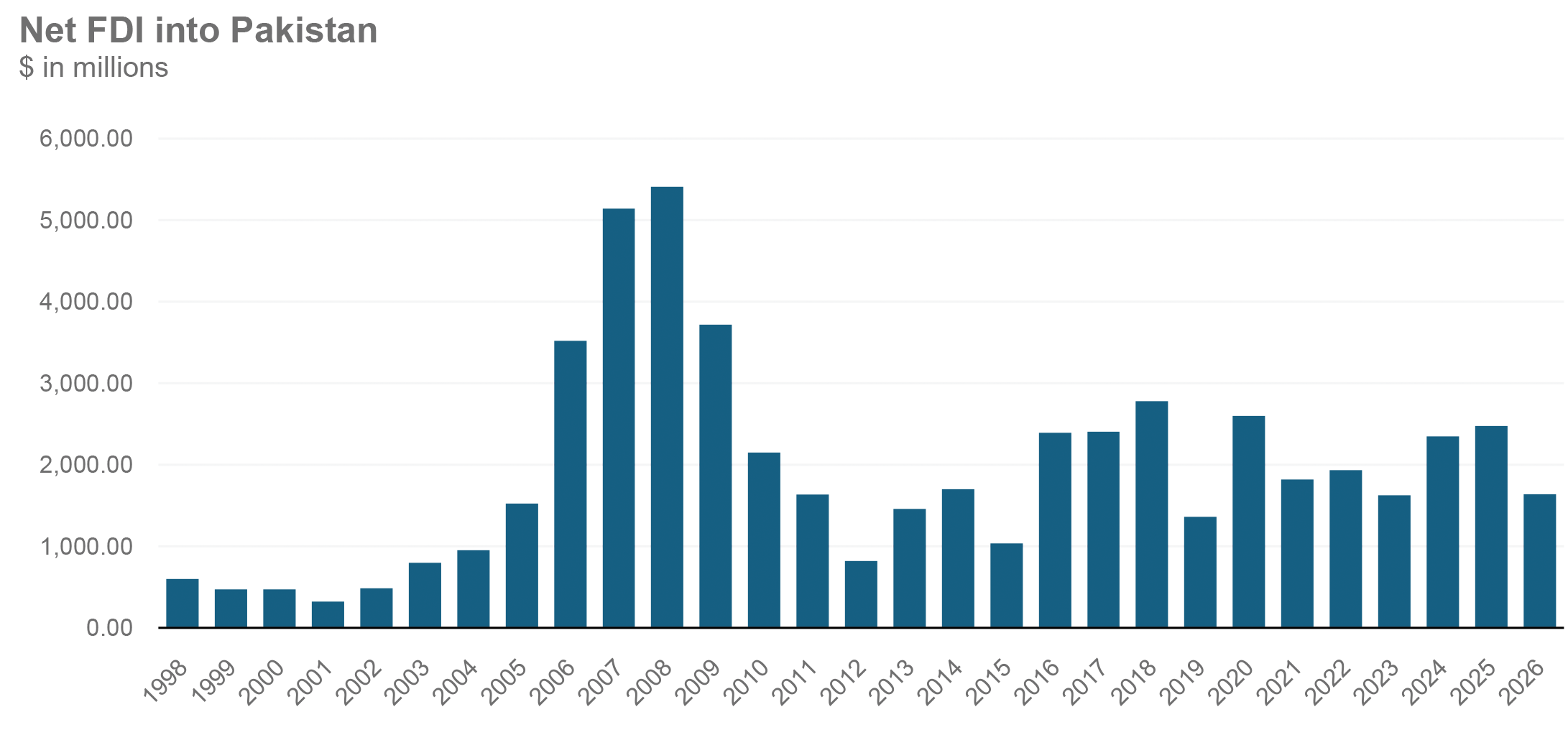
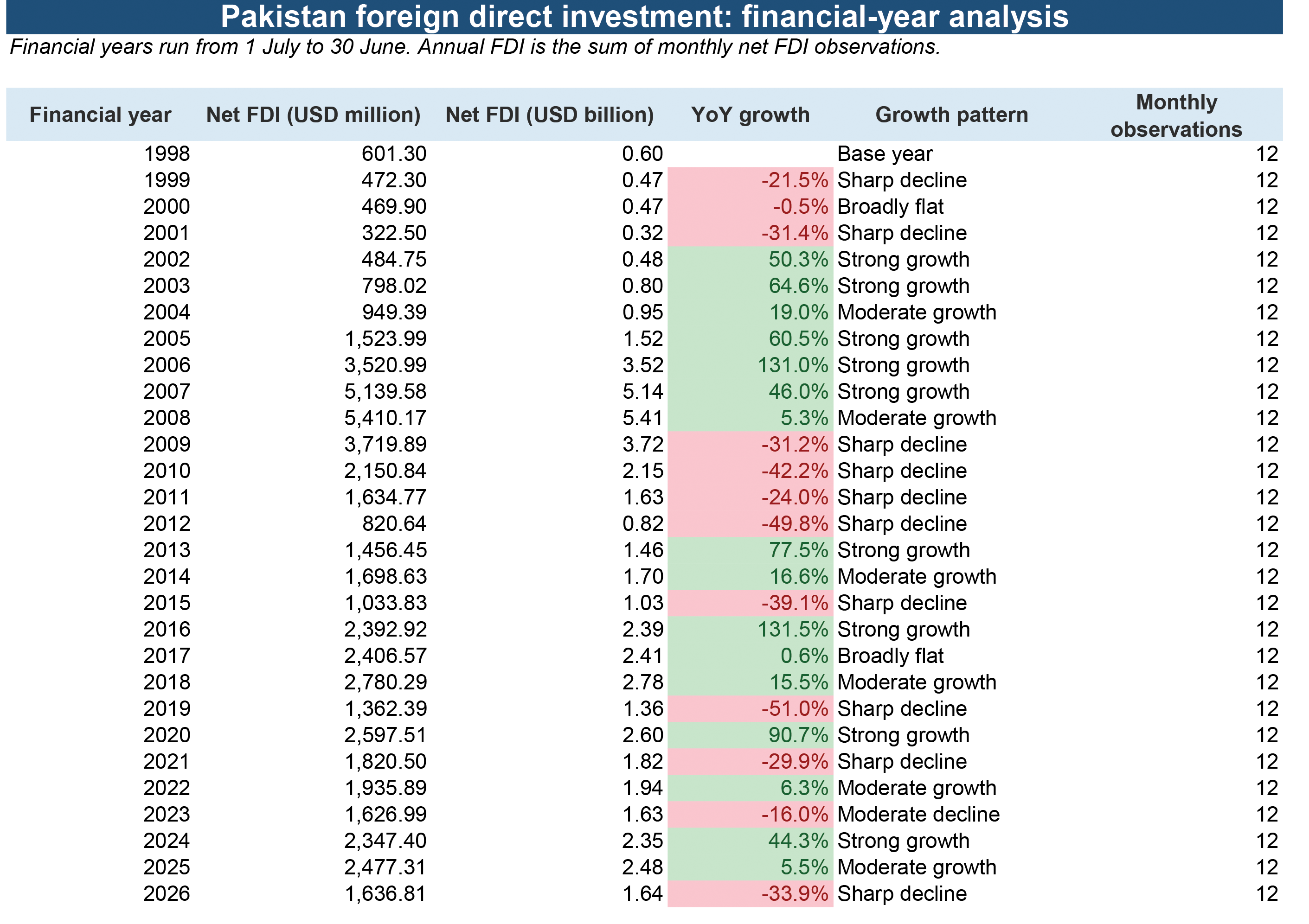
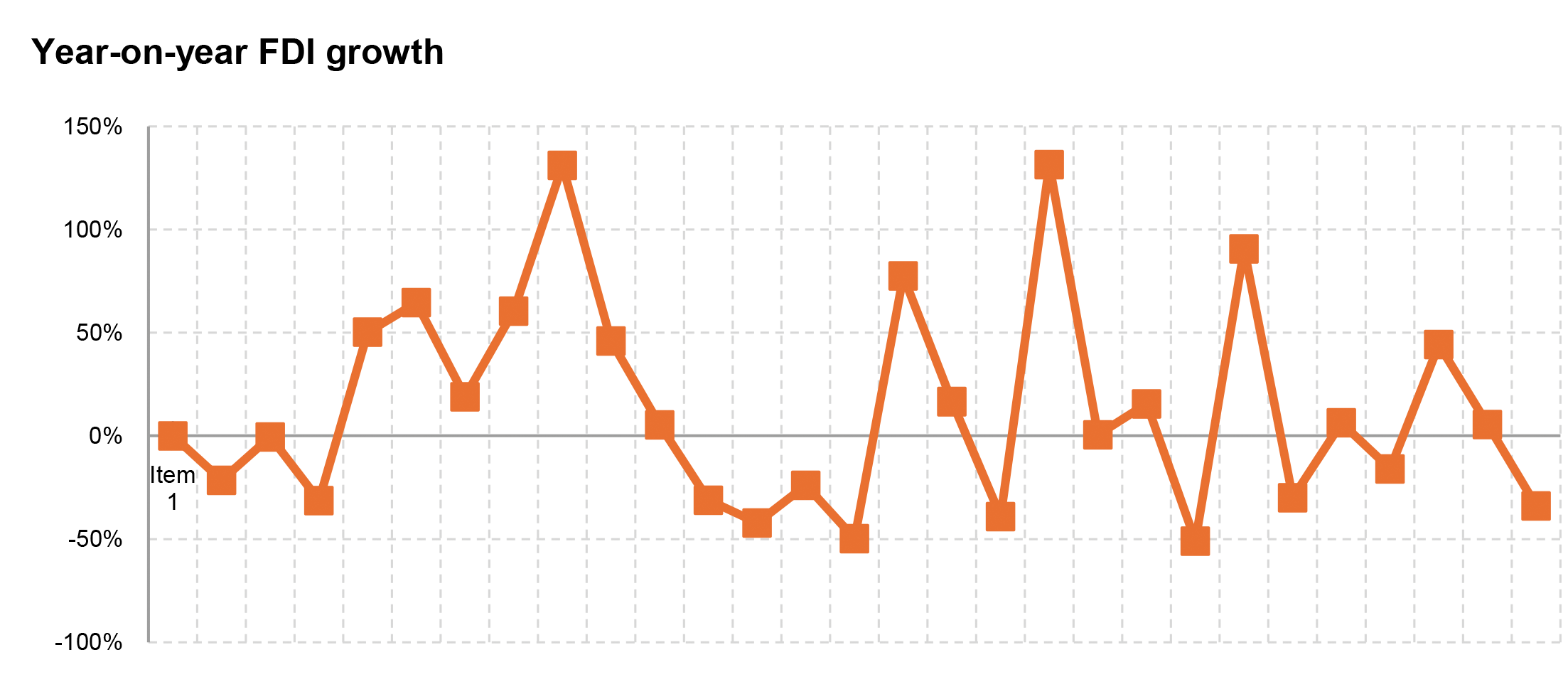
The latest data from the State Bank of Pakistan (SBP) shows that net FDI stood at just USD 1.64 billion during FY2025-26, falling 34% year over year from approximately USD 2.48 billion and amounting to only 0.39% of GDP. For a country of more than 250 million people and the world's fifth-largest population, that figure remains deeply concerning. Sustained FDI inflows are widely regarded as one of the world's most objective indicators of investor confidence because they reflect how international investors assess a country's business environment, institutional credibility, policy consistency, regulatory predictability, and long-term economic prospects. Strong inflows indicate that investors are willing to commit long-term capital, while persistently weak inflows signal structural weaknesses that continue to discourage productive investment.
Yet the more important story emerges when we look beyond the headline number.
China remained Pakistan's largest foreign investor during FY2025-26, contributing USD 862 million, representing approximately 52.6% of total net FDI. Hong Kong followed with USD 339.4 million (20.7%), while the United Arab Emirates invested USD 235.9 million (14.4%). Together, these three economies accounted for almost 88% of Pakistan's total net FDI. Once Switzerland and the United Kingdom are included, the contribution of the top five investing countries exceeds 90% of all FDI entering Pakistan.
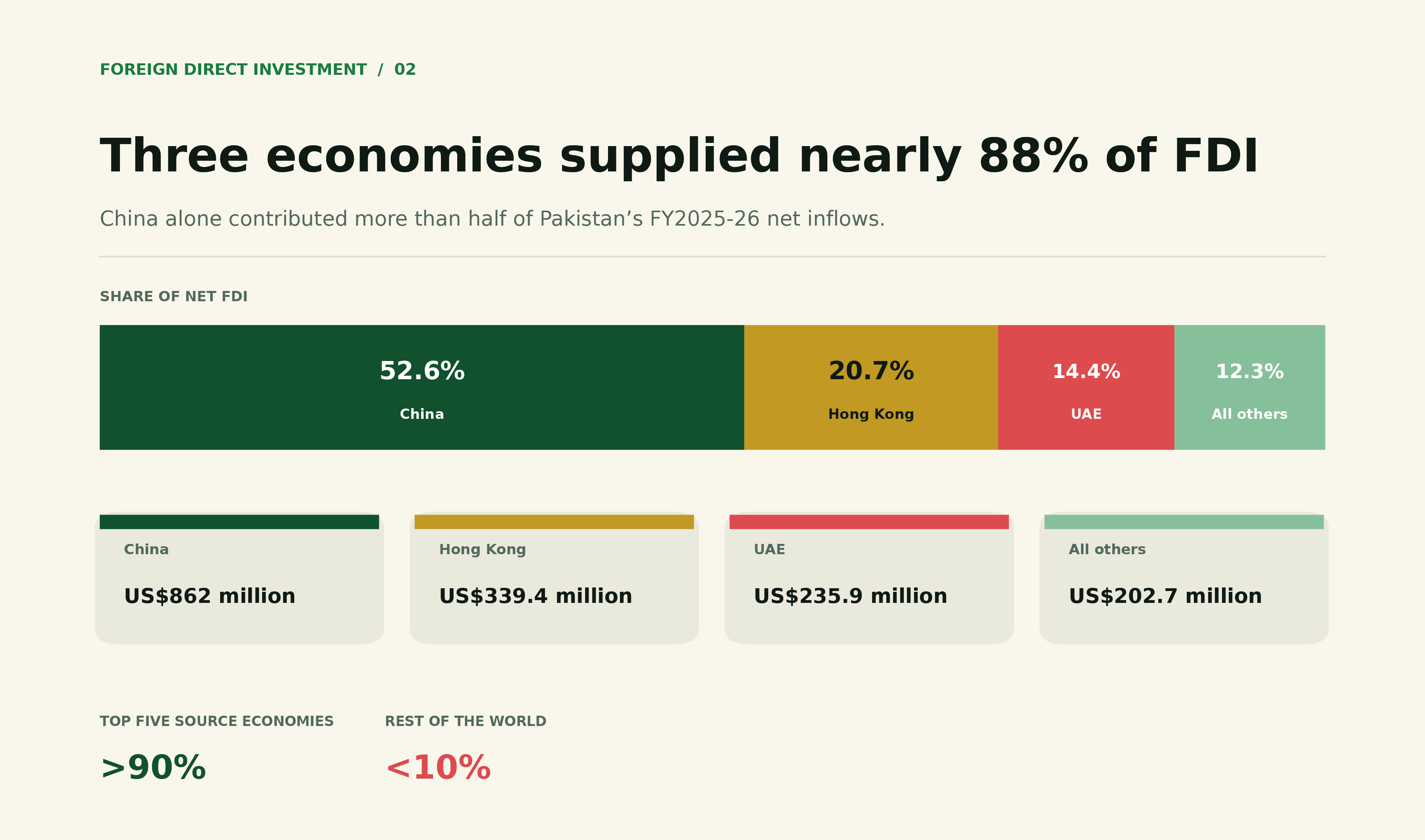
The implication is striking: the entire rest of the world contributed less than 10% of Pakistan's total FDI.
This concentration deserves far greater attention than it has received.
Every country naturally develops stronger investment relationships with certain partners. Geography, historical ties, trade linkages, and strategic cooperation all influence investment patterns. However, when more than 90% of a country's foreign investment originates from only five countries, the issue is no longer one of preference. It becomes a question of diversification, resilience, and global competitiveness.
The real policy question, therefore, is not why these five countries continue investing in Pakistan. The far more important question is why an overwhelming majority of the world's major investing nations remain largely absent.
Where are the United States, Canada, Germany, France, Italy, the Netherlands, Japan, South Korea, Singapore, Australia, the Nordic countries, and most of ASEAN? Why does Pakistan continue to attract only marginal investment from Latin America, Africa, Central Asia, and much of Continental Europe? Why do so many of the world's leading sources of outward investment continue to bypass a country that possesses one of the world's largest consumer markets, an exceptionally young population, and one of the most strategically located geographies connecting South Asia, Central Asia, China, and the Middle East?
These are not rhetorical questions. They go to the heart of Pakistan's investment challenge.
The pattern also suggests that Pakistan's FDI story is no longer purely an economic one; it increasingly reflects the country's strategic relationships. Despite years of discussion about attracting diversified global capital, there is virtually no meaningful investment coming from the United States or most other major developed economies. Likewise, inflows from many leading emerging economies remain negligible.
For decades, Pakistan has measured investment performance almost exclusively through the annual volume of FDI inflows. While the quantity of investment remains critically important because it reflects the overall health of the business climate, an equally important dimension has received remarkably little attention: the diversity of investors choosing Pakistan. The breadth of a country's international investor base often reveals as much about its competitiveness as the total amount of investment it receives. This is the missing dimension in Pakistan's investment debate, and one that deserves urgent national attention.
The absence of a diversified investor base is not merely a statistical concern; it represents an economic and strategic vulnerability. A country that depends overwhelmingly on a handful of investment partners inevitably exposes itself to unnecessary risk. Changes in bilateral relations, economic conditions within those countries, shifts in investment priorities, or geopolitical developments can disproportionately affect future capital inflows. A resilient investment framework, by contrast, attracts investors from multiple regions, sectors, and economic systems, reducing concentration risk while strengthening long-term stability.
Equally important is the quality of investment that different countries bring. Japanese investment typically strengthens advanced manufacturing and precision engineering. German firms contribute industrial technology and export competitiveness. American companies often lead in innovation, health care, digital services, and high-value industries. Singaporean investors excel in logistics, financial services, and urban infrastructure. Gulf sovereign wealth funds provide long-term capital for infrastructure, tourism, agriculture, and energy, while European investors increasingly focus on renewable energy, climate finance, sustainable manufacturing, and green technologies. A diversified investor base therefore contributes far more than financial capital; it brings technology, managerial expertise, research capability, international supply chains, global market access, and higher standards of productivity.
Pakistan is missing much of this opportunity.
The country's challenge is therefore not simply attracting more investment from existing partners; it is becoming relevant to a much wider universe of global investors. That requires asking a difficult but necessary question: Why does Pakistan's investment proposition continue to resonate with only a limited number of countries while failing to inspire comparable confidence across the broader international investment community?
The answer cannot be explained solely by external factors. Political uncertainty, regional tensions, and global economic slowdowns undoubtedly influence investor sentiment, but they do not explain why many countries facing similar, or even greater, challenges consistently attract investment from a far broader range of international investors. The more convincing explanation lies within Pakistan's own investment environment.
Global investors do not invest because countries possess potential. They invest because they believe that potential can be converted into predictable, profitable, and sustainable returns.
Pakistan has never lacked potential. Its challenge has been converting that potential into confidence.
Before committing long-term capital, investors evaluate far more than market size or growth projections. They assess the stability of economic policy, the continuity of regulations, the credibility of institutions, the enforceability of contracts, the efficiency of taxation, the quality of infrastructure, the speed of regulatory approvals, the independence of the judiciary, the professionalism of public administration, and the consistency with which governments honor their commitments. Investment decisions are therefore based not on a single incentive or policy announcement but on the cumulative credibility of the entire business environment.
One experience from my tenure as Pakistan's Minister for Investment illustrates this challenge vividly. Saudi Arabia was one of my highest priorities, and I devoted considerable effort to building institutional relationships with its leadership, senior government officials, and leading family business groups. During one of my meetings, the Saudi Minister of Investment made an observation that has remained with me ever since. He explained that Saudi private-sector investment in Uzbekistan had already reached tens of billions of dollars despite Uzbekistan having a population of only about 37 million people. His message was simple: if Saudi investors could confidently invest such substantial capital in Uzbekistan, there was no logical reason Pakistan, with a population exceeding 250 million, deep historical ties, and an exceptional strategic relationship with Saudi Arabia, should remain overlooked.
Today, Saudi investment in Uzbekistan has reached approximately USD 30 billion over the past seven years, facilitated by the Saudi Ministry of Investment but driven almost entirely by Saudi private-sector companies. That conversation fundamentally changed my perspective. It confirmed that the constraint was never the availability of capital or the absence of strategic goodwill. The real constraint was Pakistan's inability to convert diplomatic relationships into commercial confidence. Despite decades of exceptional bilateral relations, multiple high-level visits, and repeated announcements of investment memoranda, Saudi FDI into Pakistan has remained negligible.
This is not an isolated Saudi case; similar untapped opportunities exist across many countries where goodwill exists but investor confidence does not. The lesson is universal: countries do not receive investment because they enjoy friendly diplomatic relations; they receive investment because investors trust the domestic environment in which their capital will operate. Diplomatic goodwill can open doors, but only institutional credibility persuades investors to walk through them.
The United Arab Emirates offers another important perspective. Despite visible strains in bilateral relations over the past two years, it nevertheless remained Pakistan's third-largest foreign investor during FY2025-26. This demonstrates that long-term strategic economic partnerships often extend beyond temporary diplomatic or political difficulties and should never be taken for granted.
Pakistan possesses another strategic asset that remains significantly underutilized: its overseas Pakistanis. Successive governments have rightly celebrated record remittance inflows, yet the diaspora represents something far more valuable than a source of foreign exchange. Millions of overseas Pakistanis occupy senior leadership positions in multinational corporations, manage successful businesses, advise global investment funds, and influence investment decisions across every major economy. Properly engaged, they could become Pakistan's most credible investment ambassadors.
Yet many remain reluctant because their own investment experiences have too often been shaped by regulatory uncertainty, inconsistent policies, weak contract enforcement, taxation concerns, and administrative barriers. I have discussed this issue repeatedly with policymakers over the years. No country can expect its diaspora to confidently recommend it to global investors until it first earns the confidence of its own citizens abroad. Trust begins at home before it can be exported internationally.
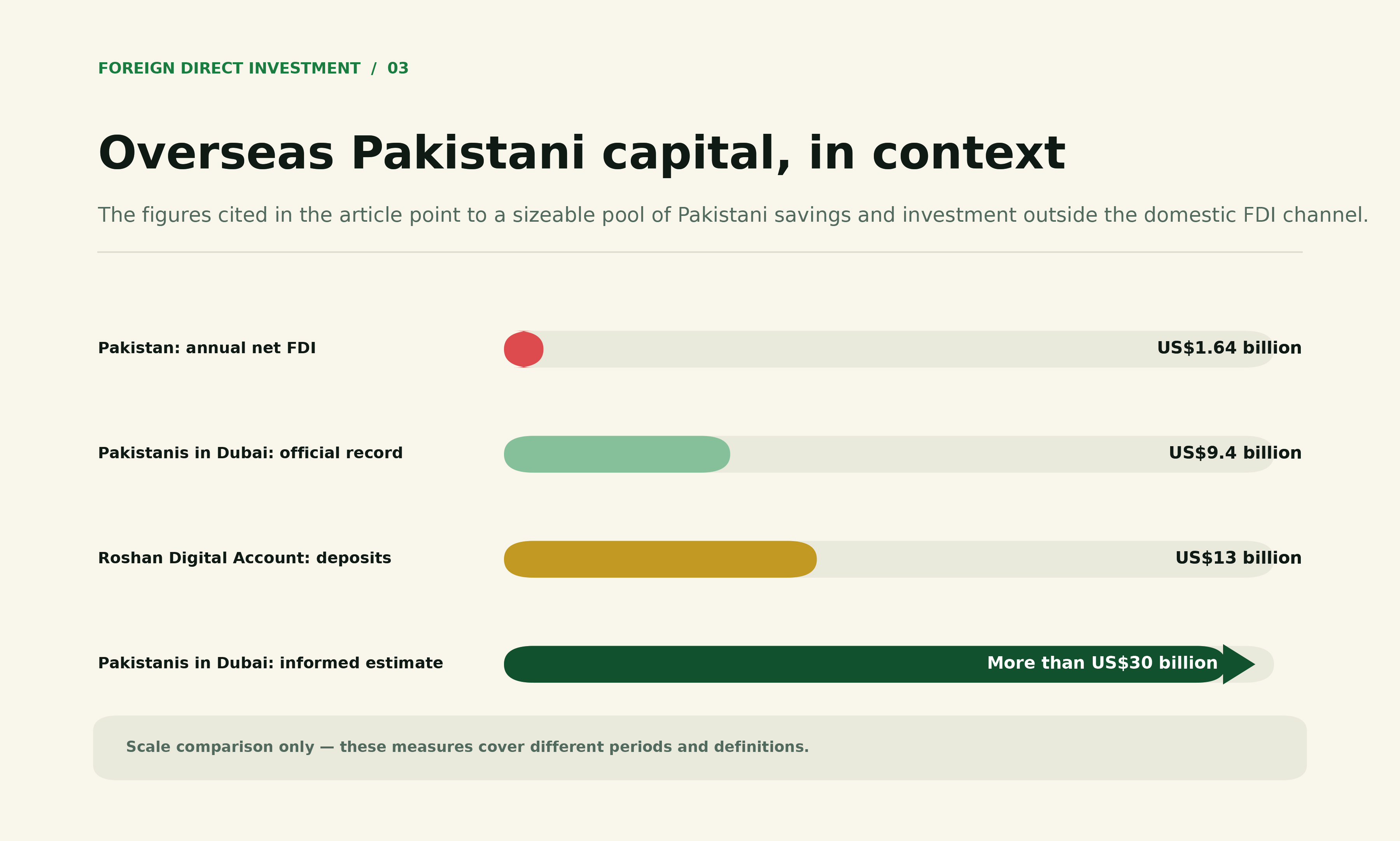
The scale of this unrealized opportunity is enormous. Overseas Pakistanis have demonstrated their financial strength repeatedly. Through the Roshan Digital Account (RDA) initiative alone, they deposited around USD 13 billion, a figure representing only a small fraction of their global savings. In Dubai, Pakistanis rank among the largest foreign investors, with officially recorded investments of around USD 9.4 billion, while informed estimates place the actual figure at well over USD 30 billion. These numbers illustrate a simple reality: Pakistani capital exists. The challenge is not the availability of resources; it is creating sufficient confidence for that capital to return home as productive long-term investment rather than remaining abroad.
Remittances are invaluable for strengthening foreign exchange reserves and supporting household consumption, but they cannot substitute for productive investment, technology transfer, entrepreneurship, exports, and job creation. Countries build sustainable prosperity through investment-led growth, not remittance-led growth. Pakistan's overseas community possesses global business networks, financial resources, professional expertise, and international credibility that few countries enjoy on such a scale. Restoring their confidence would not only unlock significant investment from the diaspora itself but also create powerful advocates capable of introducing Pakistan to a much wider international investor community.
The starting point for correcting this imbalance is not another promotional initiative or marketing exercise. It is fixing our own house. Existing investors must become Pakistan's strongest ambassadors because satisfied investors attract new investors far more effectively than any advertisement or policy announcement. That requires political stability, long-term policy continuity across successive governments, a competitive and predictable tax system, stronger institutional coordination, faster regulatory decision-making, competent economic leadership, meaningful engagement with subject-matter experts, respect for legal contracts, an efficient dispute-resolution mechanism, and a secure operating environment. Global investors do not demand perfection. They demand predictability. Countries that consistently provide certainty outperform countries that repeatedly promise potential. Unless Pakistan strengthens these domestic foundations, investor diversification will remain an aspiration rather than an achievable national objective.
The logical policy response is for Pakistan to adopt a Global Investor Diversification Strategy (GIDS) as an integral pillar of its national investment policy.
The purpose of GIDS is neither to replace Pakistan's existing investment priorities nor to reduce engagement with its longstanding partners. China, the Gulf countries, the United Kingdom, and other traditional investors will remain critically important to Pakistan's economic future. Rather, the objective is to systematically broaden Pakistan's global investor footprint so that future investment growth is supported by a more balanced, resilient, and globally diversified investor base.
A diversified investor portfolio strengthens economic resilience in much the same way that diversified financial portfolios reduce risk. Countries that depend on only a handful of investment partners remain vulnerable to external shocks beyond their control. Those that attract investment from multiple regions, industries, and institutional investors are better positioned to sustain long-term growth, absorb geopolitical volatility, strengthen exports, accelerate technology transfer, and maintain investor confidence during periods of global uncertainty. In today's increasingly competitive global economy, investor diversification is no longer simply good policy; it has become an economic necessity.
GIDS should not be viewed as another policy document. It should become the foundation of Pakistan's long-term investment architecture. For decades, Pakistan has relied on short-term initiatives, episodic decisions, and reactive policymaking to address structural investment challenges. What has consistently been missing is a bipartisan national investment strategy that survives political transitions, aligns federal and provincial priorities, and provides investors with confidence that the rules of the game will remain stable. Investment decisions are made over decades, not budget cycles. Pakistan therefore requires a long-term national roadmap supported by measurable milestones, institutional accountability, and uninterrupted implementation.
A practical Global Investor Diversification Strategy should rest on four mutually reinforcing pillars.
Market Diversification: Pakistan should identify priority investment markets beyond its traditional partners and develop country-specific engagement strategies for North America, Continental Europe, Japan, South Korea, Singapore, Australia, the Nordic economies, ASEAN, Central Asia, Africa, and Latin America. Each region possesses distinct investment priorities, sectoral strengths, and risk perceptions. Pakistan's investment outreach must therefore become research-driven, commercially focused, and tailored to the specific interests of each market rather than relying on generic investment promotion.
Sector Diversification: Pakistan's investment narrative has historically revolved around a relatively narrow range of industries. Future efforts should actively position the country in high-growth sectors such as information technology, artificial intelligence, advanced manufacturing, agribusiness, renewable energy, climate finance, health care, logistics, critical minerals, and value-added exports. Different sectors naturally attract different categories of international investors, expanding both the depth and diversity of Pakistan's investment portfolio.
Institutional Coordination: Investors evaluate Pakistan as one investment destination, not as a collection of federal ministries, provincial departments, regulators, and facilitation bodies. Regardless of the institutional architecture, investment governance must function as one coordinated national system with harmonized policies, integrated digital platforms, consistent implementation, and clearly defined accountability. Fragmented execution inevitably undermines investor confidence because inconsistency increases regulatory uncertainty, transaction costs, and decision-making delays.
Performance Measurement: Pakistan should begin publishing an annual Global Investor Diversification Scorecard alongside its FDI statistics. The scorecard should measure not only the volume of investment but also the number of investing countries, regional diversification, sectoral diversification, the concentration ratio of the top five investors, the entry of first-time investors, and the reinvestment behavior of existing investors. Such a framework would provide policymakers with a far richer assessment of Pakistan's investment competitiveness than headline FDI figures alone while allowing institutional performance to be evaluated against long-term strategic outcomes rather than isolated annual numbers.
The importance of such a strategy becomes even clearer when viewed through Pakistan's current geopolitical position. Recent macroeconomic stabilization and Pakistan's renewed international visibility have created an opportunity to reposition the country before global investors who are reassessing supply chains, production networks, and long-term investment destinations. Such opportunities are rare. Countries either convert them into durable economic partnerships through institutional readiness or watch competitors seize the moment.
Visibility alone, however, does not attract investment. Only credibility, policy continuity, institutional strength, respect for legal contracts, political stability, and a competitive business environment can convert international interest into sustained capital inflows.
Pakistan's strategic geography, demographic strength, and regional relevance already provide the country with significant comparative advantages. The missing element has never been opportunity; it has been execution. If Pakistan succeeds in strengthening institutional credibility, ensuring political stability, maintaining policy continuity, respecting legal contracts, improving the ease of doing business, and systematically engaging both global investors and its overseas Pakistani community, the country can fundamentally reshape its investment profile. The objective should no longer be to attract isolated transactions but to build an investment ecosystem that consistently generates confidence across the international investment community.
Pakistan's next phase of investment policy must therefore pursue two objectives simultaneously. The first is to increase overall FDI because stronger inflows remain the clearest international barometer of investor confidence, institutional credibility, and the health of the business environment. The second is to broaden the geographical diversity of those investors so that Pakistan is no longer dependent on a narrow circle of traditional partners. A country of Pakistan's scale should never measure success solely by how much five countries invest. It should also measure success by how many countries choose to invest.
At the center of this transformation must be one overriding national priority: fixing our own house first. That means creating an environment where existing investors prosper, overseas Pakistanis invest with confidence, institutions function professionally, policies remain predictable, contracts are honored, taxation is competitive, and governments demonstrate continuity rather than repeated policy reversals. Once that foundation is established, Pakistan's global outreach will become significantly more credible because satisfied investors will become the country's most persuasive ambassadors.
This transformation also demands a fundamental shift in how the state approaches economic governance. Pakistan needs an investment strategy measured not in months or electoral cycles but in decades, supported by clear five-year implementation plans, institutional accountability, and bipartisan ownership. Investment policy should become a permanent national agenda rather than a changing government priority. Equally important, investment governance deserves to occupy the highest level of economic policymaking because no country has achieved sustained economic transformation without sustained investment.
Ultimately, countries do not become globally competitive because they possess potential. They become globally competitive because their institutions consistently transform potential into confidence. That is the lesson demonstrated by every successful investment destination, from Singapore and Vietnam to Saudi Arabia and the United Arab Emirates. Capital follows confidence. Confidence follows credibility. Credibility follows institutions.
Pakistan's investment challenge, therefore, is not simply about attracting more capital. It is about earning broader global trust. The Global Investor Diversification Strategy provides a practical framework for achieving exactly that. By strengthening domestic institutions, diversifying international partnerships, engaging overseas Pakistanis as strategic economic ambassadors, and measuring success through both the volume and diversity of investment, Pakistan can build a more resilient, competitive, and globally integrated investment ecosystem.
The country's investment story should therefore no longer be measured only in billions of dollars. It should also be measured by the growing number of countries, companies, sovereign wealth funds, multinational corporations, and long-term institutional investors that regard Pakistan as a credible destination for productive capital.
That is the benchmark by which globally competitive investment destinations are judged. It is also the benchmark Pakistan should now set for itself.
The current geopolitical environment has presented Pakistan with an opportunity that may not come again for many years. Whether this moment becomes a turning point or another missed opportunity will depend not on geography, goodwill, or potential, but on our willingness to undertake the reforms investors have been waiting for.
These figures should therefore be viewed not merely as annual statistics but as strategic signals. The trend beneath the headlines tells an important story about Pakistan's investment competitiveness and its standing in the global marketplace. Whether we choose to act on those signals will determine if the country's current international visibility evolves into lasting economic transformation.
The opportunity is before us. The choice is ours.
This op-ed has been published in tandem with this week’s cover story, which chart’s Pakistan’s foreign investment realities. For the full picture, read the cover story.
Read more: Pakistan’s FDI Report Card

Muhammad Azfar Ahsan is a public policy advocate, business strategist, and former Pakistan’s Minister for Investment and Chairman of the Board of Investment. He is a strategic advisor to leading corporate entities, focusing on business policy, investment facilitation, and leadership branding. He writes frequently on the economy, governance, and society.
View all articles →Comments
No comments yet. Be the first to join the discussion!