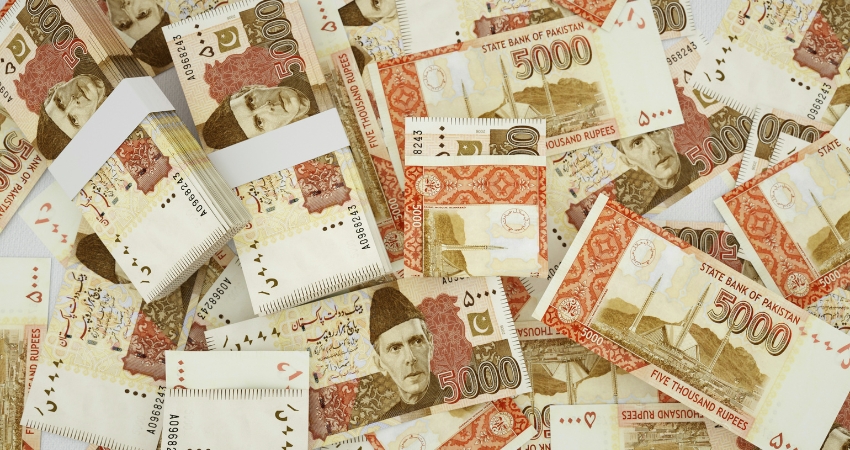
As rupee freefalls, differing exchange rates may land govt in hot water with IMF
The rupee closed at Rs 303.05 against the dollar in the interbank market, and was being sold as high as Rs 323 by exchange companies.
KARACHI: The rupee’s value continued to decline against the US dollar on Tuesday as the gap between the interbank and the ‘official’ and ‘unofficial’ rates in the open market widened, potentially putting the government in a precarious position weeks ahead of an International Monetary Fund (IMF) review.
The rupee lost Rs 1.05 or 0.35 percent in the interbank market to close at a historic low of Rs 303.05 per dollar in the interbank market, according to State Bank of Pakistan (SBP) data. The rupee has been in a freefall in recent days especially as the government lifted import restrictions, resulting in increased demand for the dollar. Tuesday’s loss marks the eighth straight session that the rupee’s value has declined.
Meanwhile, the US dollar was being sold at Rs 318 in the open market, according to the Exchange Companies Association of Pakistan (ECAP). This was an increase of Rs 3 or 0.95 percent from yesterday’s rate. However, the ‘official’ rate shared by the Association was significantly lower than the rate exchange companies were actually selling at.
According to two exchange companies that Profit reached out to, the US dollar was being sold at around Rs 323, and was in short supply.
Why do these different rates matter?
Under the terms of a Standby Agreement with the IMF that Pakistan signed in June this year, the government must adhere to a market-based exchange rate and the difference between the rates in the interbank and open markets must not exceed 1.25 percent for more than five business days.
The difference between the interbank rate shared by the SBP and the ‘official’ open market rate shared by the ECAP is Rs 14.95 or 4.93 percent, which is already much higher than the premium the IMF wants to maintain. However, the gap between the interbank rate and the ‘unofficial’ open market rate is even higher – Rs 19.95 or 6.58 percent.
This means that if the rate of the dollar does not fall in the open market, the interbank rate will have to catch up no matter what. And if this premium is not reduced by the time the next IMF review rolls around – in October or November – or the government imposes any restrictions on selling dollars to try and bring down the open market rate, it may put the government in a weaker position to negotiate with the IMF for the release of the next tranche of the $3 billion SBA.
Ismail Iqbal Securities’ Head of Research Fahad Rauf said reducing the gap between rates in the interbank and open market warrants further depreciation. “The government needs to either bring the open market rate down or let the interbank rate match it,” he commented.
If the government did not allow the rupee to depreciate in the interbank market, or breached the Standby Agreement’s conditions, it would become difficult to convince the IMF for the release of the next tranche, he pointed out.
The next tranche of about $710 million is crucial for Pakistan as the SBP’s foreign exchange reserves fell below $8 billion in the week ending August 18, 2023, which are not enough to even fully cover two months of imports. In such a situation, it is essential that Pakistan completes the next review to shore up its reserves as it has to service debts amounting to $25 billion in FY24.
It is pertinent to mention that the IMF has already begun virtual talks with the Federal Board of Revenue to review its tax collection performance in the first two months of FY24 as part of the SBA.
1 Comment
No comments yet. Be the first to join the discussion!