


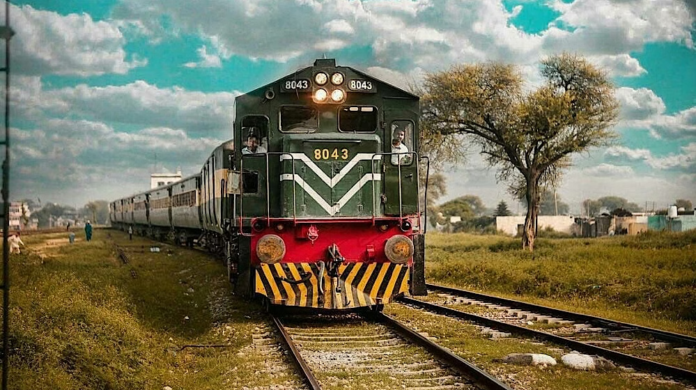
Pakistan Railways transported 8.2 million tonnes of freight during the financial year 2024–25, moving petroleum products, containers, coal, rock phosphate, fertilizer, wheat and other bulk commodities, officials said on Monday.
An official in the Ministry of Railways said the rail network is envisaged under the National Transport Policy 2018 to serve as the primary mode for long haul freight movement between industrial zones and seaports.
However, he said freight operations continue to face constraints due to ageing infrastructure, limited line capacity and shortages of rolling stock.
To improve freight handling, Pakistan Railways has launched multiple infrastructure and capacity enhancement initiatives. Among these is the construction of a 105 kilometre railway line, in collaboration with the Sindh government, to connect Thar coal mines with the main rail network. The project is aimed at enabling nationwide coal transportation and reducing the country’s imported coal bill.
The official said work is planned to begin next year on the Karachi–Rohri section (480 km) of Main Line-1 and the Rohri–Nokandi section (884 km) of Main Line-3. These upgrades are expected to increase line capacity and support additional freight traffic linked to Reko Diq and Thar coal.
On regional connectivity, he said Pakistan Railways has also proposed the Uzbekistan–Afghanistan–Pakistan Railway Corridor (UAPRC), the resumption of the Islamabad–Tehran–Istanbul (ITI) train, and the operation of a pilot freight train to Central Asian Republics, Russia and beyond, using existing rail links with Iran and multimodal routes through Afghanistan.
For safety and operational efficiency, several track rehabilitation projects are underway under the Public Sector Development Programme (PSDP). These include new track construction from Chaman Yard to the Pakistan–Afghanistan border, rehabilitation of the Kotri–Jamshoro to Kotri Akhondabad section, safety works on the Tando Adam–Rohri and Rohri–Khanpur sections, along with upgrades on multiple other routes.
To strengthen freight capacity, the official said 200 high capacity freight wagons have already been inducted, while another 620 wagons are being manufactured locally for addition to the existing rolling stock.