


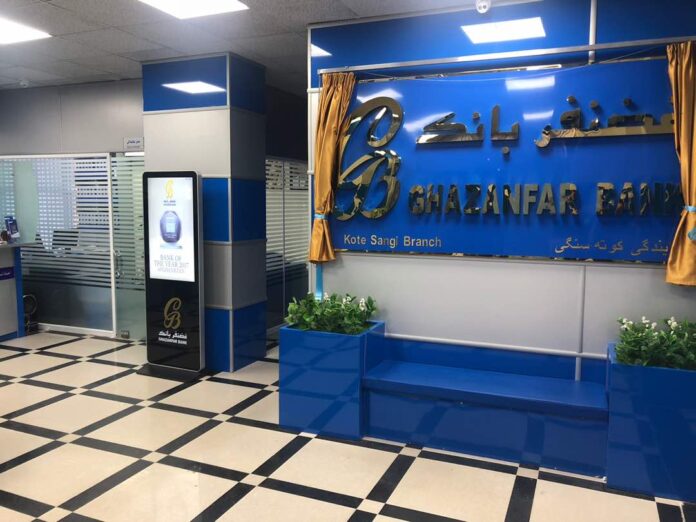
Bank Alfalah has taken the first formal step towards exiting Afghanistan, after accepting a non-binding offer from Kabul-based Ghazanfar Bank to acquire its Afghanistan operations.
In a notice to the Pakistan Stock Exchange (PSX) dated 4 December 2025, the bank said its board had approved a non-binding offer from Ghazanfar Bank to buy “Bank Alfalah Limited’s Afghanistan operations/business”, subject to satisfactory due diligence, execution of definitive agreements and all necessary regulatory approvals. The bank will now seek permission from the State Bank of Pakistan (SBP) and Da Afghanistan Bank (DAB) to allow Ghazanfar Bank to begin due diligence on the business.
The disclosure does not put a value on the potential transaction, nor does it guarantee that a deal will close. But it is the clearest signal yet that Alfalah is again serious about a strategic exit from Afghanistan, a market where it has operated for well over a decade and where regulatory complexity and geopolitical risk have steadily increased.
For investors, the move is also part of a broader pattern. Over the past several years, Bank Alfalah has been gradually rationalising its overseas footprint, even as it expands within Pakistan and doubles down on digital and retail banking at home. The proposed sale of its Afghanistan business sits alongside a parallel plan to sell its Bangladesh operations to Bank Asia, and together they mark a quiet re-centring of the bank’s ambitions around its domestic franchise.
The PSX notice frames Ghazanfar Bank’s approach as an “acceptance of a non-binding offer” rather than a firm sale. That phrasing matters. It signals that both parties agree on the broad intent and high-level commercial terms, but that Ghazanfar still needs to pore over the Afghan business’s books, legal exposures and operational set-up before committing capital.
Under the process outlined in the letter, Ghazanfar Bank must now secure regulatory clearances from both SBP in Karachi and DAB in Kabul just to start due diligence. If that hurdle is cleared, the two sides would negotiate definitive agreements, and only then would regulators consider approvals for an actual transfer of assets and liabilities. That could include branch licences, customer deposits, loan portfolios and associated staff and infrastructure.
This is not Alfalah’s first attempt to sell in Afghanistan. Back in May 2018, the bank informed the PSX that its board had authorised management to explore a sale of its offshore Afghanistan business and that it had signed a business transfer agreement with Azizi Bank to sell those operations, again subject to regulatory and corporate approvals. That transaction never fully materialised, and Alfalah continued to operate in the country, underscoring how complicated cross-border banking deals in Afghanistan can be.
The Ghazanfar interest therefore comes against a backdrop of at least one aborted exit attempt, a changed political landscape following the Taliban’s return to power, and a banking sector grappling with sanctions-related constraints and correspondent-banking pressures. For Alfalah’s board, the renewed attempt suggests a belief that a local buyer – especially one backed by a powerful domestic conglomerate – may now be better placed to navigate the regulatory thicket than a Pakistani institution trying to run a small franchise from Karachi.
To Pakistani investors, Ghazanfar Bank is not a household name. Inside Afghanistan, however, it is one of the more prominent privately owned banks and part of a wider commercial empire.
According to its own corporate profile, Ghazanfar Bank is a full-fledged licensed commercial bank, authorised by Da Afghanistan Bank and operational since March 2009. Its shareholders belong to the Ghazanfar Group, a business family with interests across petroleum and gas import and distribution and other industrial sectors.
The bank runs a comparatively compact but focused network – roughly 15 branches spread across key Afghan cities, including Kabul, Mazar-e-Sharif, Hairatan, Kunduz, Takhar, Pul-e-Khumri, Jalalabad, Herat and Kandahar. Its head office and main branch are in Kabul’s Wazir Akbar Khan area, the capital’s traditional diplomatic and commercial district.
Ghazanfar offers both conventional and Islamic banking, with products ranging from current and savings accounts to Murabaha and Musharaka financing for retail and corporate clients. It handles foreign-exchange transactions, trade finance, remittances through SWIFT and Western Union, and SME lending – all critical services in a country heavily reliant on cash and cross-border flows.
One notable detail is its regulatory standing. Ghazanfar Bank highlights that it has received top-tier CAMEL ratings from the central bank over the past several years, suggesting a relatively strong position on capital adequacy, asset quality, management, earnings and liquidity compared to peers. In a fragile banking system, that can be a competitive advantage – and may give regulators more comfort about a domestic consolidation move that leaves Afghan banking assets under local control.
For Ghazanfar Group, acquiring Alfalah’s Afghanistan business would be a strategic expansion: it would cement the bank’s standing in corporate and trade banking, expand its franchise into segments where Alfalah has historically been stronger, and symbolically mark a transfer of a foreign-owned banking asset into Afghan hands.
Bank Alfalah itself is one of Pakistan’s leading private commercial banks. Established in the early 1990s and backed by Abu Dhabi-based shareholders, it has grown into a network of over 1,100 branches across about 240 cities in Pakistan, alongside a significant digital footprint of more than 100,000 touchpoints, including ATMs, cash deposit machines and digital channels.
The bank’s international presence historically included full branches in Afghanistan, Bangladesh and Bahrain, plus operations in the UAE and a representative office in Abu Dhabi. These footprints were built during an era when Pakistani banks were pushing regionally, particularly into South Asia and the Gulf, to follow corporate clients, tap trade corridors and diversify earnings.
Financially, Alfalah has been in robust shape. For 2024, the bank reported profit after tax of around Rs38.3 billion, according to its results announcement, even as the wider Pakistani banking industry grappled with high interest rates and macroeconomic volatility. Domestic operations drive the overwhelming bulk of those earnings.
The foreign branches, by contrast, are strategic but small. They often serve specific corridors – such as Pakistan–Bangladesh trade or Pakistan–Afghanistan remittances and commerce – but do not significantly move the needle on group profitability or capital. That imbalance becomes more salient when regulatory and geopolitical risks rise, as they have in recent years.
Against this backdrop, Alfalah’s management has increasingly signalled that it sees its core growth story at home: consumer and SME banking, digital payments, Islamic banking and corporate banking in Pakistan, where it already enjoys strong brand recognition and scale. Rationalising smaller overseas outposts fits naturally into that narrative.
The Afghanistan sale process has a long history. As early as 2018, Bank Alfalah had told the PSX that its board had authorised management to explore selling its Afghanistan offshore business and assets. In that disclosure, the bank said it had executed a business transfer agreement with Azizi Bank, then one of Afghanistan’s largest private commercial banks, to sell its Afghan operations, subject to regulatory approvals and completion of documentation.
The fact that Bank Alfalah still owns and operates branches in Afghanistan – and is now accepting a new non-binding offer from Ghazanfar Bank – suggests that the Azizi transaction either stalled or was ultimately abandoned. Industry observers point to a mix of factors that could have complicated matters: shifting regulatory expectations in both Pakistan and Afghanistan, increased scrutiny of cross-border transactions, and later on, the dramatic political transition in Kabul in 2021 that redrew the risk map for all foreign banks in the country.
While Afghanistan was the first market where Alfalah signalled an intent to exit, it is Bangladesh that has recently provided the clearest template for its overseas consolidation strategy.
In May 2025, the bank announced that its board had approved the sale of its Bangladesh operations to Bank Asia Limited, a Dhaka-based bank, and that a memorandum of understanding/term sheet had been signed on 28 May 2025. The transaction is still subject to approvals from SBP, the central bank of Bangladesh and other regulators, as well as the execution of definitive agreements.
Coverage in Bangladesh and Pakistan alike has described the move as a strategic refocus: Bank Alfalah exits a relatively small overseas franchise, while Bank Asia gains a ready-made foreign-owned network and customer base. The Alfalah–Bank Asia deal is part of a broader trend of Bangladeshi banks consolidating domestic operations and absorbing foreign banks’ local branches as those foreign parents reconsider their regional portfolios.
Put together with the renewed effort to divest Afghanistan, a pattern emerges: Alfalah is pruning markets where it lacks scale and where the cost–benefit calculus of staying has worsened, be it because of regulatory effort, capital requirements or operational complexity. The bank retains a presence in Bahrain and the UAE – markets with deep financial sectors and large Pakistani communities – but appears to be signalling that secondary South Asian markets may no longer be core.
If the Ghazanfar transaction goes through, what exactly would it be buying?
The most detailed picture of Bank Alfalah’s Afghanistan business comes from its stand-alone audited financial statements for 2024, prepared for the Kabul branch network. These show that as of 31 December 2024, total assets stood at AFN 6.39 billion, down from AFN 7.75 billion a year earlier. Customer deposits were about AFN 4.61 billion, while equity (capital contributed by the head office plus reserves and retained earnings) stood at AFN 1.58 billion.
On the income side, the Afghan business generated profit after tax of AFN 90.0 million in 2024, up from AFN 79.3 million in 2023, despite a contraction in the balance sheet. Net interest income, fee income and other operating income together produced modest but positive earnings after operating costs and tax.
In practical terms, these numbers underscore two things:
- The franchise is profitable but small. Even using conservative exchange rates, the Afghan operations amount to only tens of billions of Pakistani rupees in assets and a fraction of a billion rupees in annual profit – a tiny slice relative to Bank Alfalah’s multi-trillion-rupee balance sheet and Rs38-billion-plus annual profit.
- The business is primarily deposit-funded. Customer deposits account for the bulk of liabilities, while capital injected by the Pakistani head office underpins regulatory compliance in Afghanistan.
From Ghazanfar Bank’s perspective, that combination is attractive. It is acquiring not just a book of assets and deposits, but also an operating platform: branches, systems, staff, and a client base that includes multinational corporates and cross-border traders accustomed to dealing with a Pakistani bank. That could be particularly valuable in trade finance and remittances, where relationships matter and KYC histories can reduce friction.
For Alfalah, the strategic logic of exit is different. The Afghanistan book is manageable in size but disproportionately demanding in management attention. Operating under Afghanistan’s unique political and regulatory constraints has meant navigating correspondent-banking relationships, sanctions risk, and evolving rules from both DAB and foreign regulators. These complexities consume compliance and risk resources at group level that could arguably be deployed more productively in the bank’s home market.
The Ghazanfar–Alfalah story is ultimately about two banks moving in opposite strategic directions.
For Ghazanfar Bank, the prospective acquisition is a chance to bulk up – to add another network, more customers and additional capabilities in corporate banking, trade finance and perhaps digital channels. As a domestically owned player with an industrial conglomerate behind it, Ghazanfar has a strong incentive to consolidate banking resources inside Afghanistan and to show that local institutions can absorb the assets foreign banks are shedding.
For Bank Alfalah, by contrast, it is another step in a gradual tightening of focus. The bank’s board seems intent on simplifying the group structure, shedding smaller and more complex foreign units, and concentrating capital and management bandwidth on Pakistan and a smaller set of overseas markets where it enjoys genuine scale or strategic relevance.
None of this is guaranteed to culminate in a closed deal. The Azizi Bank episode in 2018 is a reminder that regulators, politics and practical hurdles can derail even signed business transfer agreements. Afghanistan’s banking system remains under unusual strain, and both Pakistani and Afghan regulators will scrutinise any sale that touches on cross-border capital flows and deposit protection.
Yet, even at the stage of a non-binding offer, the transaction is significant. It suggests that there are still local Afghan institutions strong enough – or at least confident enough – to absorb foreign-owned branches. It also confirms that Pakistan’s larger private banks are re-evaluating the regional forays they made in the 2000s and 2010s, as the regulatory and economic calculus of cross-border branching shifts.
If Ghazanfar Bank eventually takes full control of Bank Alfalah’s Afghan franchise, Kabul’s banking landscape will gain a slightly larger domestic champion, while Karachi’s PSX investors will see another incremental tidying-up of a major listed bank’s balance sheet. If the deal falters, it will join a growing list of aborted cross-border banking transactions in a region where geopolitics, regulation and commercial logic rarely line up neatly.
Either way, the non-binding offer marks an important waypoint: a small Afghan business that once symbolised Pakistani banks’ outward push is now at the heart of two very different consolidation stories – one in Kabul, one in Karachi.