


- Fauji Foundations’ last minute exit, a loss of interest or strategic move?
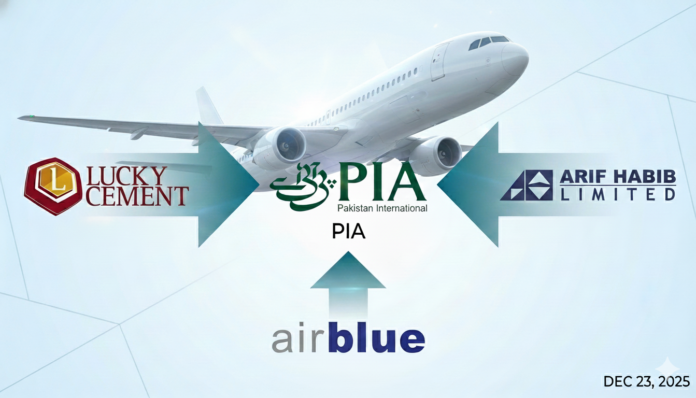
- Three consortia, led by Lucky Group, Arif Habib Ltd and Air Blue respectively, to lock horns over 75% stake in the national carrier
The much-anticipated privatisation of Pakistan International Airlines (PIA) is about to enter its final phase. The submission and opening of bids scheduled for today, December 23, 2025, will decide the fate of the national carrier, which has long been a subject of political debate and financial strain.
After years of failed attempts, PIA’s privatisation is now at a critical juncture, and the pressure is mounting as the clock ticks toward the deadline. The bidding process will now see only three contenders vying for control of the debt-ridden airline, since Privatisation Commission Chairman and Adviser to the Prime Minister on Privatisation, Muhammad Ali, confirmed in a recent interview that the Fauji Foundation, a key player in the bidding, had withdrawn from the race, leaving three bidders to compete for the 75% stake in PIA.
The push for privatising PIA has been ongoing for over a decade, with successive governments attempting to streamline operations and reduce the national carrier’s massive losses.
PIA’s financial woes are well documented. The airline has accumulated staggering debts, and for years, it has been struggling with negative cash flow, mounting liabilities, and an underperforming fleet. The government has previously taken steps to address the airline’s issues by restructuring its debt and offloading bad assets into a holding company, but has neither been able to turn it around , nor been able to sell it off.
Despite repeated efforts, political hurdles, bureaucratic delays, and strong opposition have repeatedly derailed the process. However, the tables have turned this time, and the latest round of privatisation is seen as a critical step towards resolving the airline’s financial crisis and boosting Pakistan’s aviation sector. The government has finally been able to find buyers for the national carrier.
The bidders include two major consortia and one independent airline. The first consortium is led by Lucky Cement Limited, Hub Power Holdings Limited, Kohat Cement Company Limited, and Metro Ventures (Private) Limited, while the second consortium consists of Arif Habib Corporation Limited, Fatima Fertiliser Company Limited, City Schools (Private) Limited, and Lake City Holdings (Private) Limited. The third bidder is Air Blue (Private) Limited, which is competing independently.
PIA currently operates 18 out of a fleet of 34 aircraft and has air service agreements with 97 countries. The airline also holds landing rights in more than 170 countries, making it an attractive proposition for the right bidder.
The Bidding Process
The bidding process is designed to ensure transparency and fairness, with all bids placed in a sealed box to be opened at 3:30 pm on December 23. The Privatisation Commission will review the bids and determine the reference price, which will be announced at the time of bid opening. If the bids exceed the reference price, an open auction will take place; if the bids fall below the reference price, the commission will assess the highest bid.
This level of transparency is critical in ensuring that the privatisation is carried out fairly, particularly given the high stakes involved. The airline, with its extensive domestic and international network, represents a valuable asset.
What’s at Stake for the Bidders?
The winner of the privatisation bid will acquire a 75% stake in PIA, with the government retaining the remaining 25%. Of the proceeds, 92.5% will go to PIA, while the remaining 7.5% will be transferred to the national exchequer. The successful bidder will also have the option to acquire the remaining 25% of the airline after the transaction is finalised, although this decision must be made within 90 days of the deal’s completion. The bidders will also need to deposit two-thirds of the bid amount within 90 days, with the remaining one-third payable within one year.
The government has structured the deal to ensure that no asset owned by PIA, such as its real estate, is included in the transaction. This ensures that the privatised airline can focus on its aviation business without being weighed down by non-core assets.
The Fauji Foundation’s Exit
Many may find the withdrawal of the Fauji Foundation from the bidding process as a surprise. But to those who have followed the pre-bidding drama of PIACL, it does not come as a surprise.
The foundation, as is known, is a very powerful conglomerate, with interests spanning across various sectors. It meet the necessary bidding criteria and had initially shown strong interest in acquiring PIA. Therefore, its exit from the bidding process shall not be construed as such.
Muhammad Ali clarified that Fauji Foundation’s exit does not signal a lack of interest, hinting at the possibility of a post-bidding merger with the successful bidder.
It was important to note that while all the consortia’s openly did not want to join hands with each other, with the Lucky group going as far as rejecting a joint-venture proposal pitched by Arif Habib Group at a PM-led meeting last week, there was but one company that all the bidders wanted on their side. The erstwhile Fauji Foundation, a charitable trust that supports the welfare of martyrs and ex-servicemen.
This set the stage for an intriguing development where Fauji might still become a player in PIA’s future, albeit not directly through the privatisation process, but joining any of the players who might win the bid.
The Airline’s Debt and Liabilities
While the bidding process may seem straightforward, potential buyers will need to grapple with PIA’s immense financial challenges. PIA’s negative equity is a major concern. As of June 2023, the airline’s liabilities totaled over Rs 825 billion, and its negative equity had ballooned to Rs 649 billion. The government has addressed this by creating the PIA Holding Company, which will absorb the majority of the airline’s bad debts, but the remaining liabilities of Rs 26 billion will stay with PIA and be paid off over five years.
With the debt restructured, the successful bidder will have the chance to operate a leaner airline, with a reduced burden of liabilities, but the restructuring also includes a provision to allow banks to renegotiate the deal if the privatisation does not occur within the next three years.
The Key Considerations for the Winning Bidder
For the winning bidder, the main attraction lies in the opportunity to revamp PIA’s operations while inheriting its vast network of routes and established market presence. The airline’s international and domestic routes, as well as its brand recognition, make it a prime candidate for expansion. Moreover, the government’s efforts to restructure PIA’s debts make it a more manageable investment than it would have been just a few years ago.
However, the process will not be without challenges. The new owner will need to address PIA’s legacy issues, including its tarnished reputation, inefficient operations, and high overhead costs. The airline’s workforce, once bloated with over 11,000 employees, has already been reduced to 6,500, but labor concerns will remain a crucial issue. The privatisation terms include protections for employees, ensuring no layoffs for one year and securing their pensions and benefits.
The final decision on the privatisation of PIA will rest on the results of tomorrow’s bidding process. The outcome will not only determine the future of the airline but will also set the stage for broader reforms in Pakistan’s state-owned enterprises. With three strong bidders left in the race, the final bids will likely have a lasting impact on Pakistan’s aviation industry for years to come.
As the government’s privatisation agenda moves forward, the fate of PIA hangs in the balance, and tomorrow’s bidding will be the first major step towards a new chapter in Pakistan’s aviation history.