



One of the most common occurrences in the life of a business reporter is associations for different industries whining and complaining about how they are getting the short end of the stick, and that the government is not doing enough for them. Sometimes, they have a point. More often than not, it comes at times when the government can actually do very little and the sluggish and backwards industry has done little to prepare for such a scenario.
And as businesses have experienced growing and unprecedented closures and crises in the wake of the coronavirus pandemic, the complaining has only grown. From textiles, to restaurants, the expectation is that the government must bail them out or let them operate, the consequences notwithstanding.
One of the most vocal industries in this regard has been the wedding industry. Internationally, the wedding industrial complex is a $70 billion business sector comprising all the dressmakers, florists, reception halls, event planners, photographers, caterers, limo firms, DJs, bands, and jewelry designers that many people now consider necessary expenses for a wedding.
However, just as the coronavirus is changing how the world works and people think in other sectors, it is also affecting how people get married. In the beginning of the pandemic, a number of couples shifted their nuptials online over Zoom. And even in Pakistan, the trend of small weddings at home with smaller crowds. This trend may just last.
When large events become small events, the industries around them have to change. So when the volume of work in the wedding industry decreases or goes down in scale, the way designers, florists, and makeup artists react is to rebrand and do work that may not have as much demand, but has a higher markup.
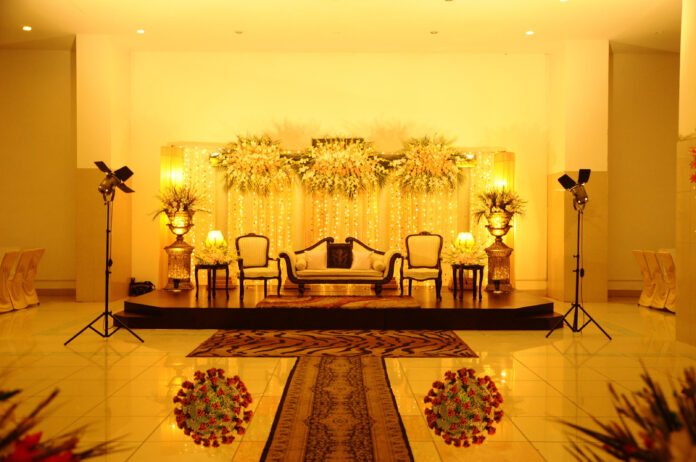
But within the wedding industry, one segment that can do very little are the owners of wedding halls. In the United States and other Western countries, weddings take place at locations that often double as resorts and have other functions. In Pakistan, buying a plot of land and building a gaudy structure on it is considered a steady investment – until something like a pandemic happens. Then, the owners begin to cry foul. This is their lament.
They’re still not banned
Initially, when Pakistan was going through the first wave of the coronavirus pandemic, everything was shut down, and the wedding halls went with it. But since the reopening, despite repeated calls for social distancing to be followed, halls have had the opportunity to remain open, and people have continued to get married. Despite this, wedding hall owners have already made their reservations known in advance, in case the second wave of the virus remains uncontrolled.
The National Command and Control Center (NCOC) for Covid-19 Prevention in Pakistan has issued Safety Guidelines (SOPs) for weddings and other celebrations in major cities over the past week. Under them, from November 20, there will be a complete ban on indoor gatherings and this will be applicable in all major cities including Karachi, Lahore, Islamabad, Rawalpindi, Peshawar, Quetta, and Faisalabad.
According to the NCOC, only outdoor weddings and other celebrations will be allowed and even in an outdoor wedding, no more than 300 people will be able to get together. Everyone is told to wear a mask and keep a distance of at least six feet to prevent the spread of the virus. Tents must be ventilated if used, while tents with closed marquee designs will not allow for wedding ceremonies. Other instructions include checking the temperature of all guests, distributing lunch boxes instead of buffets, and ensuring the availability of soap or sanitizer for hand washing. Parents and organizers of the bride and groom have been asked to distribute masks at the entrance. Similarly, it is obligatory to abstain from such traditions as shaking hands and embracing. According to the NCOC, the hours of the ceremony cannot exceed two hours and in any case, they will be required to end by 10 pm.
These guidelines are a source of frustration for those who have booked wedding halls and other arrangements in view of the declining Covid-19 cases, and wedding hall owners are not happy with these instructions. For them, the immediacy of business defeats the possible long term repercussions of not being careful.
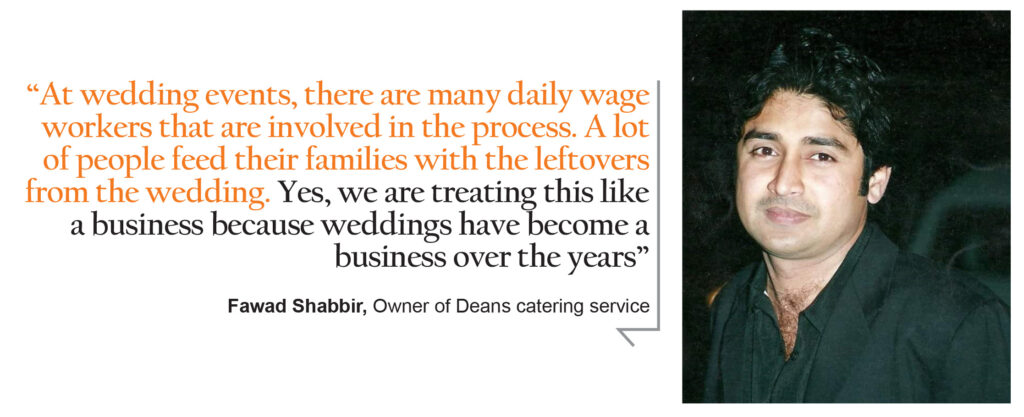
Fawad Shabbir, who owns Deans Catering Services in Lahore, is also worried about the re-closing of the wedding halls. Speaking to Profit, he said that the closure of wedding halls and a large business connected to them has already been closed for about five months during the lockdown, causing them irreparable damage.
“At wedding events, there are many daily wage workers that are involved in the process. A lot of people feed their families with the leftovers from the wedding. Yes, we are treating this like a business because weddings have become a business over the years,” he says. “Marriages that used to take place in homes began to take place in wedding halls. Due to the wedding halls, the burden on the family has been reduced, so this trend has become a convenience and a business over time.
As Fawad explains, the wedding business has changed drastically. Home events are far and few in between, and an entire litany of industries and services have grown around weddings. Because of this, people ended up investing heavily in setting aside their cinema halls, bungalows and plots for wedding ceremonies, and later joined it in a number of ancillary businesses.
“As time changed, new trends began to be used to decorate weddings and entertain guests. Then the photographer’s job was to bring life to every memory of this event. The bride and groom had a separate session and the price of this session was also decided separately. Similarly, when it came to food, many dishes were reduced to one dish. Chefs also began to gain popularity in a race to make new food and after the wedding, the chef and the wedding meal also became an important topic. Thus many businesses became associated with one marriage.”
The damage
Fawad further said that then, all of a sudden, Covid-19 shook the whole economy. The content in this publication is expensive to produce. But unlike other journalistic outfits, business publications have to cover the very organizations that directly give them advertisements. Hence, this large source of revenue, which is the lifeblood of other media houses, is severely compromised on account of Profit’s no-compromise policy when it comes to our reporting. No wonder, Profit has lost multiple ad deals, worth tens of millions of rupees, due to stories that held big businesses to account. Hence, for our work to continue unfettered, it must be supported by discerning readers who know the value of quality business journalism, not just for the economy but for the society as a whole.To read the full article, subscribe and support independent business journalism in Pakistan