Social impact or pursuit of profit? Some entrepreneurs pick both
The stories of four entrepreneurs who are making a social impact through their commercially thriving endeavours

When graduating from college, many students often face a choice: take the job that has a positive social impact, or the job that will pay well and have a bright financial future? For some entrepreneurs, it seems, the answer is both.
In years past, social entrepreneurship used to mean a slightly more financially self-sustaining charity, or a business that occasionally did philanthropic ventures. As the industry has evolved, however, it is becoming increasingly clear than social entrepreneurs do not want to compromise on either part of their pursuit: they want to pursue both social responsibility and positive impact and they want to have a financially successful venture and personal financial success.
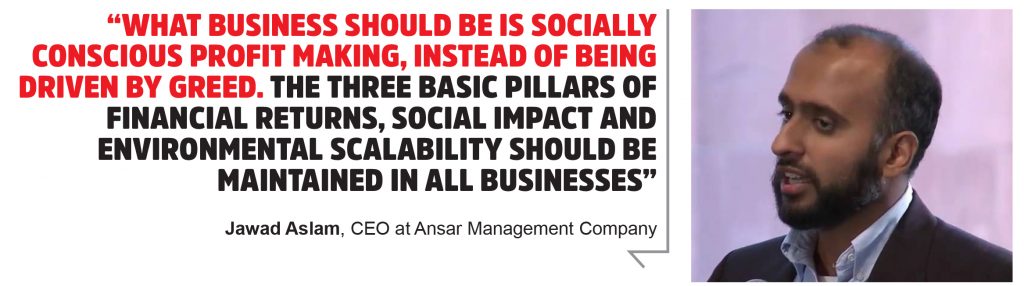
“What business should be is socially conscious profit making, instead of being driven by greed. The three basic pillars of financial returns, social impact and environmental scalability should be maintained in all businesses,” says Jawad Aslam, CEO at Ansar Management Company (AMC), a company working on low cost housing in Pakistan.
Choosing between profit and purpose is a challenge that all businesses face and the ones which succeed in striking a balance between the two often go on to make a considerable impact not just for themselves but the society as a whole. Profit recently sat down with a few ‘social entrepreneurs’ who are working for social causes while trying to pursue financial goals, and mapped out their journeys.
Affordable housing: Ansaar Management Company
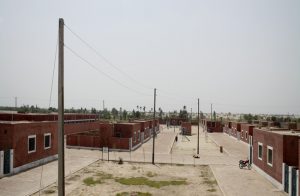 Model village built by AMC.
In 2005, Jawad Aslam used to live in Baltimore, working on high end real estate in the United States. The following year, he and his wife decided to move to Pakistan. “We did not really have a plan, but once we got to Pakistan we met Tasneem Siddiqui, the chairman of Saiban, the only organisation in Pakistan at the time working on low-income housing, and since I had been doing real estate in the US, he invited me to help him launch a project in the peri-urban areas of Lahore funded by Acumen Fund,” he says.
People who were earning between $100 to $200 month were the focus of this project. “What really motivated me was the idea of giving access to affordable houses to people who never dream of owning houses in their entire life, people who have been paying rent for the last 20 years at exorbitant rates. And on top of that this model was economically viable,” he says.
In 2009, Jawad launched Ansaar Management Company (AMC), working on a similar model, with Acumen Fund taking a 30% stake in the company. AMC builds low-income housing societies providing affordable houses costing from Rs700,000 to Rs1.8 million depending on the location, size of the plot and the covered area. The Rs1.8 million house is built on 800 square feet plots with a covered area of around 650 square feet.
The venture is modestly profitable. Jawad’s company currently earns an annualised return on investment (ROI) of around 6 to 10%, which he hopes to increase to 15% eventually. On the other hand, ROI for conventional real estate developers fall in the range of 100% to 200%. “We are charging 15 percent and a conventional developer typically targets 100%.”
How are these conventional developers able to make such exorbitant returns on their investment? Jawad says that it has something to do with the way the market is structured. “This is a market question and the market determines such outcomes. If you pay Rs2 million for your child’s education and I am the education provider and we are both willing to make that transaction, than that is not a problem. If there is no one in the market that wants to pay Rs2 million for education, then that product will not evolve. The case for housing is similar. These guys are charging 100% profit because they have a market that is able to absorb that and customers who are willing to pay that much.”
Jawad, believes that his model is better, one which would make a greater impact, generate profit and allow for greater investment to come in the sector. “We need to figure out a way to get the market to understand that this is inflated pricing. I can make the same house in half the price and make the same quality of houses accessible to a larger number of people.”
Water access: Tayyaba.org
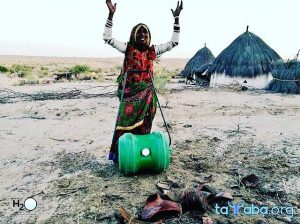 A women in Thal using H2O Wheel to fetch water.
Bilal Saqib is currently a postgraduate student at the London School of Economics (LSE), pursuing a degree in social innovation and entrepreneurship. He has lived a large part of his life in Pakistan and the United Kingdom. However, his inspiration to venture into social entrepreneurship came while he was visiting Burkina Faso. “I was in Ouagadougou, the capital of Burkina Faso, one of the poorest countries in the world, when I saw women over there using wheel shaped containers to carry water from long distances. I asked the women about it, and they said that it was probably the best thing that had happened to them in a long time,” he says.
In Pakistan, a large proportion of rural based women faced the similar daily ordeal of having to fetch daily use water from long distances. Their situation is worse, compared to women in Ouagadougou, as they use traditional clay pots, carrying them on their shoulders or head. In Burkina Faso, Hipporoller.org was working on providing water wheels and in India a similar organization, Wello Water, was doing the same work, but nothing was being done for women in Pakistan.
“I got a small team together and launched the wheel in Pakistan under my organisation Tayyaba.org. We predominantly operate in Tharparkar, Kohistan and another area in Balochistan and have impacted almost the lives of over 20,000 people in the past three years,” he says.
https://www.facebook.com/dasanipk/videos/287263431944819/
However, when it comes to having a sustainable business model for the organisation, Bilal says that the organisation runs on donations. “There is no business model. We operate on a 100% donation model, in terms of the money that goes in is the money that comes out in terms of a wheel. Nobody takes a salary.”
Going forward, however, he has a different model in mind, one which may help him generate a sustainable revenue stream. Each water wheel cost around Rs2,500 including the cost incurred for transporting them to their end users, hence, charging money from the people who actually need and use the water wheel is out of question. “The issue is that people who need this water wheel cannot afford it and the people who can afford it, do not need it,” he says.
Currently, Bilal is looking at big corporations that he thinks might be interested in investing into his venture. “So to scale this we definitely have to have a different model. We can approach different companies that want to make an impact through their corporate social responsibility (CSR) activities and can get funding from them. We can rebrand this wheel to a specific company and they can put it on their CSR report.” Recently, Bilal has been promised a small investment from Dassani, Coca Cola’s mineral water brand.
“Now companies in western economies are looking at impact investing instead of donations or CSR. Companies just don’t give donations, they want to see what sort of a social impact the business will have before investing in it,” he says.
The market for impact investing has grown rapidly in India over the past few years. According to a report published by McKinsey & Company, a consulting firm, the total value of impact investments in India has been $5.2 billion since 2010, out of which $4.2 billion has been added since 2015. Even though the number of investments have stayed between 60 to 80 per year, their size has increased from from $7.6 million per deal in 2010 to $17.6 million per deal in 2016.
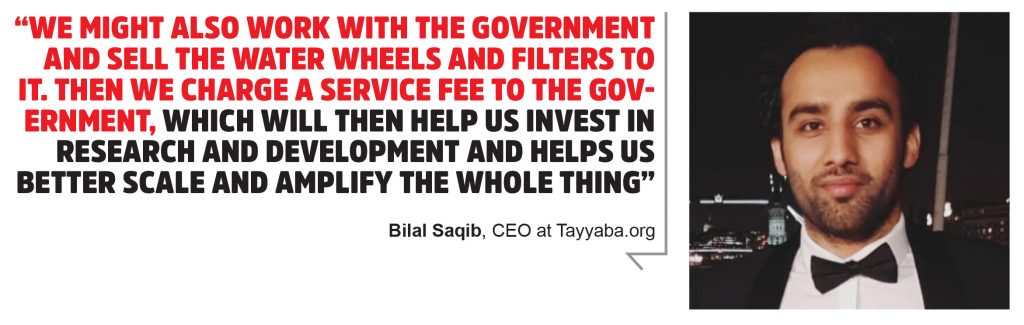
“We might also work with the government and sell the water wheels and filters to it. Then we charge a service fee to the government, which will then help us invest in research and development and helps us better scale and amplify the whole thing,” says Bilal Saqib.
In the future Bilal plans to take Tayyaba.org forward as a think tank working on social issues. “The idea is to make Tayyaba.org a think tank, where we consult with and assist the government on social issues like water, food, women hygiene and microfinancing and other tier one problems.”
Higher education: Rahnumai
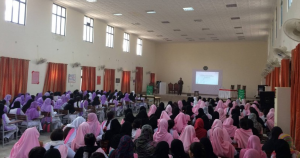 Rahnumai's counseling session being held in a government school for girls.
According to Hafiz Awais Afzal, the founder of Rahnumai, a social start-up working on increasing higher education enrolment across Pakistan, more than 65% of the universities in the country do not have an online application portal, which means that students sometimes have to travel long distances to get access to a university application form.
Back in the day, when Awais was himself applying to universities for admission, he faced difficulties due to lack of information regarding application procedures and lack of accessibility as he lived in Okara, a relatively underdeveloped region in the country.
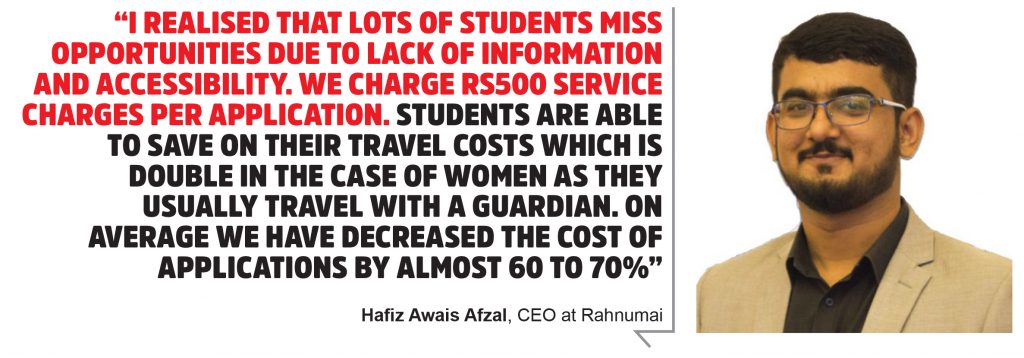
“I realised that lots of students miss opportunities due to lack of information and accessibility,” he says. Hence, Awais, initiated Rahnumai, a social venture, based in his home city, primarily focusing on increasing higher education enrolment rates in the country.
Currently, Rahnumai allows students to fill the applications online on their portal and then forwards it to the universities where these candidates want to apply. The portal gives students information about universities, their fee structure, deadlines and availability of scholarships.
“We charge Rs500 service charges per application,” says Awais. This is Rahnumai’s primary revenue stream other than the fee charged for other services and corporate sponsorships.
The start-up also provides one-on-one career counseling and conducts sessions in colleges to help the students navigate their portal and fill the application form.
“Students are able to save on their travel costs which is double in the case of women as they usually travel with a guardian. On average we have decreased the cost of applications by almost 60 to 70%,” he says.
So far, Rahnumai has reached almost 20,000 students and has processed around 1,500 university applications.
Awais claims that his venture is not only increasing higher education enrolment rates but is removing class differences and the gender gap by providing students equal educational opportunities and is increasing the diversity of the future workforce of the country by bringing new universities and subject options previously unknown to intermediate students into the limelight.
Renewable power: EcoEnergy
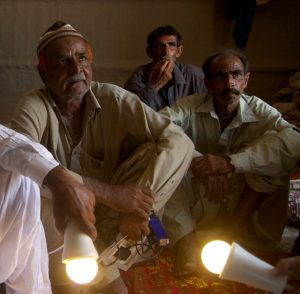 People living in off grid areas using energy efficient lights produced by EcoEnergy.
Shazia Khan is a Pakistani American environmental lawyer based in Washington DC, energy being her area of specialisation. She started her career with the World Bank working for the Africa energy sector, going on to work at the Global Environment Facility, where she realised that her home country Pakistan, where almost 71 million people live off the grid, could benefit greatly from solar energy due to the high solar radiations that the country receives.
In 2009, she launched EcoEnergy Finance, a non-profit entity, with the intention of making a commercially viable business model for making clean energy affordable to off grid population in Pakistan. EcoEnergy Finance operated as a non-profit for seven years, raising money for market research and product testing.
She along with her co-founder Jeremy Higgins built a small team and spent four years carrying out market research across 44,000 households trying to understand their purchasing power, consumer preferences and the behavioural shift that was required for the adoption of the new technology and another three years building and testing different products.
Once a business model was in place, a fully for-profit entity EcoEnergy Global was launched. The company currently offers energy solutions ranging from 20 watts to 500 watts. “Our products cost the same or less than what our customers are spend on their energy needs, we provide financing services and develop a credit score for them and offer them after sale services,” she says.
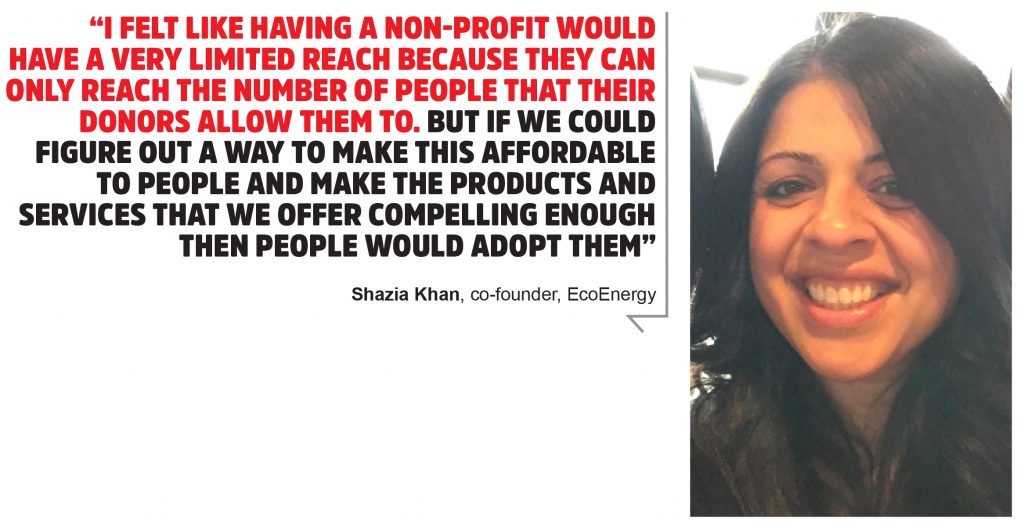
“I felt like having a non-profit would have a very limited reach because they can only reach the number of people that their donors allow them to. But if we could figure out a way to make this affordable to people and make the products and services that we offer compelling enough then people would adopt them.”
EcoEnergy Global primarily operates in Sindh, providing solutions to anyone living off the grid but now hopes to compete for on grid customers as well and expand into Southern Punjab and Balochistan.
“It is a shame that the government has not done anything to provide access to electricity to these people, but that leaves a great opportunity for the private sector to step in. The new Prime Minister has also talked about widespread adoption distributed solar. We will be happy to work with the government. But primarily our customers can pay for themselves and are not subsidised in any way by the government. So, we are confident that what we are providing is exciting and compelling and affordable for our customers regardless,” she says.
Shazia Khan believes that the for-profit model of her business is better than how most non-profit non-governmental organisations (NGOs) operate and serves as a motivating force for her business to do well. “I did not want to have a small NGO. An NGO can get away for a very long time without being successful and without anyone ever saying that it is unsuccessful, but a business is a failure if it does not fulfill the need of its customers.”
The writer is an economics and business journalist reporting for Profit. He is currently an MBA candidate at LUMS University and holds a Bachelors degree in Economics and Politics from the same university. He can be reached at [email protected] or at twitter.com/muhammadfaran
View all articles →Comments
No comments yet. Be the first to join the discussion!