




Apple CEO Tim Cook paid a visit next door this April, to cut the ribbon in Mumbai and New Delhi as India welcomed its first Apple stores with exultation and sanguinity. The air was redolent with the sound of animated chatter as the event marked the evolution of Apple’s involvement in India. A new chapter in a relationship dating back to 2017 when India enticed Apple to outsource iPhone manufacturing. A relationship that has even led to Apple rivalling arch-rival Samsung in adopting India’s PLI’s scheme to net the country over $9 billion in phone exports this fiscal year alone.
We observed with bated breath and a twinge of envy as our rival made these strides. How did India manage to pull this off? How did it convince the world’s most valuable company to invest? These were just some of the many questions that ran through our minds as we witnessed the spectacle.
Our mobile industry, in contrast to its Indian counterpart, currently stares into the abyss. A paucity of raw materials and components has debilitated the industry, and its inability to open letters of credit portends a complete shutdown.
As Cook left India with a note expressing his eagerness to return, it was clear that India had made a lasting impression. For us looking on with envy, this only added insult to injury. The contrast couldn’t be more pronounced. It was hard not to imagine what it would be like if these stores had opened under the guise of Lahore’s minarets and not Delhi’s, or peppered with the briny zephyr of Karachi and not Mumbai.
How did we let another opportunity slip through our fingers? Does April’s situation offer a chance for reflection on our capabilities and limitations? In this momentary lapse in mobile manufacturing, we can ask: Should we expect Tim Cook on our shores anytime soon or will we repeat history by supporting an inferior industry? [restrict level=1]
Pakistan’s tryst with mobile manufacturing
For the sake of brevity, our story begins in 2019 with the creation of Transsion-Tecno Electronics: a joint venture between China’s Transsion Holdings and Pakistan’s Tecno Group. The company was to manufacture Transsion’s Itel, Tecno, and Infinix brands in Pakistan.
The very next year, the Engineering Development Board (EDB) doubled down by unveiling the Mobile Device Manufacturing Policy (2020). It aimed to facilitate mobile phone manufacturing by offering incentives such as:
- Regulatory duties and fixed income tax waived on CKD/SKDs for mobiles up to $350
- Higher fixed income tax on $351-$500 category by Rs 2,000 and $500 by Rs 6,300 on CKD/SKDs
- Measures to prevent misdeclaration
- 3% R&D allowance for local manufacturers exporting mobile phones
- Sustained tariff differential between CBU and CKD/SKD
- Local industry to follow a roadmap for localising value chain
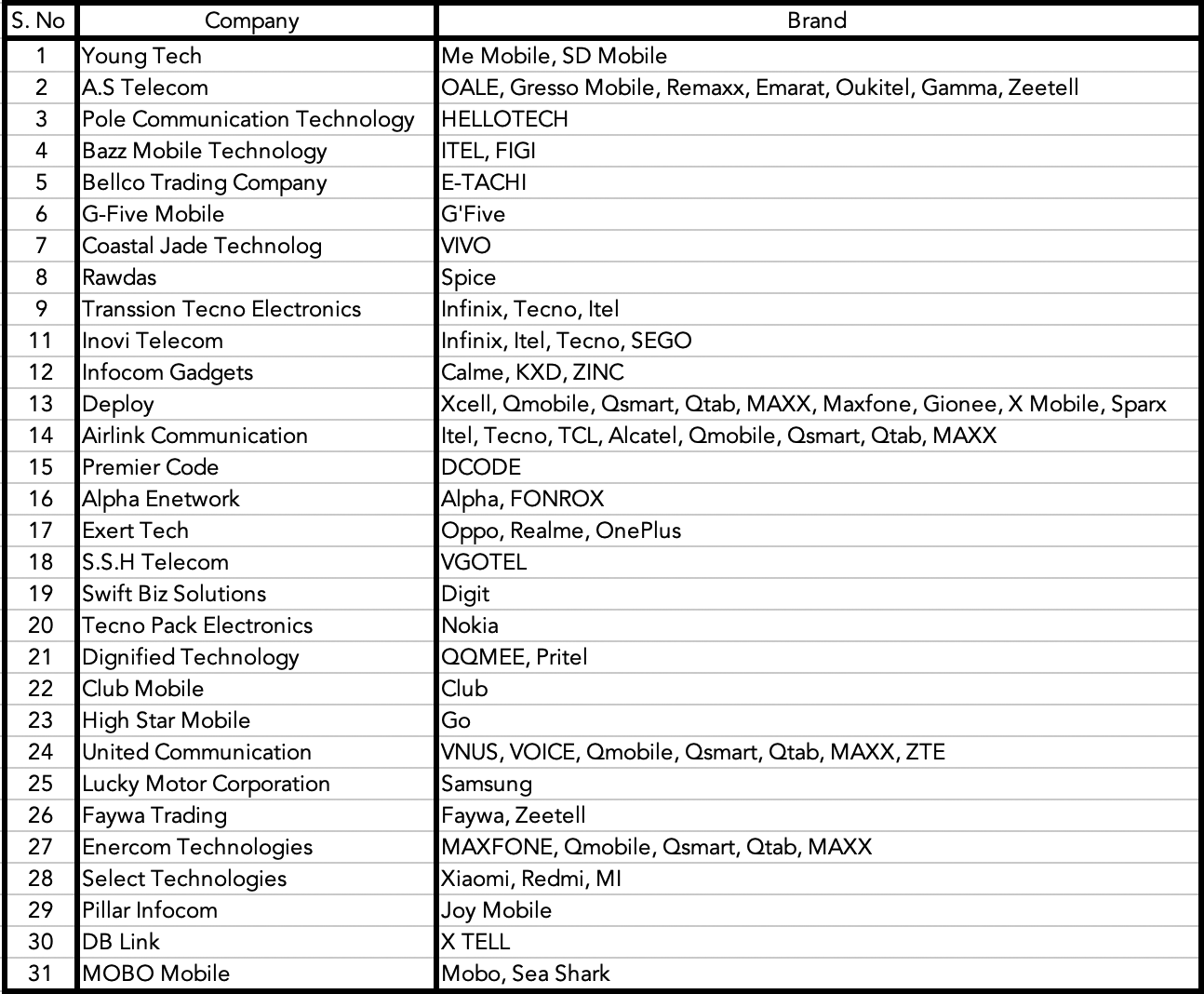
The EDB granted licences to 30 companies to partner with international brands to locally manufacture mobiles. It even enticed global giants like Samsung, Xiaomi, and Oppo to partner with local partners such as Lucky Motors,Tecno Pack Electronics, and Exert Tech respectively.
If you think the policy resembles another sector’s policy framework under the EDB’s purview, you’re right. It’s uncannily similar to the automotive industry. However, the policy hit the ground running.
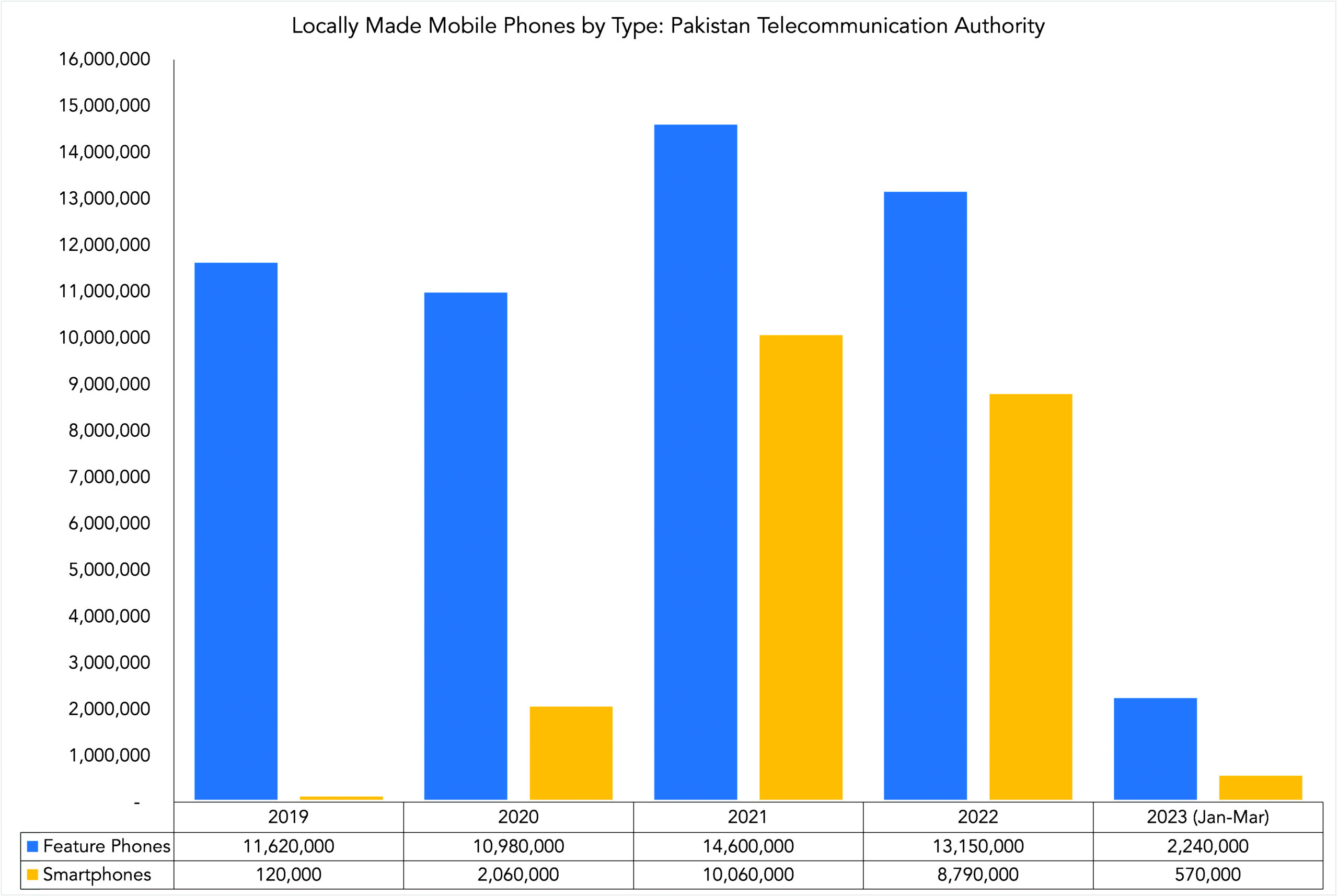
Locally built phones’ production numbers shot up from 290,000 to 24.6 million in 2021, based on Pakistan Telecommunication Authority’s (PTA) statistics. Despite the economic crisis in 2022, mobile producers still churned out 21.94 million units. These numbers may seem large, but there’s still room to grow. Pakistan’s total number of cellular subscribers has only grown year-on-year.
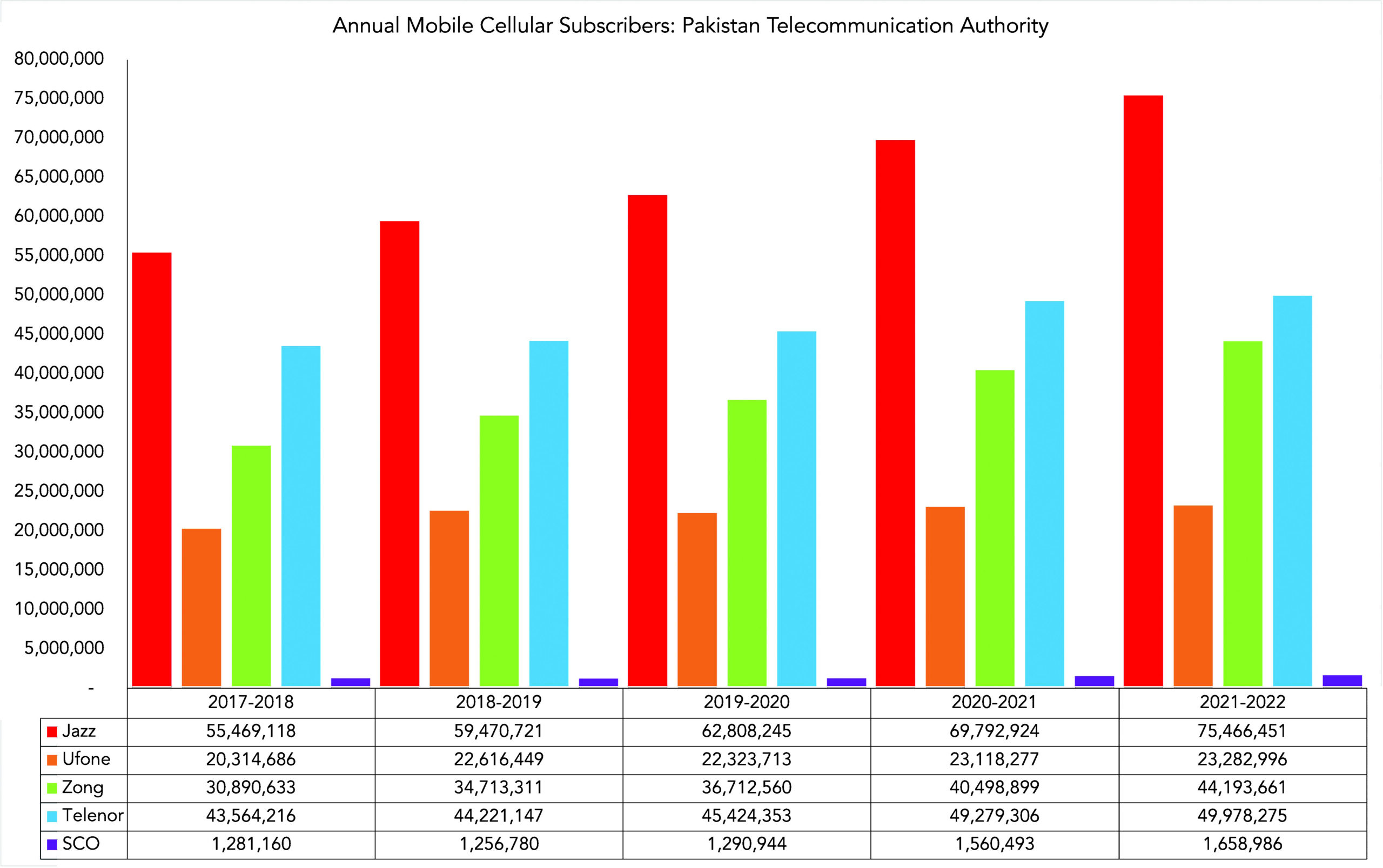
 Total cellular subscribers rose to 194.58 million at the end of 2022, with an average annual increase of 10.7 million between 2017 and 2022. These 10.7 million subscribers are completely new customers. This means companies can target existing customers and are also guaranteed 10.7 million new customers every year based on the past half-decade trend.
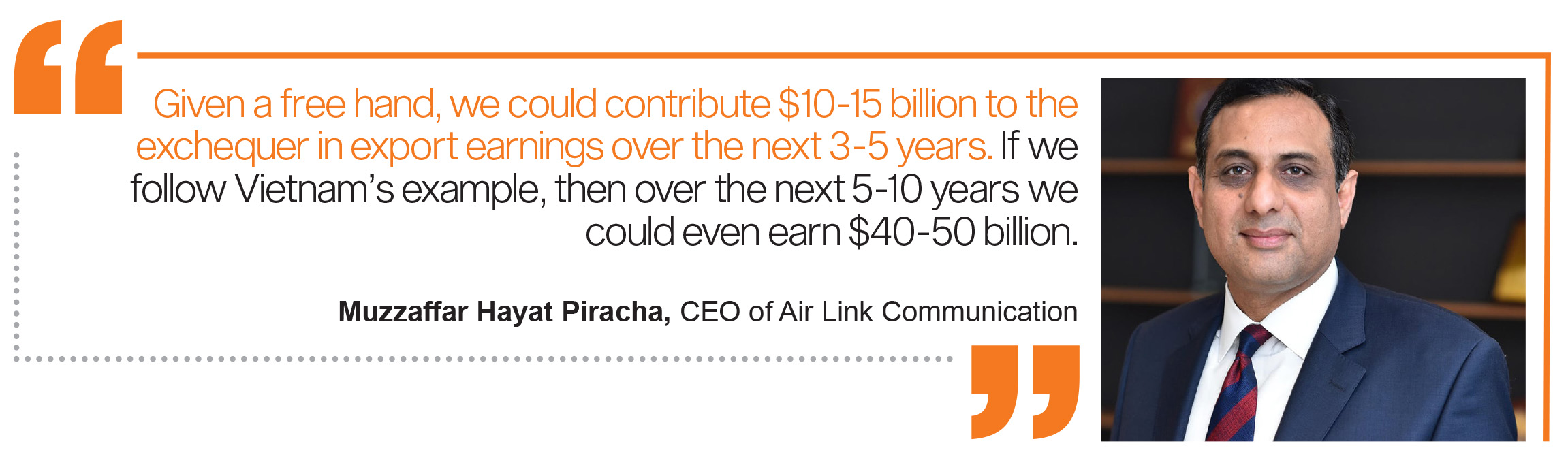
 It seems like an incredibly lucrative business. The only thing grander than its potential are the towering claims it has made regarding its position in Pakistan’s economy. “This is a sunrise industry, bursting with opportunity. With proper nurturing, it has the potential to generate a staggering $10-15 billion in export earnings,” declares Muzzaffar Hayat Piracha, CEO of Air Link Communication and Senior Vice Chairman of the Pakistan Mobile Phone Manufacturers Association. Piracha’s Air Link is one of 30 licensed companies that manufacture mobile phones in Pakistan both directly, and through its subsidiary Select Technologies.
“Given a free hand, we could contribute $10-15 billion to the exchequer in export earnings over the next 3-5 years. If we follow Vietnam’s example, then over the next 5-10 years we could even earn $40-50 billion,” Piracha elaborates. For context, Pakistan’s exports for FY 2021-22 stood at $31.782 billion according to the Pakistan Bureau of Statistics (PBS).
Trouble in paradise
“Not even a single rupee worth of letters of credit (LC) can be accessed, leaving us without raw materials needed for production. The industry teeters on the brink of closure,” warned Piracha. “In all honesty, the industry has already shut down. The question is whether it will collapse entirely. Major global brands like Samsung and Xiaomi stand poised to abandon Pakistan,” Piracha continued.
So what’s the solution? “If we are granted LCs again, then the sector will resume production. It was booming,” posits Piracha.
We could end the article here; we have chronicled this nascent sector’s journey. But this moment of halt begs the question: what are we even doing here? This sector has come out of nowhere for most of us and makes mind-boggling claims.
How many of us knew that our Samsung phones are made here? Or that they’re made by the same company which makes the KIA Sportage? This lapse in production is our opportunity to ensure our Samsung phones don’t suffer the same fate as their estranged Sportage cousin.
Calling the export bluff
Profit has scoured State Bank of Pakistan’s (SBP) and PBS’ trade data to find the value of mobile phones exported, but came up empty-handed. This is odd because mobiles are listed as an easily identifiable import item. So why isn’t the reverse true?
“If it isn’t a listed item, then the volume probably doesn’t merit it,” says Dr Aadil Nakhoda, Assistant Professor at IBA. Profit searched for any export data, and could only find three instances. The PTA highlighted how Inovi Telecom had exported to the UAE in August 2021 and December 2022. The only other instance relates to Razak Dawood lauding Air Link for exporting locally built mobiles to the UAE in September 2021. And that’s about it. This is a far cry from the $1 billion that the industry aimed to achieve by June 2022.
While some suggest sinister reasons for why local companies are not exporting, Profit suggests an alternative. In their current capacity, they simply cannot.
Tempering expectations
The UAE and ‘African countries’ are the only cited markets where these phones have been exported. Piracha claims phones are also being exported to Saudi Arabia and Oman, but this cannot be corroborated. Maybe it’s just him exporting there?
“Let’s examine the markets touted as export destinations. The Middle East is a high-end market dominated by Apple and Samsung. A phone made directly by Samsung in Vietnam is cheaper than one made through a joint venture (JV) in Pakistan. They can directly export phones from their subsidiary in Vietnam to the Middle East and reap the profits themselves. Why share profits with a local partner in Pakistan?”, says Muhammad Naqi, CEO of Premier Code.
Naqi’s Premier Code is one of the 30 mobile phone manufacturing companies. However, it has gone the mobile route alone rather than entering a JV with any international manufacturer like most others in the industry.
“Looking at Africa, Egypt is also big on manufacturing. Samsung and Nokia have their own manufacturing centres there. Even if our local players could beat Samsung and Nokia in terms of costs, African countries are bound by free trade agreements. If you export to Africa, how would you have a cost advantage against a company based there?” Naqi adds.
The lack of a potential cost advantage, and subsequent un-exportability raises the spectre of comparison with the one industry that mobile manufacturers ideally want to stay clear of: the automotive industry.
Automotive industry part deux?
“Mobiles are a necessity, cars are a luxury,” declares Piracha. “Your phone is your lifeline. Forget it at home? You turn back. But no car? No problem. Catch a ride, pedal a bike, hop on a bus, or hail a rickshaw,” Piracha adds.”The mobile industry boasts massive volumes, unlike automotive which has never exported anything. With $10-15 billion in potential exports, localisation is inevitable,” Piracha reflects. Piracha draws comparison with the automotive industry by using the word ‘necessity’.
“Cars are essential too. How can you label a Mehran a luxury?” asserts Nakhoda. “The Mehran was an affordable alternative to a motorcycle. It was the people’s car. But with each price hike, it slipped out of reach for the average person,” Nakhoda adds.
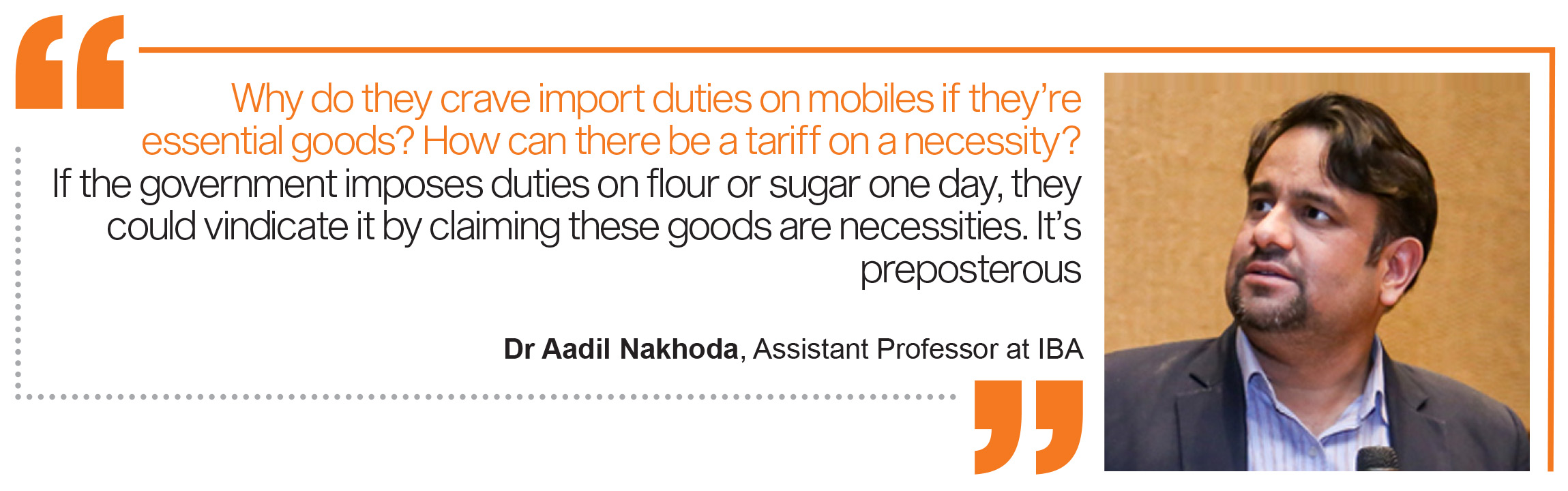
“Why do they crave import duties on mobiles if they’re essential goods? How can there be a tariff on a necessity? If the government imposes duties on flour or sugar one day, they could vindicate it by claiming these goods are necessities. It’s preposterous,” Nakhoda exclaims. “If mobiles are necessities, are we establishing value chains that will never produce iPhones or other high-end phones? It’s mind-boggling,” Nakhoda questions.
The comparisons transcend mere slip of tongue and accidental coincidences. They align with technical capacities too.”Localisation? At best, you can only localise 10-15% of a mobile’s value. Certain things cannot happen in Pakistan,” Naqi asserts.
“Take chipsets. The investment required is astronomical. Even if you could muster the funds, the water needs are immense. Manufacturing chipsets is a water-guzzling industry and Pakistan is water-scarce. The clean water requirement means it’s a non-starter,” Naqi explains.
“LCD screens? The market isn’t big enough for anyone to consider manufacturing here. Only five to six companies in the world make LCDs. Setting up manufacturing in Pakistan would require massive investments that local groups can’t undertake. Samsung invested $500 million to set up its LCD plant in India. Their government gave rebates and concessions which ours would struggle to match,” Naqi elaborates.
“And cameras for phones? Those also cannot be made in Pakistan,” Naqi adds. Naqi’s outlook is grim. Nakhoda doesn’t mince words: ‘If they can’t cut it on cost, they won’t export. They’ll just lobby to jack up duties and cash in on domestic margins. It’s a tale as old as time – it happened in automotive and mobiles could be next,”.
The situation is quite bleak. However, not having a sector is easier than scrapping one. It’s also not as if the sector is left gasping for straws. It’s new, there are underlying realities that favour it. Do they know it is the question?
What about our Tim Cook moment then?
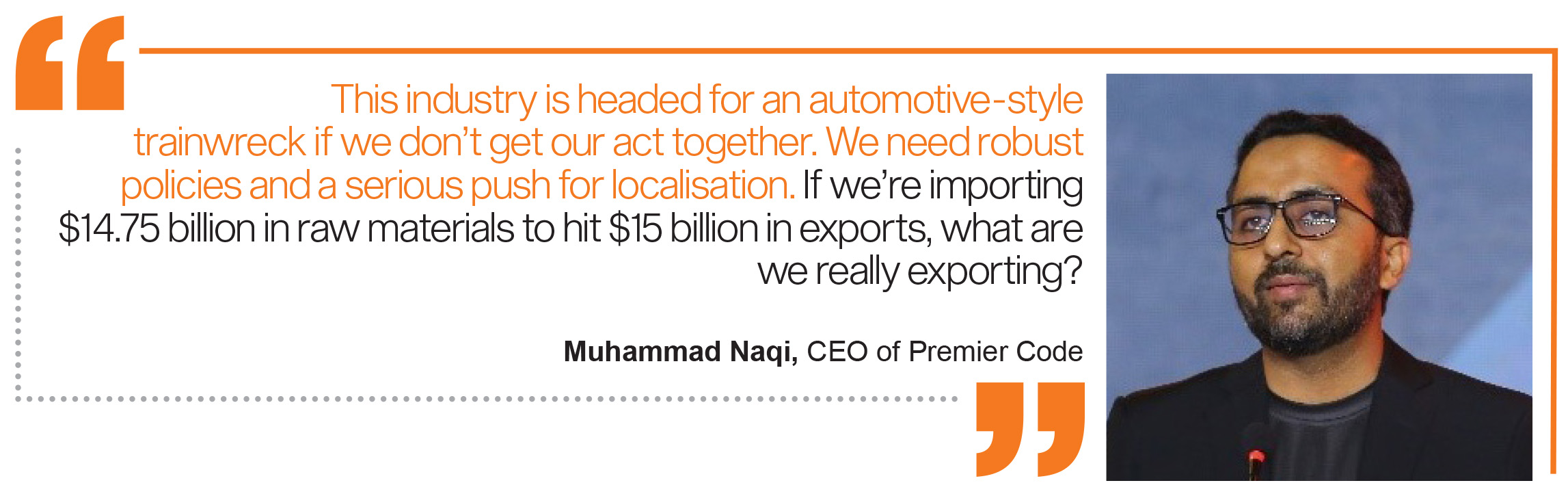
Naqi pulls no punches: “This industry is headed for an automotive-style trainwreck if we don’t get our act together. We need robust policies and a serious push for localisation. If we’re importing $14.75 billion in raw materials to hit $15 billion in exports, what are we really exporting”?
There are several low-hanging fruits ripe for the picking in the sector. According to PTA’s statistics, half of Pakistan’s mobile users have feature phone users. These phones, with their relatively simple manufacturing vis-à-vis smartphones, provide opportunities for economies of scale.
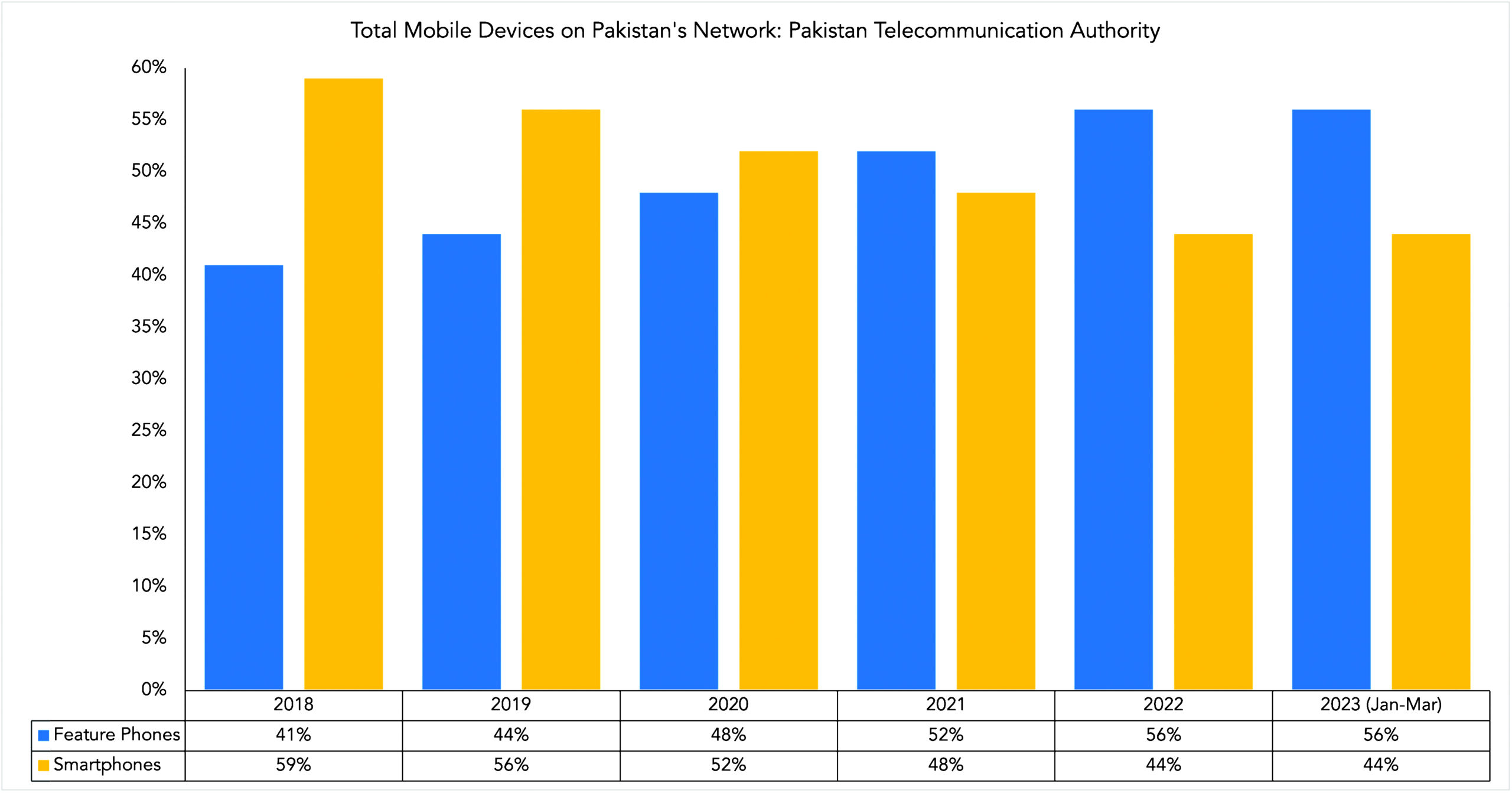
Phone manufacturers are cognisant of this. The majority of locally made phones are feature phones. The disparity in scale between feature phones and smartphones raises questions about potential synergies between the two segments. However, the silver lining is that smartphone production could increase to meet unmet demand if LCs for import become obtainable as Piracha claims. Even if the idea seems far-fetched amidst the current crisis.
“If the principal’s skin is not in the game, they will not work on localisation, exports, or technology transfer,” asserts Naqi.”We can start working on patents and intellectual property rights in the processes that have been brought over. Once we start incorporating these, localisation in terms of the value of the mobile phone will increase,” he elaborates.
“A low-hanging fruit is how India enticed chipset manufacturers to set-up their testing centres,” Naqi reveals. “They initiated the process of having companies outsource their labour to India,” he adds. “This was followed by R&D labs, and eventually other large-scale processes. India leveraged Foxconn to convince Apple to increase their investment in India,” he continues.
The clock is ticking. Staring at our neighbour green with envy won’t do us much good if we remain silent spectators.
The mobile manufacturing industry stands at a crossroads, teetering on the precipice of triumph or tragedy. Can it achieve cost advantages and fulfil its promises to export? The stakes are high. Pakistan cannot afford to nurture another industry that relies on taxpayer largesse. It cannot have another nascent industry, dubbed a sunrise industry, become a foundering rather than delivering on its promises. This momentary lapse in production provides opportunities to discuss what the sector is, what it should be, and most importantly what it absolutely should not be. [/restrict]

Nice Information Good Work Keep it Up!
Sir, you did not cover the aspect that the Pakistani govt has for years driven foreigners away. Take any sector (oil and gas: ENI, OMV, Exxon…pharma : Bristol Myers Squibb, Merck, Pfizer… Banking: ABN Amro / RBS, Barclays, HSBC…. Other sectors AIG, Commercial Union / Aviva, Temasek, Virgin Atlantic,
Etc). How would they attract Apple or Microsoft or anyone else?
InshaAllah it will be a huge success. technology, it and service industry can bail out pakistan and we have a vibrant youth familiar with these things.
Pakistan’s cellphone industry holds immense potential, poised to become a remarkable $15 billion exporter. With the right strategies and investments, it has the power to shape a thriving technological landscape and create countless job opportunities. Let’s support its growth and turn this opportunity into a shining success story for Pakistan.
I cannot thank you enough for the impact your writing has had on my personal and professional growth. Your articles have been instrumental in shaping my perspective and enhancing my skills.
8171 BISP and Ehsaas program will start meeting from Monday Federal Minister of Benazir Income Support Program Shazia Murri has announced that this time a stipend of Rs.9000 will be given. You can check your eligibility through the 8171 web portal and register through Ehsaas 8171.
The purpose of BISP 8171 Check Online Registration is to register those households who are poor and needy, as Pakistan has suffered economic problems due to Corona and 53% of the population has been affected. Unemployment increased as people lost their businesses and could not support their homes.
BISP 8171 is a program in Pakistan called the Benazir Income Support Program (BISP). It helps people who are poor and need help. The program gives money to those who are eligible. BISP 8171 is important because it tries to make things better for people who don’t have much money. It helps them go to school, get medical care, and have a better life. The program is trying to make sure that everyone has a fair chance to succeed in Pakistan. Apply Now
Market Size: Pakistan has a vast mobile phone market, with millions of subscribers. The penetration rate of mobile phones is quite high, and it continues to grow as more people gain access to affordable devices and affordable data plans.
I found the post to be highly good. The shared information are greatly appreciated
The shared information are greatly appreciated
The post was truly enjoyable. I value your contribution and the information you shared.
Pakistan is one of the biggest market of Mobile Phone who import from another countries. At this time in Pakistan people interested to buy Samsung and iPhone mobiles which are highly expensive. Basic purpose of android mobile is to produce best quality content. Because Youtube and tiktok start monetization in Pakistan so that its demand going increasing day by day. On the other hand, people are using big size app for video editing that just run in Samsung and iPhone models.
The shared information is greatly appreciated…Keep updating keep growing.
The shared information is really amazing. Keep updating us
Fantastic piece! The details you’ve provided in this article are not only enlightening but also skillfully presented. It’s clear that you’ve dedicated considerable thought and effort to craft this post.
Great article! I found the information you shared here to be both insightful and well-presented. It’s evident that you’ve put a lot of thought and effort into this post.
A good point was raised in the article: Over USD 14 billion worth of imports required to export USD 15 billion worth of resulting goods. Doesn’t sound clever.
Apple CEO Tim Cook paid a visit next door this April, to cut the ribbon in Mumbai and New Delhi as India welcomed its first Apple stores with exultation and sanguinity. 5566 Rashan Program. The air was redolent with the sound of animated chatter as the event marked the evolution of Apple’s involvement in India. A new chapter in a relationship dating back to 2017 when India enticed Apple to outsource iPhone manufacturing. A relationship that has even led to Apple rivalling arch-rival Samsung in adopting India’s PLI’s scheme to net the country over $9 billion in phone exports this fiscal year alone.
5566 Rashan Program.