


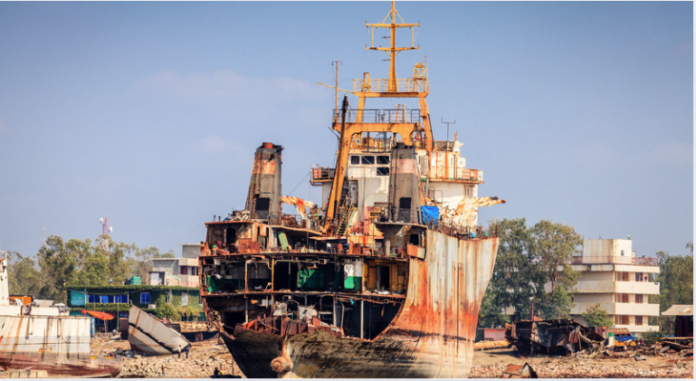
Pakistan recently announced that one of its ship recycling facilities had been certified under the Hong Kong International Convention (HKC). Prime Green Recycling Yard, which has been operating for over two decades in the Gadani shipbreaking yard, recently obtained this certification, making it the first Pakistani shipbreaking yard to do so.
Shipbreaking, at its core, is a recycling industry. In theory, it is supposed to reduce waste by salvaging reusable material from end-of-life ships, and free it up for usage in other industries. The most important of these materials are metal and steel, key components in a ship’s make and build, which are then used to supply the country’s metal needs.
Yet, what ideally would have led to green consequences has been beset by various bottlenecks which have restricted its potential to be a force for good. The industry, dominated by South Asian countries of India, Bangladesh, and Pakistan, has been a hub of practices that have not only been environmentally detrimental, but also harmful to human life. Poor regulatory oversight, lack of adequate protection for both the environment and the workers, and blasé attitudes towards modernising the industry have led it to become one of the most dangerous professions in the world.
But, there have been efforts to mitigate these harmful effects and to push back against these practices in an effort to make shipbreaking a more sustainable practice. The HKC is one such effort. Pakistan’s first steps to bring its shipbreaking industry in line with global standards as exemplified in this recent move are a necessary step to ensure that this industry remains competitive globally and is better for the employees as well as the natural environment.
Much more, however, needs to be done to ensure that Pakistan’s shipbreaking infrastructure is developed and safe enough for it to be competitive in a world that is increasingly moving towards reducing carbon emissions and helping conserve the climate.
Shipbreaking Industry:
Big ships, like small things, have a lifespan. Usually, after 20 years, these ships – such as cargo vessels, tankers, bulk carriers, cruise liners – become costlier to maintain. The owners think better of keeping these vessels, and sell them off for scraps to shipbreaking yards. They get money, and the shipbreakers get to keep and use all that’s of, on, and within the ship.
The process of breaking ships up into manageable pieces is heavy and intensive. According to Business Insider, a 150 ft tall and 900 ft long vessel would require 200 workers to spend around 3 months of effort to fully knife through it. Cruise ships, which are the most complex sort of ships, can take up to a year to be fully dismantled.
It is estimated that 95% of the metal (mostly steel, copper, and aluminium) that is obtained in this process of destruction is reusable. Other valuable kinds of material include glass, wood, furnishings, plumbing, batteries, generators, and electronic appliances, all of which can be sold again in various flea markets, if not supplied to small businesses.
The process of breaking a ship is also very dangerous. An old ship, beside the things mentioned above, also contains residual oil, asbestos from insulation, lead from paint, and other kinds of toxic and heavy metals. All these things can, if not properly managed, cause great hazards. The oils, for example, could lead to massive explosions, considering blowtorches are the main implement used to cut metal up. Similarly, toxic material can seep into the environment and ravage local species and their habitat.
Now there are various methods of picking apart a ship. The most dangerous one of these is the beaching method, which is, you guessed it, mainly used in the shipbreaking yards of South Asia. It is also the cheapest method of breaking ships. In this method, a ship is ‘beached,’ i.e., thrust on the beach while its engine is on so that the front part of it is on land, while the rear part is on the sea. Then, this process involves pulling down large pieces of metal from the ship; these pieces fall to the ground or on the water, from which they are towed to be broken into further smaller pieces.
Obviously, this process is dangerous since, as NGO Shipbreaking Platform points out, “cutting operations take place in the intertidal area, pollutants are inevitably discharged into the environment and washed away by the tide.” At the same time, massive pieces of falling metal can catch and crush workers, whether suspecting or not.
This practice is banned in much of the world but has found a fervent practitioner in the shipbreaking yards of South Asia. And that is part of the reason why these beaches are preferred. Most of the ships, for example, in these yards originate either in Europe or China. The reason is that lax regulatory regimes, poor oversight, cheap labour, and high demand for scrap in local markets mean that the ship-sellers can command a higher price in these markets, by some estimates, over 10 times more than in the industrial north.
Although there are protocols, such as the Basel Convention of 1992, to prevent developed nations from exporting hazardous waste, such as is present in older ships, to developing nations, these regulations have been routinely bypassed. One of the most common methods is to change the ship’s flag to that of a country – such as Panama, Comoros, or Saint Kitts and Nevis – that has lenient laws regarding the export of end-of-life vessels to countries with poor shipbreaking infrastructure and practices.
The HKC, too, aims to promote safe and environmentally sustainable ship recycling practices. Adopted in 2009 by the International Maritime Organization, it sets out standards that govern the management and disposal of waste and hazardous material as well as the promotion of worker safety in shipbreaking yards. According to these standards, every ship arriving at a shipbreaking yard must contain an inventory of all the hazardous material present in the ship, and delineate a clear plan to handle it. The shipbreaking yard, before accepting this, also needs to submit a report to the local government and attest to its own ability to handle the hazardous material in a safe and environment-friendly manner.
Moreover, all shipbreaking activity is to be carried out on impermeable flooring, and there must be oil-water separators to properly treat runoff. The beaching strategy, where ships were cut on beaches, had also to give way to cutting in controlled, land-based zones.
The three major nations of South Asia, which together accounted for over 84 percent of the global tonnage processed in 2024, were slow to ratify this. The slowest however was Pakistan, which only did so in late 2023, meaning it had less time than its neighbouring counterparts India and Bangladesh to take systemic measures to bring their shipbreaking operations in like with the protocols set forth in the HKC.
The treaty went into effect in June 2025, by which time Pakistan had not a single HKC-compliant shipbreaking yard across its length or breadth.
And now it finally has its first.
Shipbreaking In Pakistan:
Pakistan’s shipbreaking industry is concentrated in the Gadani shipbreaking yard, which is the third largest yard of its kind in the world. According to some reports, it was once the largest such yard in the world, and employed over 30,000 direct employees in the 1980s.
Located almost 40 km south of Karachi, Gadani is spread across a stretch 10 km long, and is composed of over 130 functional plots, where various shipbreaking companies have been leasing out space to carry their harsh business. 34 of these plots are owned by the Balochistan Development Authority (BDA), while the rest are owned by various businessmen and landlords.
Gadani emerged as a hub of shipbreaking in the 1960s. One good reason for this was the geographical characteristics of this beach, which was particularly suited for carrying out the beaching strategy mentioned above. The water level is deep here, while the sand is firm. This means that unlike other beaches where there is wait for the tide to be high to push the ship onto the sand, here ships could make it to the shore comparatively easily.
This shipbreaking yard can process over 120 ships in a year, and generate around 1.2 million tonnes of metal, which is then re-rolled and supplied to the metal industry. And it is here that the shipbreaking industry’s chief significance lies. By some estimates this recycled metal fulfills anywhere from 15 to 20% of the local metal industry’s annual demand for raw material.
Other than that, the industry employs thousands of people. It was said to have employed 12,000 in 2020, though the NGO Shipbreaking Platform sets the current employment at around 5,000, with potential to rise up to 20,000 in peak periods. It also generates approximately billions of rupees in taxation and other duties. Dewan Farooqui, ex-Chairman of the Pakistan Ship Breakers Association (PSBA), mentioned in 2020 the figure of PKR 16 billion as the industry’s yearly contribution to the national exchequer during normal times.
But this valuable industry has seen a decline in the past few decades, losing ground to yards such as Alang in India, and Chittagong in Bangladesh, and even Aliaga in Turkey. Even as recently in 2014, the number of vessels dismantled by Pakistani shipbreakers had numbered 110. In 2024, this number had fallen to 24.
While in the 1980s, the government had supported shipbreaking, the industry fell prey to the growing government indifference, as well as the removal of subsidies and tax disadvantages. At the same time, the regulatory framework the industry was supposed to be working under was consistent; in fact, shipbreaking wasn’t even recognized as industry proper until July 2025. This meant that this industry could not benefit from various government schemes and incentives, outlined in either the national budget or the Public Sector Development Program, to promote the general economic health of various sectors.
Moreover, the depreciation of the rupee, like for other industries, harmed this one too, by eroding the ship-buying potential of the shipbreakers. Other than that, the underdeveloped infrastructure as well as the lack of investment have contributed to a general falling in the capacity of the industry. This downward trend was combined with the poor working conditions, which led to the biggest explosion in the global shipbreaking industry in 2016, where at least 29 workers died and more than 60 were injured while dismantling an oil tanker at Gadani. There was another fire in 2017, claiming the lives of 5 people.
The government placed a ban on shipbreaking after that, but it was soon reversed without any substantial change in the conditions. The workers continued to be exposed to risk, while earning as little as USD 4 per day working in dangerous conditions and living in areas without proper sanitation and access to basic amenities of life.
Furthermore, the industry’s situation continued to exacerbate since it was slow, compared to others in the region, to institute infrastructural reforms to reduce risks to human health and safety, as well as the environment. Bangladesh, on the other hand, though also slow, was much quicker than Pakistan, and was able to convert 14 of its 153 registered shipping yards compliant with new green standards. Pakistan has celebrated its first only now.
Consequently, Bangladesh and India, the other two major shipbreaking countries are miles ahead, while Pakistan – even after the decline in its industry – comes third in terms of tonnage processed in 2024, though the number of ships has declined manifold from the more than hundred that it used to process in a year.
Shipbreaking Industry Statistics (2024):
| Country | Gross Tonnage | Number of Ships |
| Bangladesh | 2,417,731 | 130 |
| India | 1,459,209 | 101 |
| Pakistan | 638,747 | 24 |
| Turkey | 476,303 | 84 |
| Rest of the World | 341,678 | 45 |
Source: NGO Shipbreaking Platform
What is the Significance of this New Shipbreaking Certification?
One thing must be stated at the outset. Carried out under the International Labour Organization’s Safe and Environmentally Sound Ship Recycling and Decent Work programme, which is facilitating the upgrading of local shipyards to meet international standards as set out in the HKC, it is only the first step, a small step; but it is a necessary step, and one that does give some room for hope.
There are signs that the government is also becoming serious about this upgrade of the industry. In June 2025, for example, the Ministry of Maritime Affairs approved PKR 12 billion to support the modernisation of the Gadani shipyard into a “model green facility”. It also, as mentioned above, formally recognized shipbreaking as an industry, making its protection and flourishing part of the government’s economic responsibility.
This is supposed to not only encourage the overhaul of practices, but also help set up of critical infrastructure to help improve working and living conditions for the thousands of workers at the yard, many of whom are not native, but have shifted across large distances (sometimes as far as Khyber Pakhtunkhwa). In fact, the Minister of Maritime Affairs also announced the construction of a 30-bed hospital with residential blocks for the medical staff, as well as labour colonies, 32 km of road, a school, a public park, and modern water supply and treatment systems.
At the same time, there is some Chinese interest as well in the general maritime industry of Pakistan. For instance, as recently as December 2025, a Chinese conglomerate called Shandong Xinxu Group, proposed the building of a €2 billion Integrated Maritime Industrial Complex at Port Qasim. This complex is proposed to contain not only shipbuilding and shipbreaking facilities, but also the revival of the Iron Ore and Coal Berth Jetty, and the establishment of a steel mill integrated with port operations.
So, there’s evidently interest in the potential of Pakistan’s shoreline. And it’s not that the potential is invisible to us.
As mentioned above, the shipbreaking industry supplies anywhere from a sixth to a fifth of the local metal demand. In doing so, it eases pressure on destroying more of the environment to cudgel up more metal from the hurting earth, but also helps the balance of payments by reducing Pakistan’s reliance on steel imports.
On this point, while the government has been subsidising the importers of scrap metal, it has generally left the shipbreaking industry without such incentives. Given that this industry also employs thousands of people, some subsidies must also be given so that – while locally supplying scrap to the industry – it can also bring in tax revenues for the exchequer, grant employment to thousands of people, and rebuild what was once the biggest player in this industry across the globe.
At the same time, these policies would require adequate follow-up, and consistency in its focus and effort, while being supported by central and provincial authorities. Not only must the rights of the workers – especially at least to the minimum wage, but given the risks involved to a higher wage – be protected, but a real regulatory framework must also be established to monitor the progress of Pakistan’s shipbreaking yards in their bid to be compliant with the latest international standards.
While it remains to be seen how much of Pakistan’s recent moves turn to hot air in the future, there is not much of a choice. The world is moving towards a new direction, and not getting in line would leave Pakistan stuck behind in practices that are not only harmful to workers and the environment, but which also increasingly fail to bear fruit, and are rapidly losing their attraction.
The HKC mandate, for instance, would take full effect by 2030. And in the future, shipbreaking would be allowed only on facilities compliant with EU standards. In fact, globally such shipbreaking facilities are moving away from the beaching method, shunning it for its destructiveness, and towards alternative methods like dry docking, which involve shipbreaking operations to be performed on stabled and controlled platforms with stringent safety requirements.
There’s no shortage of ships to be dismantled anytime too. In fact, Pakistan is already eyeing a share of the estimated 400 ships damaged in the war between Russia and Ukraine. But, given that shipbreaking in Pakistan is done primarily by the beaching method, and in order to be competitive this method must give way to more sustainable ones, there certainly is a tall task of development ahead.
And, though it is a fair enough reason, this fear of being left behind should not be the only motivation for Pakistan to modernise its shipbreaking industry. Pakistan should instead take charge and proactively work to transform its industry given that it spells out potential material benefits which would in no small measure help stabilise Pakistan’s general economic condition.