


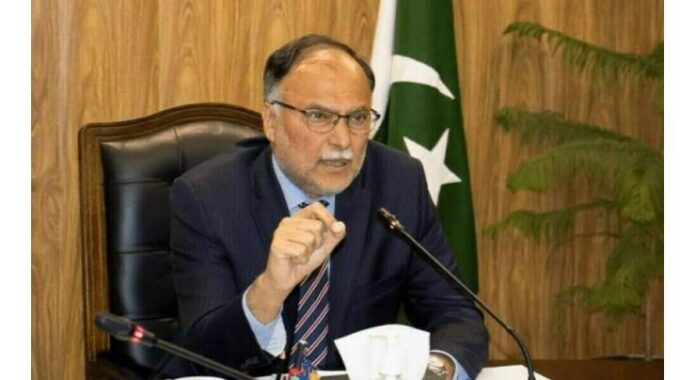
Pakistan effectively slipped into an internal default in early April 2022 after the Ministry of Finance said it lacked funds to release the final instalment of the federal development budget, Planning Minister Ahsan Iqbal said on Friday.
Speaking on Geo News programme Geo Pakistan, Iqbal said the finance ministry on April 1, 2022, informed the government it could not disburse remaining development funds because it had no money available.
He said the episode amounted to a “virtual internal default”, an unprecedented situation in Pakistan’s history, and fuelled speculation at the time that the country could default externally within four to six weeks.
The remarks referred to the final days of the Pakistan Tehreek-e-Insaf (PTI) government led by then prime minister Imran Khan, which was removed through a no-confidence vote on April 7, 2022.
Iqbal said economic conditions had stabilised since the Pakistan Muslim League-Nawaz (PML-N)-led coalition took office, citing improvements in growth, inflation and investor confidence.
He said the economy, which he described as having stalled, recorded 3.7% growth in the first quarter of the current fiscal year, while large-scale manufacturing activity was increasing.
Iqbal also pointed to upgrades by international ratings agencies Fitch, Standard & Poor’s and Moody’s, and said inflation, which had been rising at an annual rate of 38%, had fallen to about 4%.
“If inflation had not been brought under control, it would have continued rising every month,” he said.
The planning minister said the government’s stabilisation efforts were anchored in the International Monetary Fund programme, which will run until 2027 and is fully owned by the government.
He said the latest budget included a deliberate reduction in duties in export-oriented sectors and partial liberalisation of imports for raw materials and machinery to expand export capacity.
Such measures typically lead to higher imports initially, he said, but imports of machinery and inputs would translate into higher exports in coming quarters.
On taxation, Iqbal said higher taxes on the salaried class were imposed under IMF conditions. He said the number of tax filers had nearly doubled and that additional relief would be considered in the next budget.
Calling taxation a “life and death” issue, he said all income earners, including traders and landowners, would have to be brought into the tax net. He added that digitisation would allow authorities to match lifestyle and spending data with tax records.