


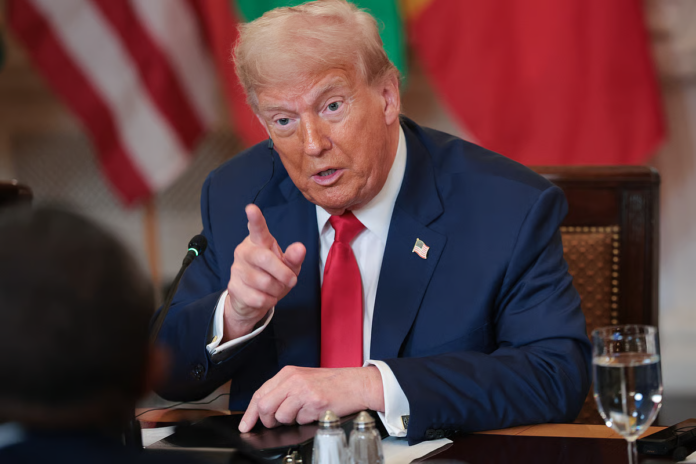
US President Donald Trump has called for a $100 billion investment into Venezuela’s oil sector, aiming to revive the country’s vast energy reserves, but received a cautious response from oil industry executives during a meeting at the White House on Friday.
The proposal, which would involve companies re-entering Venezuela’s energy market, was discussed with major oil firms, including Exxon and Chevron. While acknowledging the potential of Venezuela’s oil reserves, executives cautioned that the country’s current conditions, including political instability and the legacy of previous asset seizures, make it an unattractive investment.
Exxon’s CEO, Darren Woods, pointed out that the company had already had its assets seized in Venezuela twice and would require significant changes to consider re-entering. “Today it’s uninvestable,” Woods said.
Venezuela’s oil production has suffered in recent decades due to mismanagement, disinvestment, and US sanctions. The country currently produces about one million barrels per day, a fraction of global supply. Chevron remains the last major US oil firm operating there, and other companies, like Spain’s Repsol and Italy’s Eni, also maintain a presence.
Trump’s proposal for a $100 billion investment in Venezuela’s oil sector aims to increase production and lower global energy prices. However, analysts say that major investments will only be made if the country achieves political stability and provides security, legal certainty, and a competitive fiscal framework.
David Goldwyn, a former US State Department official, noted that while smaller investments could come from independent companies, the scale Trump envisions would require substantial subsidies and political guarantees. “The conditions are just not right,” he said, adding that any significant financial commitments would likely not materialize until Venezuela’s political situation stabilizes.
Despite the skepticism, some smaller firms expressed optimism about the potential for Venezuela’s oil sector, with some suggesting that under the right conditions, production could increase over the next few years. However, the $100 billion target remains a distant prospect, with analysts estimating that even a modest increase in production would require yearly investments of $8 to $9 billion.
The White House has indicated it may roll back some sanctions to facilitate this investment, coordinating with Venezuela’s interim authorities under Vice-President Delcy Rodríguez, though maintaining control over the oil sales process to leverage influence.
The discussions underscore the complex challenge of revitalizing Venezuela’s oil sector, with the future of US involvement contingent on political stabilization and security in the region.