


The Central Development Working Party (CDWP) on Thursday approved five major health sector projects under the Uraan Pakistan social sector initiative, aimed at expanding access to healthcare, reducing out-of-pocket medical expenses, and strengthening protection for vulnerable households.
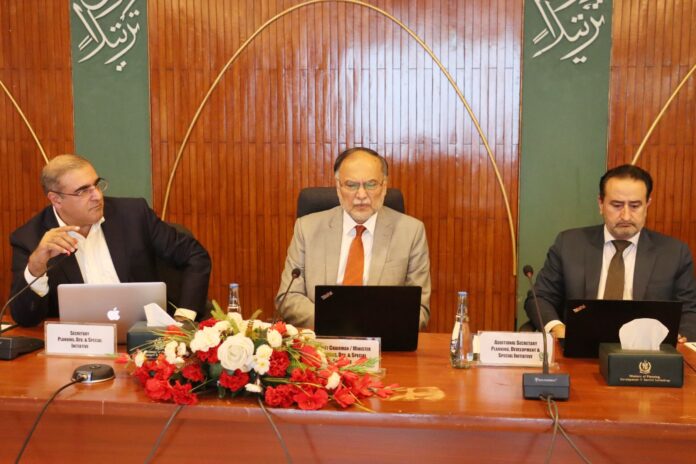
The meeting, chaired by Federal Minister for Planning, Development and Special Initiatives and Deputy Chairman Planning Commission Ahsan Iqbal, approved three projects with a cumulative cost of Rs12.524 billion, while two large schemes worth Rs56.823 billion were recommended to the Executive Committee of the National Economic Council (ECNEC) for final consideration. Federal Minister for National Health Services, Regulation and Coordination Mustafa Kamal attended the meeting to present and defend the health sector proposals.
Among the projects sent to ECNEC was the revised Sehat Sahulat Program, with a total cost of Rs40.19 billion. Under the updated framework, the programme will be implemented through the development budget on a universal basis in Islamabad Capital Territory, Azad Jammu and Kashmir, and Gilgit-Baltistan, focusing on secondary and priority inpatient care.
During the discussion, Ahsan Iqbal directed that the programme be restored to its original name, the Prime Minister National Health Program, noting that its expansion beyond targeted beneficiaries in later years had diluted resources meant for poor and deserving families. He stressed that public funding should prioritise vulnerable groups under the Uraan Pakistan social protection framework.
The CDWP also approved a revised project for the establishment of Jinnah Hospital (Polyclinic PGMI-II) in Islamabad at a cost of Rs15.95 billion, recommending it to ECNEC. Under the revised scope, the hospital’s bed capacity has been increased from 311 to 400, alongside upgrades in IT systems, building works, biomedical equipment, furniture, and provisions for cost escalation, including the impact of sales tax on imported equipment.
The planning minister expressed concern over sharp cost increases in the project and instructed the health ministry to ensure realistic and evidence-based costing at the PC-I stage. He also directed that essential facilities, including a mosque, be incorporated within the approved project cost.
Two additional revised projects were approved by the CDWP: the development of an Integrated Disease Surveillance and Response System with public health laboratories and workforce training, costing Rs7.48 billion, and the strengthening of points of entry and border health services in Karachi, valued at Rs2.86 billion. While approving the disease surveillance project, the chair made it clear that no further revisions would be entertained.
Another scheme, involving the strengthening and upgradation of the cardiology department and allied services at the Federal Government Polyclinic Hospital in Islamabad, with a cost of Rs2.17 billion, was also cleared after detailed deliberations.
The approvals form part of the government’s broader push under Uraan Pakistan to improve health infrastructure, enhance disease surveillance, and reduce financial hardship caused by medical expenses.