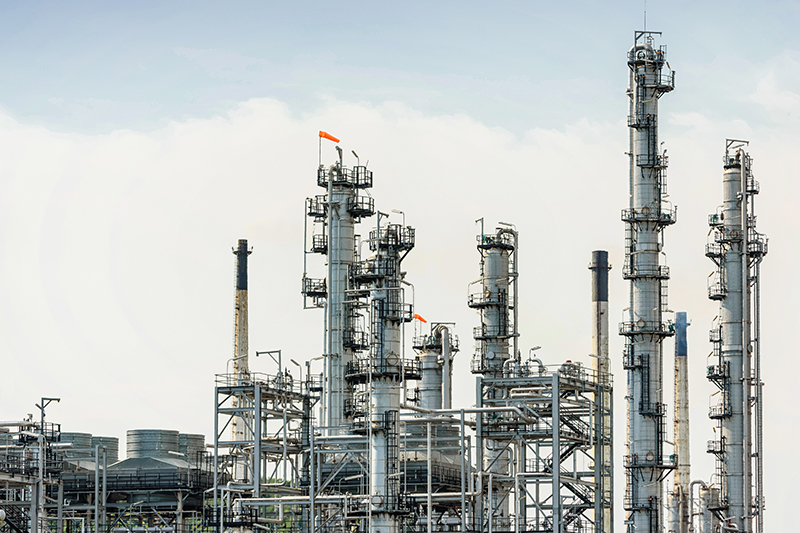
In the sprawling industrial landscape of Karachi, Pakistan’s largest refineries stand as monuments to both the country’s industrial ambitions and its policy paralysis. These facilities, designed decades ago to process crude oil into the fuels that power the nation’s economy, now face an existential crisis that threatens Pakistan’s energy security and economic stability.
Pakistan imports 70% of its petrol and 30% of its diesel, draining precious foreign exchange reserves at a time when every dollar counts. Meanwhile, domestic refineries operate at just around two-thirds of capacity, producing outdated Euro II and Euro III standard fuels while the world moves toward cleaner alternatives. This is not merely an industrial challenge, it’s a national crisis playing out in slow motion.
The anatomy of Pakistan’s refining sector
Pakistan’s refining sector comprises five major players with a combined capacity of 20 million metric tons annually. PARCO leads with 44% market share, followed by Pakistan Refinery Limited, National Refinery, Attock Refinery, and Cnergyico. Together, they employ thousands and represent billions in industrial infrastructure. Yet despite this capacity, the sector’s financial health has deteriorated dramatically, gross margins crashed from 5.9% to just 2.2% in FY25, while net profits plummeted 84% year-on-year.
The root of the problem lies in obsolete technology. Most Pakistani refineries operate on decades-old infrastructure that urgently requires modernization. Except for Cnergyico and PARCO, most facilities lack the capability to fully convert naphtha into Motor Spirit, resulting in inefficiencies, lower yields, and continued dependence on imports. These refineries are essentially “hydro-skimming” facilities, the petroleum equivalent of using a typewriter in the age of computers. They lack the sophisticated cracking and coking units that modern refineries use to convert heavy residues into valuable products. Consequently, Pakistani refineries produce excessive furnace oil (24% of output) that nobody wants, while the country imports the high-quality diesel and petrol it desperately needs.
Why upgrades are not optional but essential
The importance of refinery upgrades extends far beyond corporate balance sheets. Industry sources emphasize that post-upgradation, refineries will produce Euro-V standard fuels with significantly lower sulphur content, a transformation that would deliver immediate and tangible benefits to public health through improved air quality. The current Euro II/III fuels contain sulphur levels that contribute directly to respiratory diseases, cardiovascular problems, and premature deaths, particularly in urban centers where vehicle emissions are concentrated.

Courtesy Advanced Energy Technology
For the companies themselves, modernization means survival. Without upgrades, refineries will continue producing fuels that will eventually become unmarketable as environmental standards tighten globally and domestically. They’ll remain stuck with furnace oil that must be exported at a loss while watching helplessly as imports capture the growing market for quality fuels. The domestic consumption of furnace oil has already become commercially unviable following the imposition of petroleum levy in the current federal budget, further squeezing refinery economics.
For the government, the stakes are equally high. Every barrel of imported petroleum product represents foreign exchange bleeding from an economy that can ill afford it. In FY25 alone, Pakistan spent $11.4 billion on petroleum imports, nearly 20% of total imports. Upgraded refineries could double petrol production, increase diesel output by 50%, and reduce furnace oil production by 80%, potentially saving billions in foreign exchange annually while improving the country’s current account deficit.
Why refineries can’t go at it alone
The $6 billion question, literally, is why refineries need government support for upgrades. The answer lies in the brutal economics of refining and the regulatory constraints under which the sector operates. The refining sector functions under a government-controlled pricing regime where product prices are determined by authorities, not market forces. Consequently, refineries cannot recover upgradation costs through product pricing adjustments, they’re essentially price-takers in a market where the government sets all the rules.
Given that the required investment runs into several billions of dollars, and considering current economic conditions where refineries are barely covering operational costs, it is simply not feasible for these companies to finance such massive projects entirely from their own resources. Pakistani refineries, already struggling with single-digit margins and 84% profit declines, cannot generate the internal cash flows necessary for such investments.
Moreover, international investors understand these risks all too well. Chinese investors withdrew from Pakistan Refinery Limited’s tender, explicitly citing policy uncertainty. Without government guarantees and incentives, no rational investor, foreign or domestic, will commit billions to projects that could be rendered unviable by the next budget announcement or IMF review mission.
Promise and paralysis
Recognizing these realities, the government introduced the Brownfield Refinery Policy in August 2023, later amended in February 2024. The policy mandates all refineries to minimize furnace oil production and make their entire product slate Euro-V compliant within a six-year timeframe. The government committed funding support of approximately 25-27% through duties collected on High-Speed Diesel and Motor Spirit, with an escrow mechanism allowing refineries to retain portions of deemed duty collections for upgrade costs.
The policy set ambitious targets: within six years, refineries would upgrade to produce Euro-V standard fuels, double petrol production, increase diesel output by 50%, and slash furnace oil production by 80%. Refineries had agreed on all commercial and technical terms of the upgradation agreement and were prepared to proceed, investments amounting to approximately $6 billion were at an advanced stage of readiness.
Yet today, although the policy was approved two years ago, implementation has effectively stalled. Only Pakistan Refinery Limited has signed the upgradation agreement so far, and even PRL’s tender failed to attract investors. The other four refineries remain uncommitted, and the entire program sits in limbo, primarily due to unresolved taxation issues that emerged after policy approval.
The sales tax curveball
The antagonist in this narrative isn’t just the IMF, it’s also the government’s own unilateral decision-making. Background discussions with the refining sector reveal that the government’s decision to exempt petroleum products from sales tax, while intended to provide consumer relief, significantly increased project costs and undermined the entire feasibility of the upgrade program.
At present, nearly all petroleum products are exempt from sales tax, except furnace oil, which remains taxable despite its domestic consumption becoming commercially unviable. This exemption prevents refineries from recovering input taxes on goods and services, creating an annual loss of Rs.35 billion. For upgrade projects requiring billions in imported machinery and equipment, the inability to recover sales tax adds hundreds of millions to project costs.
While the government offers sales tax exemptions and income tax holidays under the Greenfield Refinery Policy which has been in place for several years but failed to attract any meaningful investor interest, the Brownfield Policy, with $6 billion in ready investments, remains stalled over the same tax issues. Industry sources argue that to ensure equitable treatment and unlock these investments, the Brownfield Refinery Policy should, at minimum, offer sales tax exemptions similar to those available under the Greenfield policy.
The IMF veto
Compounding the sales tax problem is the IMF’s inflexible stance. Under Pakistan’s Extended Fund Facility, the IMF insists on an 18% GST on all petroleum products with no exceptions. When the government tried to compromise, proposing a partial 0-3% GST, the IMF refused.
The IMF has also rejected tax-free imports of machinery for upgrades and insisted on petroleum and carbon levies on furnace oil from July 2025, even though refineries use this furnace oil internally for operations. These levies would increase operational costs by 80%, potentially forcing some refineries to shut down entirely.
What the industry wants to do about it
The refining sector has proposed specific, implementable solutions that could break the deadlock. First, they argue that since the government is already reimbursing sales tax related to fiscal year 2024-25 through product price adjustments, a similar mechanism should be adopted to reimburse sales tax incurred on current production costs. This would provide immediate relief without requiring IMF approval for structural tax changes.
Second, all imports related to refinery upgradation projects should be exempted from sales tax to ensure timely implementation and financial viability. This targeted exemption would reduce project costs by hundreds of millions of dollars without affecting broader revenue targets.
Industry sources emphasize that these aren’t requests for subsidies but for policy consistency and a level playing field. If the government can offer comprehensive tax holidays for theoretical Greenfield projects that never materialize, surely it can provide similar support for Brownfield upgrades with $6 billion in committed investments.
As 2025 draws to a close, Pakistan’s refinery sector stands at a crossroads. The tragedy is that all stakeholders, government, refineries, even the IMF, agree on the end goal: modern, efficient refineries producing clean fuels for Pakistan’s growing economy. The disagreement is merely on how to get there, and this disagreement has paralyzed progress for two years.
The refinery crisis exemplifies a broader challenge facing Pakistan: how to balance immediate fiscal pressures with long-term development needs. It’s a test case for whether the country can execute complex industrial policy in an environment of fiscal constraints and international oversight.