


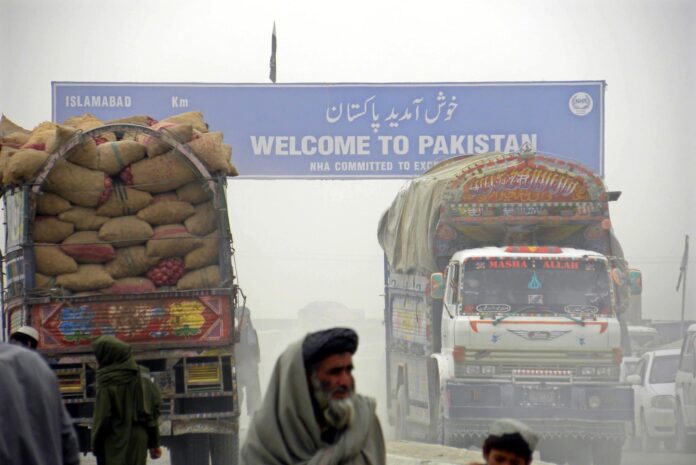
The suspension of bilateral trade between Pakistan and Afghanistan for nearly two-and-a-half months has imposed a far heavier economic cost on Kabul than Islamabad, with Afghan export losses running several times higher, according to trade data.
The disruption followed a deterioration in relations over security concerns, after which Pakistan closed its border in October and Afghanistan suspended trade ties in early November. Since October 10, 2025, Afghanistan’s export losses are estimated at about 10% of its total exports, compared with roughly 0.6% for Pakistan.
The uneven impact reflects deep asymmetries in trade dependence. Nearly 46% of Afghanistan’s exports are destined for Pakistan, including a significant share routed onward to India via the Wagah border. By contrast, Afghanistan accounts for around 3.46% of Pakistan’s global exports. The assessment excludes transit trade, which represents about 40% of Afghanistan’s total imports, further amplifying Kabul’s exposure.
India has emerged as Afghanistan’s second-largest export destination, absorbing around 40% of its exports despite not sharing a border. Exports to other neighbours remain limited, with Iran at 1.94%, Uzbekistan at 3.14% and Tajikistan at 0.37%, underscoring the concentration of Afghan export markets in Pakistan and India.
Afghanistan’s export mix adds to the vulnerability. Fruits and vegetables accounted for 71% of total exports in 2024, according to World Bank estimates, products for which alternative markets are harder to secure quickly. While Kabul may divert some imports toward Central Asia, Iran and India, replacing Pakistan as a primary export conduit remains challenging.
For Pakistan, the immediate losses are smaller. Average export losses since October are estimated at $222.5 million, about 0.6% of total exports, compared with Afghanistan’s estimated $173 million, or roughly 10% of its average annual exports.
Historically, Pakistan has run a trade surplus with Afghanistan. Pakistani exports fell after August 2021 but recovered to $1.39 billion in FY24, led by medicines, rice and cement. Afghan exports to Pakistan, meanwhile, stood at $612 million in FY25, keeping Pakistan as Kabul’s single largest market.
The suspension is also accelerating shifts in sourcing. Afghanistan–Pakistan Joint Chamber of Commerce President Khan Jan Alokozai said Afghan traders are placing cement orders with Iran, Uzbekistan and Tajikistan, while medicines are increasingly being sourced from Turkey, Uzbekistan, Iran and India via air cargo. Pakistani pharmaceutical products still account for an estimated 60–70% of Afghanistan’s market, he said, but that share is under pressure.
Transit trade trends point in the same direction. Afghanistan’s imports totaled $10.8 billion in 2024, with Pakistan supplying about 32%. However, tighter controls and a growing negative list for transit cargo have reduced Afghan imports transiting Pakistan from $6.7 billion in FY23 to $1.01 billion in FY25, with industry estimates suggesting the figure could fall below $1 billion in FY26.
Business groups on both sides have urged a resumption of trade, warning that prolonged disruption could lock in alternative routes and suppliers. Former Sarhad Chamber of Commerce and Industry president Muhammad Ishaq said uncertainty has also stalled planned industrial relocations, including textile operations that had begun shifting from Punjab to Central Asia.
Analysts say the data underline a clear imbalance: while Pakistan faces manageable losses, the suspension risks accelerating structural shifts in Afghanistan’s trade that could be difficult to reverse even after borders reopen.