


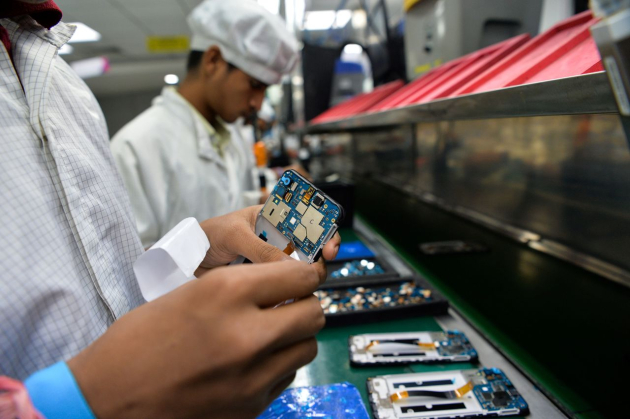
The federal government has decided to withdraw incentives and impose penalties on mobile and electronics manufacturers in cases of non-compliance with localisation targets, reporting requirements and operational obligations under the proposed Mobile and Electronic Device Manufacturing Policy.
The decision was taken during a high-level meeting chaired by Special Assistant to the Prime Minister on Industries and Production Haroon Akhtar Khan on Monday, where officials reviewed progress on the policy and agreed on strict enforcement mechanisms, including suspension of import licences and financial penalties for violations.
The policy framework aims to shift Pakistan’s electronics sector from assembly-based operations toward deeper localisation and export-oriented manufacturing, with compliance linked to continued access to incentives.
The meeting was attended by Secretary Industries and Production Saif Anjum, Engineering Development Board (EDB) Chief Executive Hammad Mansoor, and representatives of mobile phone manufacturers. A detailed presentation outlined the transition from complete imports to phased local manufacturing, focusing on employment generation and industrial capacity building.
Under the policy framework, mandatory export targets have been ruled out, with officials noting that forced export benchmarks have proven counterproductive in other sectors, including automobiles. Instead, export performance will be encouraged through fiscal instruments, with export outcomes proposed to be linked directly to Tax Increment Financing (TIF).
Quality certification has been made mandatory for exports, though officials clarified that compliance will not be enforced coercively. The government plans to establish local testing and certification laboratories to support exporters in meeting international standards.
The policy also introduces defined performance benchmarks for localisation. The EDB has been tasked with specifying minimum component thresholds, including at least 40 parts per semi-knocked-down (SKD) kit for smartphones and 15 parts per SKD kit for feature phones. Penalties will apply in cases of underperformance against these benchmarks.
To address valuation and under-invoicing risks, officials agreed that valuation rulings will be institutionalised with joint participation from the EDB, the Pakistan Mobile Phone Manufacturers Association and the Customs valuation directorate. In addition, both completely built units (CBU) and locally manufactured mobile phones are proposed to be placed under the Third Schedule of the sales tax regime to curb misdeclaration.
The policy also sets a minimum tariff gap of 30% between CBU and SKD imports to protect local manufacturing, while a Tax Increment Financing levy may be applied on both CBU and SKD imports. Officials noted that e-waste management remains a complex area and will be addressed through a separate, structured framework.
Manufacturers informed the meeting that global brands including Samsung, Xiaomi, Oppo, Vivo and Nokia have shown interest in expanding manufacturing operations in Pakistan under the new policy.
Officials said the policy will be presented to the prime minister after final alignment with stakeholders, with implementation focused on compliance-driven incentives, localisation discipline and export-linked growth.