How to fix the Pakistani economy
Profit speaks to five of the nation’s top experts on what the government should do in order to get the economy humming again

By now, it is abundantly clear that the Pakistani economy is not working, at least not for the overwhelming majority of the people in the country, and perhaps not even for the politically well-connected rent-seeking elite for whom the entire economic structure has been distorted in the first place. What, then, is the way forward? The Imran Khan Administration’s economic team, led by Finance Minister Asad Umar, appear to be taking a long time in getting settled in and appear indecisive about what to do next. We at Profit thought we might try to help them along.
Profit contacted five of the top experts on the economy to get their version of what is the right thing to do to put the economy on the right track in the backdrop of falling exports and balance of payments crisis. All five have either directly worked in the government, or else been in a position to advise the government or key figures in the country’s ruling political parties. And four out of the five have doctoral degrees in economics or related disciplines.
These accounts were narrated individually to Taimoor Hassan. They are presented here, without comment from Profit’s usually opinionated editorial staff. [Editor’s Note: That seems harsh. True, but harsh.]
Stabilise the macroeconomy, then focus on poverty alleviation
Reduce taxes, rein in government spending, and then prioritise poverty alleviation through programs to incentivise and fund entrepreneurship
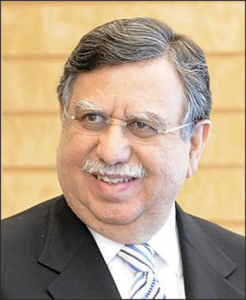
Shaukat Tarin
Pakistan’s long-term economic strategy should focus on the welfare of the common man. The economy should be tweaked so that in the long run, economic benefits such as higher income levels and lower unemployment could be passed on to the common man.
The medium to long-term strategy to achieve these ends requires stabilizing the macroeconomic environment to attract investors who are willing to invest on a long-term basis. Key macroeconomic indicators such as inflation should be brought down and exchange rate should be stabilized, complemented with lower interest rates.
Presently, our fiscal side is totally out of line with our expenditures exceeding our income. The government takes most of the money and there is nothing left for the private sector and businesses. There is a need to increase our revenues on a war footing.
Our tax-to-GDP ratio is very low so if we plan our economy to grow at a rate of 6-8%, the tax-to-GDP ratio needs to be increased to 20%, from the present around 13%, in the next five years. The tax collection should be done across the board with a primary emphasis on introducing new tax filers in the tax net instead of increasing taxes on those who are already in the tax net. If we increase the number of taxpayers to 10 million in the next five years, we stand a chance.
Secondly, the rate of sales tax should also be reduced from 17.5%. Overall, we should introduce a progressive tax regime in which all incomes are taxed, all consumptions are taxed and any exemptions are expunged.
In the same spirit, we have to rationalise our expenditures, with the debt payments among them being the most sizeable after defence expenditure. A major revenue affliction comes from our public sector companies which incur losses to the tune of Rs700-750 billion per year. These commercial organisations should be turned into profit-making entities through proper structural reforms to enable them to earn profits to contribute towards the national exchequer. Expenditures need to be rationalised and all unnecessary expenditures like the number of ministries and divisions should be cut.
On the external side, we always run into a problem when we run out of dollars and during the past five years, our trade deficit has doubled. Instead of increasing, our exports have decreased and this happened despite the fact that our oil imports decreased due to a slump in oil prices and commodity prices also decreased. This is the height of our under-performance. The problem lies in the fact that we don’t have a proper export base which needs to be broadened.
We need to work on our imports side and curb frivolous and unnecessary imports. We also need to work more on our exports.
The issue with our exports is that we don’t have an exports base which needs to be broadened. We need to export agriculture, IT and engineering products and explore new areas where our export competitiveness can be increased. Our existing exports should be more value added so that we don’t lose competitive edge in the market for existing exports. In textiles, which are around 60% of our exports, we are converting one million bales into $1 billion whereas China converts the same one million bales into $4 billion. They are able to do that because they add value to their products. If we convert one million bales into $4 billion, we will be able to add over $45 billion through the 14 million bales in just textile exports. The government should provide subsidies to the industries as long as they are making value additions to their products.
The problem with value addition is that it requires consolidating. Presently, businesses in Pakistan are being run by families and there are no foreign investors in the exports sector. This essentially means that no capital comes into Pakistan from outside and there is no solid connection with the international markets. It all needs to be consolidated. The bankruptcy law, that we call Corporate Restructuring Act (CRA), needs to be made active.
Smaller companies need to be consolidated and foreign investors need to be brought in as they will bring the capital, technology and access to the international markets. Moreover, the Special Economic Zones (SEZs) that China has made should be encouraged to export. Pakistan should produce goods where it has vertical competitiveness. We should also scale up the production of goods that are essential for us to meet the domestic demand and then also export them.
Foreign currency reserves can also be beefed up through remittances by introducing diaspora bonds to encourage the professionals who chose to keep their money outside of Pakistan to bring it back to the country.
Then there is Foreign Direct Investment (FDI). The Board of Investment (BoI) needs to be strengthened to be able to provide a one-stop shop for investors so that all of their problems are solved in one place. The office of the BoI should ideally be located in the office of the prime minister, should be high-powered and be formed of people with high credibility.
The government should also provide a stimulus to the housing sector which further stimulates at least 40 other industries which can generate a lot of jobs and generate economic growth that will be widespread.
Once the macroeconomic environment has been stabilized and the housing sector has been stimulated, the agriculture sector needs to be reformed. The first step into developing the agriculture sector would be to increase productivity that can be done through the usage of better quality of seeds and improving irrigation techniques. The Zarai Taraqiati Bank Ltd (ZTBL), instead of just lending the money, should have an attached services division in which experts advise people about seeds, water, levelling of land and marketing of agricultural products etc. There is a need to strengthen institutions altogether.
Once the main trajectory is set, Pakistan needs to alleviate poverty. Poverty should not just be left to the trickle-down effect. The lowest levels of our society, which form about 6-6.5 million households, should be enabled to stand on their feet through encouraging entrepreneurship in them rather than making them beggars. They should be given money to start small businesses so that they can be bread earners for themselves and others instead of just being beggars.
An overarching set of measures would be required for administrative reforms to implement the policies in the right way.
Having said all that, all plans made by the government should have a buy-in of the stakeholders. From operating ministries down to the common man, they should be a part of the plan. If the government is mulling over a policy concerning agriculture, it should engage all stakeholders including the farmers. If a policy is being devised about industries, the government should involve the industrialists as well as the private sector, workers and buyers and sellers for their input about particular problems faced by the industry.
The whole process, however, requires political will and competent people. As long as mediocre people are hired to run policies, mediocre results will be produced. The government institutions should be revamped by hiring very good and competent people who should then be allowed the space to work. They should also be held accountable provided that they are given the required authority and space they need to do their work in the first place.
Shaukat Tarin is a banker and former federal finance minister.
Move our exports up the value chain
The government should formulate a clear trade strategy, and then subsidise industries that can compete globally
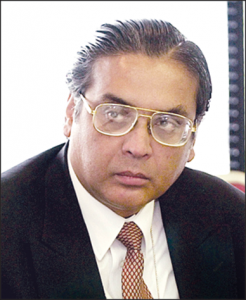
Dr Hafiz A. Pasha
In the short term, we have no other option but to stabilise the country and the economy. Hopefully, once we have stabilised it, in the next two or three years, we can probably move on to somewhat higher growth trajectory of about 5-6%.
At this point in time, we would probably go down in terms of growth to about 3.5-4% at the maximum. Historically, we have ended up with a balance of payment crisis because we followed a policy of import substitution, which has limits to it in terms of internal market growth. Had we followed an external export-led growth strategy, we would probably have found ourselves in a better position. Other countries like India, in the ‘90s, switched to an export-led growth strategy and their exports went up almost six times in just a decade. Bangladesh has done well and they have very solid results. Their per capita income has, more or less, caught up with Pakistan and they have been able to sustain their international transactions.
The defect lies in the strategy which was not focused on sustainable external relations through export-led growth.
The other problem we have had historically, which doesn’t explain the business cycle but explains the long-term growth rate, is that our investment rates are relatively low. In the Musharraf period, the investment rate approached to about 20%. In the Ayub Khan period in the ‘60s, it was between about 20-25%. Now we are down to about 15-16%. Pakistan’s two big constraints have been a lack of export-led growth and a lack of relatively high level of investment.
The problem with the import-substitution strategy is that although we are a very large country, our per capita income hasn’t been going up very rapidly. And then there are limits to market growth.
The other thing with the import substitution strategy is that it is doomed to failure in the presence of free trade agreements (FTA) especially with China, which counts to about 60-70% of our manufactured imports excluding POL products. There is no way we can compete with the Chinese, particularly with the FTA. They have wiped out a whole set of industries in Pakistan. They have access to concessional tariffs and in some cases zero tariff.
More importantly there is a massive under-invoicing going on. The only hope we have is high-value added agriculture and value-added textiles. We have about 20 products where our exports are $100-250 million dollars. That is where we need to diversify our exports. Import substitution cannot work unless we cancel or renegotiate the FTAs.
Another sector where we have hope is the information technology (IT) sector. It has a lot of potential. Indian technology companies want access to Pakistan’s IT labor force because the Indian IT sector is overdeveloped. The result is that the IT technologists and engineers in India are extremely highly paid whereas our salaries for these IT engineers and graduates are today one half or less than what Indian technologists are getting.
But Indian companies are unable to enter the Pakistani market because we don’t have an agreement yet on services. We really need to expand trade with India especially in the IT sector because it will open up opportunities for Pakistani technologists and engineers. There is scope there but the South Asia Free Trade Agreement (SAFTA) is partly functional and SAARC Agreement on Trade in Services (SATIS) is non-functional.
Moreover, Pakistan has not yet granted MFN status to India and maintains a negative list with its neighbor. We have a trade deficit with India which is about 2.5 times what we export to India. The problem is that we never really had a very strong medium to long-term strategic trade policy. There is no orientation towards exploiting international opportunities and developing our agriculture and trade in line with market opportunity. A shocking fact is that Indian export of jewelry is more than Pakistan’s total exports. There was a time when Pakistan was able to get its export of jewelry up to $1 billion, which is now less than $10 million. Pakistan never had a strategic orientation towards developing exports.
One of the lessons of the development history is that small and medium enterprises are often at the cutting-edge. That is where you really see the innovation, the ground-level transfer of technology. Even to this day, 40% of South Korea’s exports are by small enterprises. That is where our focus should be [for exports]. Even today, SMEs of Pakistan, especially the ones located in Punjab, export up to 60% of their output, whereas for our manufacturing industry (large scale industrial units), their exports are not even 25% of their output.
The government has an important role to define industrial development but it should only be to the extent that there should be regulations to prevent emergence of monopolies and cartels. We need to have a very effective Competition Commission and the Securities and Exchange Commission to check the manipulation going on in our industries. Take the example of sugar, automobiles, cement, pharmaceuticals and all these big industries. They are engaging in monopoly and transfer pricing and we are doing nothing about it.
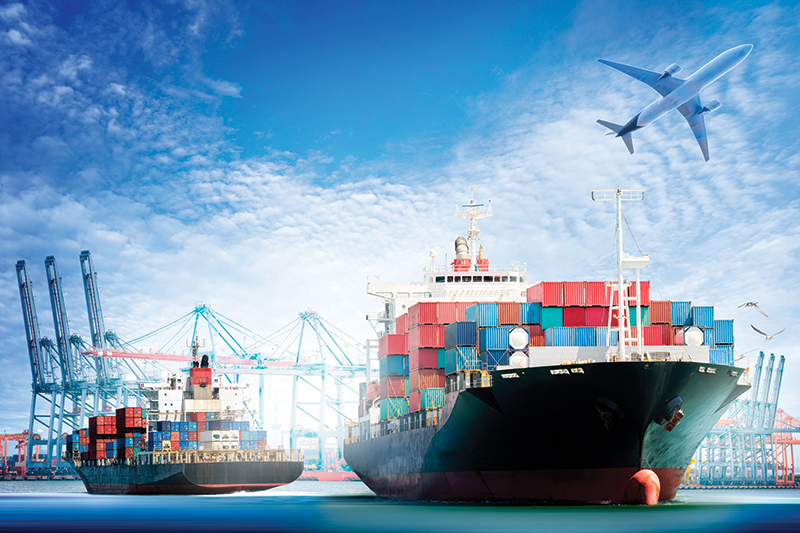
The government should, however, provide subsidies to agriculture. It is something that is done globally. Following Partition, we exported agricultural products to India. Today, we are importing cotton from them in large quantities. That is because India has massively subsidised agriculture. India provides $27 billion in agriculture subsidies, including $15 on fertilizer. Consequently, the price of urea in India is less than half in Pakistan in dollar terms.
To manage the external accounts, import rationalization measures can also help achieve certain goals. We have tried a few things in the past. The first thing we need to do, which we did after sanctions were imposed upon us following the nuclear explosions and it worked very well, is that we need to use the increasing interest rates more effectively to control imports. We need to introduce cash margins of 10-30% across the board except for three items: petroleum products, fertilizers and medicines. We have introduced some cash margins on luxury goods but that is a very small import base. We have to do this across the board.
The second thing we need to do is check the under-invoicing of Chinese products by imposing minimum import prices. We used to have a regime of international trade prices in the late ‘90s but that was more to control valuation by customs. We have to go for minimum import prices on key imports from China like iron and steel for example. India is levying minimum import prices on 28 critical items, including some items from China and a few items in FTA with Sri Lanka. This is admissible within WTO rules and regulations. We also need to have stronger National Tariff Commission which can explicitly identify under-invoicing.
We also need to adopt a managed float regime to manage our exchange rate. At no stage must our real effective exchange rate get overvalued. In the Ishaq Dar era, our currency was 27% overvalued against a weighted average of a few currencies including the dollar. After the latest devaluation, our currency is more or less correctly valued.
There are so many things that we can do to improve our revenue side. But we need to have a revitalized revenue authority [to collect taxes]. Our Federal Board of Revenue (FBR) needs fundamental reform. There is enormous scope on the revenue side. Pakistan’s tax gap is close to 3-4% of the GDP. Enhancing revenues does not require revolutionary steps. Through sensible and rational steps, we can improve our tax-to-GDP ratio and extract an additional Rs1 trillion at least, for the national exchequer.
Unfortunately, however, Pakistan at this point in time does not have the capacity either to conceive or implement strong structural reforms.
Dr Hafiz A Pasha is Professor Emeritus at Beaconhouse National University, former UN Assistant Secretary General and former federal finance minister.
To solve the long-term balance of payments problem, fix education first
The key determinant of long-term economic growth of the country is the depth and range of innovations that take place within that society
Dr Akmal Hussain
The fundamental reason why Pakistan goes to the IMF repeatedly has to be sought in the structural features of Pakistan’s economy. The pattern of Pakistan’s economic growth is what can be called a ‘stop-go’ pattern. There are periods of relatively high GDP growth followed by very slow growth, where per capita income is either stagnant or even negative in some cases.
The literature on new institutional economics shows that the distinguishing feature between the developed and undeveloped countries is that the developed countries are able to sustain their GDP growth rates and their per capita income growth rates over long periods of time whereas the undeveloped countries are unable to do so. Starting from Ayub's period, or even earlier, whenever Pakistan had high rates of growth, it ended up with a balance of payments crisis and that is what lands it in the lap of the IMF.
The fact that Pakistan grows in spurts followed by periods of slow growth is intimately linked with the fact that we keep going to the IMF. Their loans provide temporary relief and governments are able to avoid the difficult task of making the structural changes necessary to become independent of IMF bailout packages. The reason why high growth periods come to an end with a balance of payments crisis is because of Pakistan’s exports structure, where the growth of exports is incapable of keeping pace with the import expenditures that are associated with the high GDP growth.
Whenever there is high GDP growth, there is a high import expenditure. More machines have to be imported, more fuel, equipment and industrial raw materials are imported to maintain economic growth. If the growth of exports is slow as compared to imports, then inevitably – as we have seen from our experience – we will end up with essentially a balance of trade crisis which translates into a balance of payments crisis. Therefore, one of the hallmarks of Pakistan’s inability to sustain high GDP growth, and indeed one of the hallmarks of Pakistan’s underdevelopment, is that we can’t export enough and so our capacity is constrained.
Since independence, our exports have been concentrated in the textile industry and it has predominantly been in the low-value end of the textile range. Internationally, the textile industry is known as a ‘sunset industry’ because as global demand for goods and services increases, a smaller and smaller percentage of increased demand goes into expenditure on textiles. So growth of the global export demand for textiles is low.
On top of that, Pakistan has not even adequately graduated from the low-valued added end to the high-value-added end of the textile range, let alone diversify out of textiles altogether. Even within the textile sector, Pakistan is losing its share to its competitors. That is because our exports are not only low-value-added, our cost of production is very high. We are inefficient in the production of textile exportable and the quality is very poor as compared to our competitors, which is why our export capacity is so insufficient that we cannot finance the import requirements of high growth.
In the medium term, we have to diversify our exports out of textiles into high-value-added, knowledge-intensive goods and services because an increasing share of the global exports is coming in the form of demand for knowledge-intensive goods and services. Predominantly, our export policy should concentrate on diversification of exports towards high-value-added, knowledge-intensive goods and services, which will require hard decisions on the part of the government and decisions which require deliberations outside the narrow thinking of mainstream economics. Within orthodox economic thinking it is difficult to grasp what is involved in export diversification towards knowledge-intensive goods.
Recent work by Professor Aghion and others at Harvard University has shown that the key determinant of long-term economic growth of the country is the depth and range of innovations that take place within that society. In other words, the capacity to generate long-term growth, and hence the ability to maintain high rates of export growth, is dependent on the depth and range of innovations in the country. So when we talk about export diversification, we are really talking about developing the capacity for innovation in the country.
Innovation requires research and building an innovation infrastructure in the country. That essentially means bringing about a transformation of the education system to produce people who have the capacity to do critical thinking and do original work, in whatever field that is. Unless the schools and colleges and universities are reconfigured, so as to produce such minds that are capable of original thinking, Pakistan will not be able to develop an innovation infrastructure.
Strangely enough, education reforms are necessary to solve the balance of payments problem in the long-run and a necessary dimension of export policy. And the research has to be at the cutting-edge of knowledge in every field. Mediocrity in research will simply not do. Therefore, to boost exports and growth, there is a need to build new kinds of schools which train students and children to do original thinking and build universities which are capable of producing world-class research.

Presently, the government is trying to support the textile industry by giving them subsidies. This is a policy that is misconceived and counter-productive. It is misconceived because if the aim is diversification of exports, giving subsidies to the industries that are inefficient, low-value-added and which are not competitive in the international market, is throwing good money after bad. It is also counter-productive because the more subsidies you give to such industries, the more difficult it will be to diversify exports.
If the government wants to subsidize industries, it should do it in an intelligent way. An example is South Korea. They first worked out which particular industrial units had the ability to innovate, to improve their technologies and had the capacity to become export-competitive. It was not just a particular industry but precisely the particular industrial units that were supported by the government through subsidies.
At the moment, the category of industry which has to be given subsidy is not textiles but industries such as software, electronics, renewable energy. If the government cannot provide subsidies to tech startups, it can at least provide subsidized credit to young talent freshly graduated with ideas to work on these startups.
The government also needs to think of subsidizing small-scale industries. Because of their smaller size and management structure, these industries are much more likely to be innovative than a very large industry, in Pakistan at least. The agrarian products such as high-value dairy products, packaged meat fruits and vegetables also have considerable potential for exports.
Subsidizing inefficient industries like textiles is a rent you are giving them. Rent can be seen in terms of unearned income. It is a rate of return on an asset including skills which is higher than what you would get in the best alternative use. So if you have an industry that would otherwise go into loss and you start giving them subsidies, and it starts generating profit on the basis of the subsidies, that profit is actually unearned. And that is a kind of rent.
Unfortunately, Pakistan’s institutional structure has been set up in such a way which systematically generates rents for a small coalition of elites. This is the other fundamental issue that needs to be addressed. If Pakistan wants to get out of underdevelopment, get out of this repeated going back to the IMF for loans and avoid getting into repeated balance of payments crisis, the rent-based institutional structure that prevails in the economy needs to be changed. It has deliberately been set up by power elites in such a way that unearned income or rents can be generated for them.
Prime Minister Imran Khan’s original vision was that Pakistan’s long-term development has to be based on its people through the provision of health, education and social protection for all so that the capabilities and potential of Pakistan’s people can be actualized and brought to bear for development. That’s the sort of development we want. But if Pakistan goes to the IMF, it will be going in the opposite direction because the IMF will require cutting down public expenditure. They are going to try to control the import expenditures through contracting the growth rate of the economy. When interest rates are increased they knock out the dynamic, innovative export oriented industrial units that are usually highly leveraged.
So a misconceived short term policy further undermines our potential for exports and increases our dependence on foreign loans in the long run. Slowing down growth will also eventually lead to higher levels of poverty and unemployment.
Dr Akmal Hussain is a Distinguished Professor and Dean, School of Humanities and Social Sciences at the Information Technology University (ITU).
For the Pakistani economy to triumph, we must develop our cities
We need to deregulate our cities to allow more construction and high-rise development
Dr Nadeemul Haque
Pakistan’s economic strategy started with the Harvard Advisory Group and Dr Mahboobul Haq. However, we never changed it, nor did it evolve. We are still stuck there. That was a very simple strategy. We were a new country. The international development world had just started. They wanted to mend and look after us like parents look after little babies. They created a model of which Dr. Mahboobul Haq was a part. The model included development through establishing infrastructure on borrowed money. They wanted to give us money as we were a low savings country. Sadly enough, the world has changed, and we are still pursuing the old model.
But while we are a resource constrained economy dependent on foreign aid, we borrow to postpone reform. We are also in love with vanity projects. Successive governments in Pakistan prefer external borrowing to finance ill-planned and unnecessarily expensive projects like Metro buses, Orange Line trains, Islamabad airport and an excessive expansion of universities.
Everywhere, cost-benefit analysis is carefully done and considered before projects are undertaken. In the past, this was done. Now politicians and civil servants realize projects are a gravy train and refuse to do any real cost-benefit analysis. Without a serious cost-benefit analysis, the Planning Commission is rendered useless. Projects now follow political expediencies. And that too on borrowed money. No wonder we repeatedly experience a balance of payments crisis and need the IMF.

It is not surprising that research, both inside the Planning Commission and in academia, has found that the returns on the PSDP are low and perhaps even negative.
Economics has moved on. Planning is not considered useful or doable. Developing industry at any cost or merely looking for dollars is considered old style “mercantilism.”
These old policy ideas have now been replaced with new thinking where growth is no longer considered to be arising merely from projects and industry. Instead, the economy grows when entrepreneurial and innovative activity thrives. Note an entrepreneur is not a man with money who got some license and cheap land and credit to set up an industry. An entrepreneur is a person who sets up a new business or businesses, taking on all financial risks without any help from the government. Do you ever see Bill Gates or Steve Jobs asking for government help?
The government should also stop acting like a father and tell people what to do. In a society, entrepreneurs, thinkers and innovators should be allowed to express themselves. In the Mahboobul Haq period, the role of the government was of a socialist which prompted the government to undertake excessive planning and control the markets strictly. But that model had failed even in the Ayub period. The role of the government is not to decide how to control the market: what should be bought and what should be sold, but to define the limits of the economy very clearly, formulating rules and policies that maintain a clean marketplace for the buyer and seller to interact.
Moreover, if the government knows where to invest it can make money doing so. We have seen the government unable to run a business. Why then do we think that the government knows where to invest?
The government should not provide direction and incentives without having the relevant knowledge. Without such knowledge, the government cannot decide which businesses should be run and which supported. If an industry is unable to stand on its feet, it is okay to let it die. Around the world, industries die! Bankruptcy is not such a bad thing. Why are we stuck with the 70-year-old industries that we keep alive through subsidies?
What then should the government do? The government should monitor the economy through research and analysis. Let the local businessmen devise a strategy according to the economic conditions prevailing. If allowed to operate freely, the forces of supply and demand will eventually bring everything to equilibrium, whether it is import demand or export supply. Businesses must manage exports and imports to maximize their profits. It is not the government’s job to export for them or to give them subsidies to do their work.
The government must stand ready to resolve disputes in a timely manner as they arise in business. A competent legal framework to facilitate economic transactions and coupled with an effective and efficient judicial system, will foster innovation and entrepreneurship to let the economy thrive and people to prosper.
We estimated in the Planning Commission Framework for Economic Growth that Pakistan’s youth bulge requires a growth rate of over 8% if the growing labor force is to be absorbed. In recent years because of a lack of reform our long run growth rate and productivity are both declining. Our growth rate now oscillates between 3 and 5% which is far below potential. I am surprised that finance ministers are claiming victory with growth rates at about 5%. Let us be clear that for Pakistan a growth rate of less than 4% is a recession. While anything less than 7% should be regarded as failure of policy. We should not accept any growth rate of less than 7% as satisfactory performance. Hold your finance ministers to a higher standard! They must give us a growth rate of 7% or accept their failure.
An important hub of growth which we overlook, is cities. Our cities have been overregulated to choke out investment. And so is the construction industry, which stimulates growth and revitalizes many other industries. Expensive land in the cities is being underutilized. Prime land is occupied by big houses instead of high-rise buildings, which have more economic value. When cities are dense and properly developed, entrepreneurship comes there inevitably.
If developed properly, like in the western economies, cities can add almost 4% of growth to the economy. Unfortunately, government bureaucracy is vested in keeping the unproductive and slow-growth urban sprawl alive. Cities are spreading at the cost of the environment and economic growth. Yet there is no debate or thinking on this subject.
I have been asking for the last 20 years why there are no tower cranes in Pakistan. Every country that is growing at a rapid rate has thousands of tower cranes in their cities. Is it not odd that in our cities which are some of the largest in the world, there are no tower cranes? This means that unlike the rest of the world we are not allowing tall building to be made. Why is it that we are so different from the world? Or is it that we are more stupid?
Analysts who are looking for rapid export expansion and point to the export performance of East Asia must also note that East Asian development happened not only with rapid increase in exports but also with rapid urbanization and high-rise development. Maybe the two – exports and high-rise development — are related in ways that we have not studied yet.
Whichever way you look at it, we need to deregulate our cities to allow more construction and high-rise development. To my mind this is a must for accelerating growth.
All this needs to be reinforced with civil service reform. As Max Weber pointed out, the civil service is the keeper of the rules, the maker and implementer of policy and regulation, and the monitor and evaluator of policy and programmes in all countries. It is the name given to many bodies of diverse skills many organizations, numerous work and reporting processes as well as a multiple checks and balances.
In Pakistan, it has become concentrated and monopolized by a group of generalists. It lacks skills and checks and balances and has no work processes or policymaking skills.
In most of the government, we have even lost the understanding of what a policy is. The policy is now at the whims of politicians. Frequent policy changes are bad for business. Policies such as tax policy should be very clear and defined for a long term, with no room for arbitrary changes. Moreover, no policy or legislation should be passed which the government is incapable of financing. Policies should be based on research and there should be monitoring reports on how the policy is working. That is essentially the work of the bureaucracy.
We are facing a crisis repeatedly for the last 40 years. The crisis in Pakistan’s economy is essentially because of excessive dependence on unnecessary loans for wasteful expenditures. Without reform for productivity, we can keep on this treadmill of a crisis. If we make a more thoughtful government, deregulate our cities and markets, stop trying to prop up tired old industries, develop new laws and justice system, we will clear the room for entrepreneurship and innovation. If we let our cities have the imagination to create all kinds of activities. The cities will create these activities themselves, without the government’s support, if they have the space to do it.
If we develop a modern civil service capable of midwifing a 21st-century market and city, we will generate large investment flows to generate the required 8% growth.
If we deregulate the market place so that for the ‘survival of the fittest’ and not coddling the aged vested interest, we will grow exports and industry needed to absorb our youth bulge.
Dr Nadeemul Haque is former Deputy Chairman of the Planning Commission and served for several decades as an economist at the International Monetary Fund.
Economic reform without political consensus is impossible
Technocratic solutions are not enough; Pakistan needs to have major political parties agree on the broad contours of economic policy
Dr S Akbar Zaidi
Reform of Pakistan’s economy should be undertaken after considering both economic and political factors. In deciding policy directions and reforms, you have to get the political parties together to form an agenda which all broadly agree upon, that certain things vital for the economy and for the well-being of the people, like taxation reforms, should not be messed with regardless of the party in power.
There should be a minimal consensus between all the political parties of letting a policy continue if a change is to be expected. This predominantly requires one to know what a certain political party wants to achieve and what it wants to do that is going to set the direction of the economy for the long and medium term. Basically, what Pakistan requires today is a robust taxation system, completely revamped and expanded.
Today, less than 1% of Pakistan’s population pays income tax, and most do so involuntarily since their tax is deducted at source. The government should go after tax defaulters and extract money from them. In revamping all this, technocratic solutions are useless. All the parties know that revenue needs to be enhanced. If all the major parties form a consensus, a lot can be achieved.
There is a dire need to rationalize taxes across all the verticals. Many sectors of the economy, like agriculture and industries, decry multiple layers of taxation by the state which need to be rationalized in such a way that they are uniform as well as progressive. There are certain categories which can be taxed, like income, wealth and consumption. Tax should be based on income and wealth, not through an indiscriminate indirect tax mechanism.
A major part of the expenditure goes to defense which needs to be waned and directed towards expenditure on social sectors such as healthcare and education. Pakistan should invest more on schools, hospitals, social development infrastructure, and the knowledge economy.
Things have changed now. Our exports are particularly poor and I do not yet see hope in achieving anything through our existing exports. Our exports are hopeless, we have hardly diversified and been dependent on the same export mix for 50 years. There is nothing we can do with our current exports. All we have is kinoos, dates and some textiles. There is little of value that we have that can be exported to increase foreign exchange. No matter how much we devalue our currency, our exports cannot be increased in their present form. We need to be brave enough to accept this.
The export structure needs a complete overhaul and we need to explore new areas, products and services, where we can gain something in the medium to long-term. The challenge lies in investing in the knowledge economy, information technology (IT) and software. That is where we should be heading now. Our industries are outdated. In the current circumstances, we should forget that we can capture any market through exports. Any efforts to improve the old export model will be counter-productive.
In trying something new, we should focus on developing the IT sector in the country and improve health infrastructure so that people can come to Pakistan to get healthcare, just like India. India is an exporter of health services now, which Pakistan can achieve as well if we prioritize our health sector. Pakistan can also venture into the pharmaceutical industry and encourage exports in that sector.
With textile and cotton, our exports have been static for a long time. We have devalued our currency by almost 35% in just one year and yet our exports have fallen. This will give an idea of our export competitiveness and also about how little devaluation helps our exports. So, it is a completely different restructuring of the economy that we need to direct it towards growth.
The import substitution strategy that the current government is trying to embark upon cannot work in the present circumstances, especially in the presence of a free trade agreement (FTA) with China. The FTA has destroyed the local market. Import substitution is a good slogan but cannot be given importance in the current circumstances. If import substitution is to work, Pakistan should venture towards the knowledge economy and build the capacity to substitute.
The government should provide incentives to certain industries where it sees a high potential for investment, exports, and foreign exchange. Such industries should be protected but not for an indefinite period of time. There should be a timeline and scale defining how the government is going to intervene in a particular sector or industry, and how it is going to be incentivized for a certain period before it becomes uniform for everyone. Incentives should not be for life but they should be there in a rational way if the government wants to increase income and reduce unemployment.
Things can improve considerably if Pakistan’s agriculture sector is reformed, which requires improvement in the irrigation and water distribution system.
Pakistan should actually stop cultivating sugarcane because it consumes a lot of water. We are a water scarce country. There are other healthier alternatives to sugarcane that consume less water. Importing sugar would be a more sensible decision than producing it locally because the international price for sugar has fallen but our prices are higher. But the local price is protected here. There is a considerable political rent that the sugar barons extract out of this sector. There is a potential to reform the whole sector but there is a huge mafia behind the sugar industry so this would be particularly hard to achieve. The sugar sector is patronized by powerful political interests who will not allow any changes. We can grow wheat, barley, and cotton instead. But the government needs to ban underproductive crops.
Import tariffs are a revenue measure but Pakistan cannot rationalize import tariffs as long as it is a part of the World Trade Organization (WTO). And tariffs are a global phenomenon. There is an ongoing tariff war between America and China. If one country increases the tariff for the other, it is responded in a similar manner. The suffering and loss are eventually mutual. Pakistan cannot increase import duties as such.
But if we are able to restructure the system of taxation, which has a component of value-added tax and consumption tax, and income tax is structured in a way that taxes are paid by those who have money, then there is no real need to impose import duty tariffs. Governments levy import duties as a measure to increase revenue so if there is a proper taxing system in place, there is no such need.
But the present trajectory of the government is unknown. It has been five months now that the Pakistan Tehreek-e-Insaaf (PTI) government has been in office. That is almost 10% of the total tenure of the government and yet there is no clear policy direction, vision or even a decision of what the government wants to do next. The growth rate has been predicted to be around 3% for the year and inflation has started rising again. Complacency and indecision by the government have marred the economy with uncertainty, which can wreak havoc of monumental proportion.
These persisting problems have not been created by the PTI and they are not responsible for them. However, they now have to take responsibility for what happens over the next five or so years. They cannot keep blaming the past governments or corruption and have to start by taking decisions to put things in order. Procrastination and indecision, which have both created uncertainty regarding the economy, must come to an end. It is time for the government to act and take decisions rather than dilly-dally.
Akbar Zaidi is a Political Economist based in Karachi. He teaches at Columbia University in New York, and at the IBA in Karachi.

The author is a staff member and can be reached at [email protected]
View all articles →20 Comments
No comments yet. Be the first to join the discussion!