















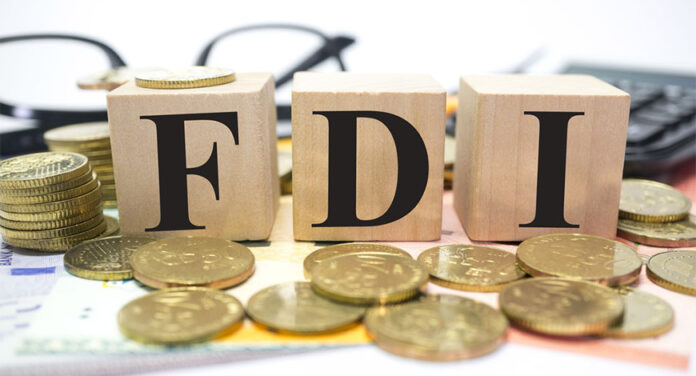
Foreign direct investment into Pakistan remained broadly stable in November, inching to $179.7 million, up 0.45% month-on-month from $178.9m in October. However, net FDI was 22% lower year-on-year, compared to $231.9m in November 2024, according to State Bank data.
Net inflows in the fiscal year to date stood at $927.4m during July–November FY26, higher than $735.3m in the same period last year.
Sector breakdown
The power sector led activity in November with net inflows of $90.1m, followed by financial and insurance services at $69m, and manufacturing at $16.8m. Mining and quarrying saw the largest withdrawal at –$21.9m, with information and communication (–$3.1m) and transport (–$1.3m) also posting outflows.
Over the first five months of FY26, power accounted for $401.3m in net inflows, financial services $333.1m, and manufacturing $135.3m, while mining and quarrying recorded –$55.1m.
Country-wise flows
China remained the single largest contributor in November with $81.6m net, followed by Hong Kong ($23.3m), Switzerland ($16.8m), the UAE ($14.5m), and the Netherlands ($6.8m). It is important to note that the US recorded inflows of $2.8m, while the UK posted an outflow of –$5.6m.
For July–November FY26, China led at $308.4m, followed by Hong Kong ($143.3m), the UAE ($100.8m), Switzerland ($89.4m), and Canada ($38.3m). The US posted net outflows of –$64.6m, while UK flows stood at $55.6m.
Total foreign investment
Total foreign investment — including direct, portfolio and public flows — showed a net outflow of $32.4m in November, while the July–November FY26 period showed $313.7m net inflows, supported by $305m in portfolio gains.
While November did not signal a directional shift, analysts note steady inflows across power and finance continue to underpin the investment profile, tempered by selective withdrawals in mining and technology sectors and uneven country flows.