


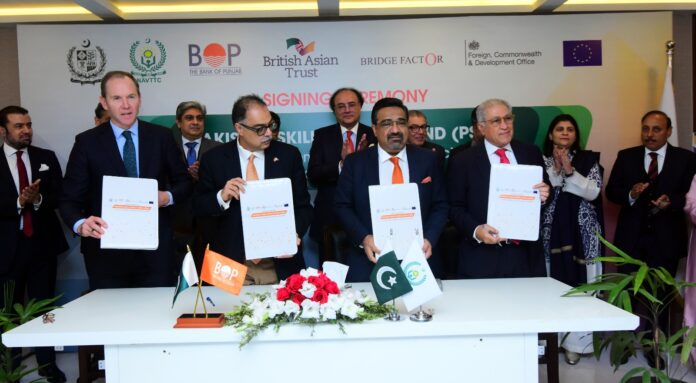
The government has launched Pakistan’s first private-capital-funded Pakistan Skills Impact Bond (PSIB), with a Rs1 billion pilot tranche backed by a guarantee from the Ministry of Finance, marking a shift toward outcome-based financing for technical skills development.
The three-year instrument aims to fund a scalable Technical Skills Development Programme, with payments linked to measurable outcomes including certification, job placement and at least six months of employment retention for trainees.
Under the model, future tranches are planned to gradually link repayments to a small portion of trainee salaries, reducing reliance on sovereign guarantees and embedding longer-term financial sustainability through market-based mechanisms.
The launch ceremony included the signing of financing documents such as investor and issuer agreements and was attended by senior government officials, development partners, private sector representatives and international organizations.
Speaking at the event, Muhammad Aurangzeb, Federal Minister for Finance and Revenue, said the PSIB reflects a broader policy shift from traditional budget-based social spending to outcome-driven and accountability-focused financing.
He said the government’s Rs1 billion guarantee was intended as a catalytic, proof-of-concept measure to attract private capital, with a clear roadmap to limit future government balance-sheet exposure and encourage participation from institutional and capital market investors.
Aurangzeb said skills development and human capital are central pillars of Pakistan’s economic reform agenda, adding that large-scale upskilling and reskilling are necessary to translate demographic potential into sustained economic outcomes.
He also highlighted the programme’s gender inclusion target, under which 40% of trainees will be women, following recommendations from the British Asian Trust.
The minister noted that the PSIB emerged from work undertaken by a multi-stakeholder Committee on Social Impact Financing, which developed Pakistan’s first Social Impact Financing Framework covering education and human capital, gender equality, health, population stabilisation, climate resilience, and poverty and migration.
National Vocational and Technical Training Commission Executive Director Muhammad Amir Jan said the bond represents a transition toward a demand-driven and outcome-based skills ecosystem, supported by reforms in governance, financial transparency, provincial coordination and industry linkages.
Federal Minister for Education and Professional Training Khalid Maqbool Siddiqui said the initiative was a step toward strengthening coordination and long-term planning in education and skills policy.
The event was also addressed by Zafar Masud, who outlined the role of Bank of Punjab in the PSIB structure, and Asif Rangoonwala, who detailed the Trust’s role as programme manager.
Matt Cannell spoke on the partnership with the Foreign, Commonwealth & Development Office, while Gulmina Bilal Ahmad reaffirmed NAVTTC’s commitment to delivering measurable outcomes for youth under the bond framework.
Officials said the PSIB is intended to serve as a pilot for future social impact financing instruments, with the goal of scaling skills development through private capital and performance-linked funding.