


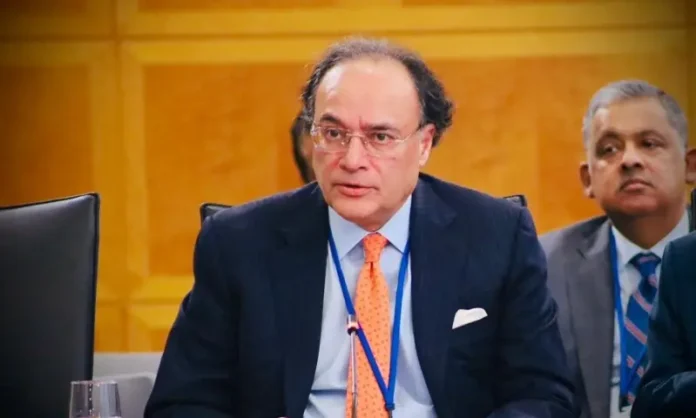
Federal Minister for Finance and Revenue Senator Mohammad Aurangzeb on Wednesday acknowledged that high taxation and elevated energy costs remain key pressures on businesses, saying some firms have exited Pakistan due to these structural challenges.
Speaking at the Pakistan Policy Dialogue in Islamabad, the finance minister said the government was fully aware of economic constraints but noted that 20 new foreign investors had entered the Pakistani market over the past 18 months, including companies such as Google, Aramco, Wafi Energy and Turkish Petroleum.
Aurangzeb said the government would soon transfer 24 additional state-owned entities to the Privatisation Commission for divestment, following the sale of Pakistan International Airlines (PIA). He added that privatisation was necessary to curb losses that continue to burden public finances.
The finance minister said foreign remittances are projected to exceed $41 billion in the current fiscal year, compared to $38 billion last year, providing support to external accounts.
He also announced that responsibility for tax policy formulation has been shifted to the Finance Division, while the Federal Board of Revenue (FBR) will focus exclusively on tax collection. Aurangzeb said reforms in the energy sector were beginning to show results, with circular debt gradually declining.
Addressing concerns about business exits, Aurangzeb said firms face difficulties when taxation, energy costs and financing expenses rise simultaneously, describing these as “real issues” for the private sector. He added that reforms were underway to reduce pressure on the national exchequer and stabilise the economy, but stressed that sustainable growth requires adjustments from both the government and businesses.
He noted that some multinational companies had adapted by shifting to local sourcing, improving margins and expanding exports, which allowed them to continue operating in Pakistan. Others that failed to revise their business models would need to reassess their strategies, he said.
Aurangzeb said structural reforms were being implemented across sectors, including the ongoing transformation of the FBR, with a renewed focus on compliance and enforcement to ensure effective implementation of tax laws.
He stated that state-owned entities waste more than Rs1,000 billion annually, citing Utility Stores, Pakistan Public Works Department (PWD) and PASSCO as examples of institutions that were shut down due to sustained losses.
The finance minister warned that higher duties damage the economy and said the government had initiated tariff reforms, adding that lower tariffs would help boost exports and industrial output.
Despite current economic pressures, Aurangzeb expressed confidence that ongoing reforms would support long-term stability and help attract further foreign investment, saying the government remained committed to easing the cost of doing business and strengthening financial systems.