


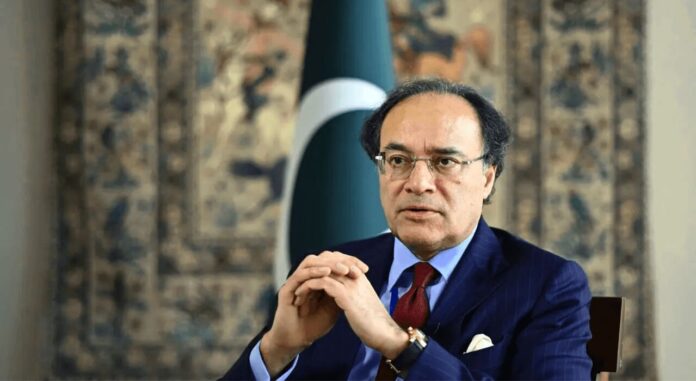
Finance Minister Muhammad Aurangzeb said on Thursday that the United States is re-establishing itself as a pivotal economic partner for Pakistan, citing the $7 billion financial close of the Reko Diq project backed by the International Finance Corporation (IFC) and the US Export-Import Bank. He made the remarks during a panel discussion at the Global Development Finance Conference – Momentum 2025 in Riyadh.
Aurangzeb participated in a session on climate adaptation alongside senior global finance leaders including Zeina Toukan, Jordan’s Minister of Planning; Qahhorzoda Faiziddin, Tajikistan’s Minister of Finance; and Serge Ekue, President of the West African Development Bank. The discussion focused on the financing needs of emerging economies facing increasing climate risks.
He said Pakistan’s economic relationship with the United States has strengthened in areas such as minerals and mining, and advanced technologies including AI, blockchain and digital infrastructure. Calling Reko Diq a “transformative development,” Aurangzeb said the project’s financial close, with IFC leading the syndication and US EXIM as a key participant, represents a major milestone.
According to the minister, the copper and gold mine is expected to generate export revenues equivalent to 10% of Pakistan’s current export base in its first year of commercial production in 2028. He added that Pakistan anticipates strong investment interest from the US, China, GCC states and other partners as the project scales, contributing to global supply chains for energy transition minerals.
Responding to a question on geopolitical dynamics, Aurangzeb said Pakistan follows an “and-and” strategy, maintaining constructive relationships with both the United States and China. He noted that China remains a longstanding ally through the China-Pakistan Economic Corridor (CPEC), whose second phase now aims to commercialise earlier infrastructure investments through business-to-business partnerships.
Aurangzeb outlined the severe economic toll of climate events, recalling the 2022 floods that caused an estimated $30 billion in losses and highlighting renewed flooding this year. He said Pakistan expects to lose about half a percentage point of GDP growth due to climate-related disruptions. While macroeconomic stabilisation has enabled the government to build buffers for immediate relief efforts, he stressed that large-scale reconstruction requires substantial external financing.
He cited progress in establishing an AI-enabled early warning system at the National Emergency Center, which now provides monthly climate forecasts to support quicker response and planning. However, he said Pakistan’s domestic resources remain insufficient to fund long-term climate adaptation.
The minister pointed to the government’s 10-year Country Partnership Framework with the World Bank Group, which allocates around $20 billion, with one-third dedicated to climate resilience and decarbonisation. He said Pakistan must now prepare high-quality, bankable projects to unlock these funds.
Aurangzeb also expressed concern over the slow and bureaucratic nature of global climate financing mechanisms, including the Green Climate Fund and the Loss and Damage Fund. In contrast, he noted progress through multilateral channels, including Pakistan’s recent receipt of the first $200 million tranche under the IMF Climate Resilience Fund.
He concluded that while Pakistan will continue allocating fiscal resources domestically, international development partners and global capital markets remain essential for meeting the country’s climate adaptation and resilience needs.