


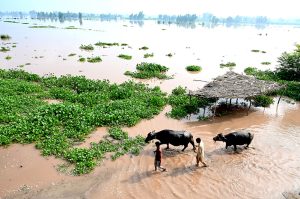
The Senate was informed on Friday that more than 80% of international commitments announced after Pakistan’s 2022 floods were extended as soft loans rather than grants, with the country eventually receiving less than half of the total pledged amount.
Replying during Question Hour in the Senate of Pakistan, Minister for Parliamentary Affairs Tariq Fazal Chaudhry said most international pledges were subject to conditions and phased disbursement arrangements, limiting immediate access to funds.
He said the government decided to meet flood-related losses through domestic resources under the direction of the prime minister, adding that both the federal and Punjab governments compensated affected families from national funds.
The minister told the House that Pakistan has entered into 16 international climate-related agreements since 1990, covering areas such as climate adaptation, mitigation, environmental protection and resilience building. He said the country is currently engaged with three major international funding mechanisms, including the Green Climate Fund, the Global Environment Facility and Adaptation Fund projects.
Responding to supplementary questions, he said Pakistan continues to raise climate change concerns at international forums, describing it as a global issue requiring collective action. He added that scientific data shows a 23% decline in annual snowfall in glaciated regions, alongside about 3% glacial degradation, highlighting the visible impacts of changing climate patterns.
The minister said the data underscored the need for long-term, science-based planning to address climate risks, noting that climate-related impacts were already being observed across the country.